Ripple (XRP) trades sideways in a narrow range between support at $2.83 and resistance at $2.92 on Tuesday. Interest in the cross-border token has remained significantly suppressed over the past few weeks, reflecting the general sentiment that September is a bearish month for crypto.Ripple (XRP) trades sideways in a narrow range between support at $2.83 and resistance at $2.92 on Tuesday. Interest in the cross-border token has remained significantly suppressed over the past few weeks, reflecting the general sentiment that September is a bearish month for crypto.

XRP consolidates as losses linger ahead of October

  • XRP trades sideways between the 100-day EMA support and the 50-day EMA resistance.
  • XRP upholds marginal profits in September, but downside risks persist amid widespread volatility.
  • XRP Open Interest weighted funding rate steadies, suggesting a gradual shift in sentiment as traders pile into long positions.

Ripple (XRP) trades sideways in a narrow range between support at $2.83 and resistance at $2.92 on Tuesday. Interest in the cross-border token has remained significantly suppressed over the past few weeks, reflecting the general sentiment that September is a bearish month for crypto.

However, based on CryptoRank's data, XRP is on course to end September with marginal profits of about 2.76%. The table below shows that XRP has posted profits in three consecutive Septembers, with the highest gains of 46% in 2022.
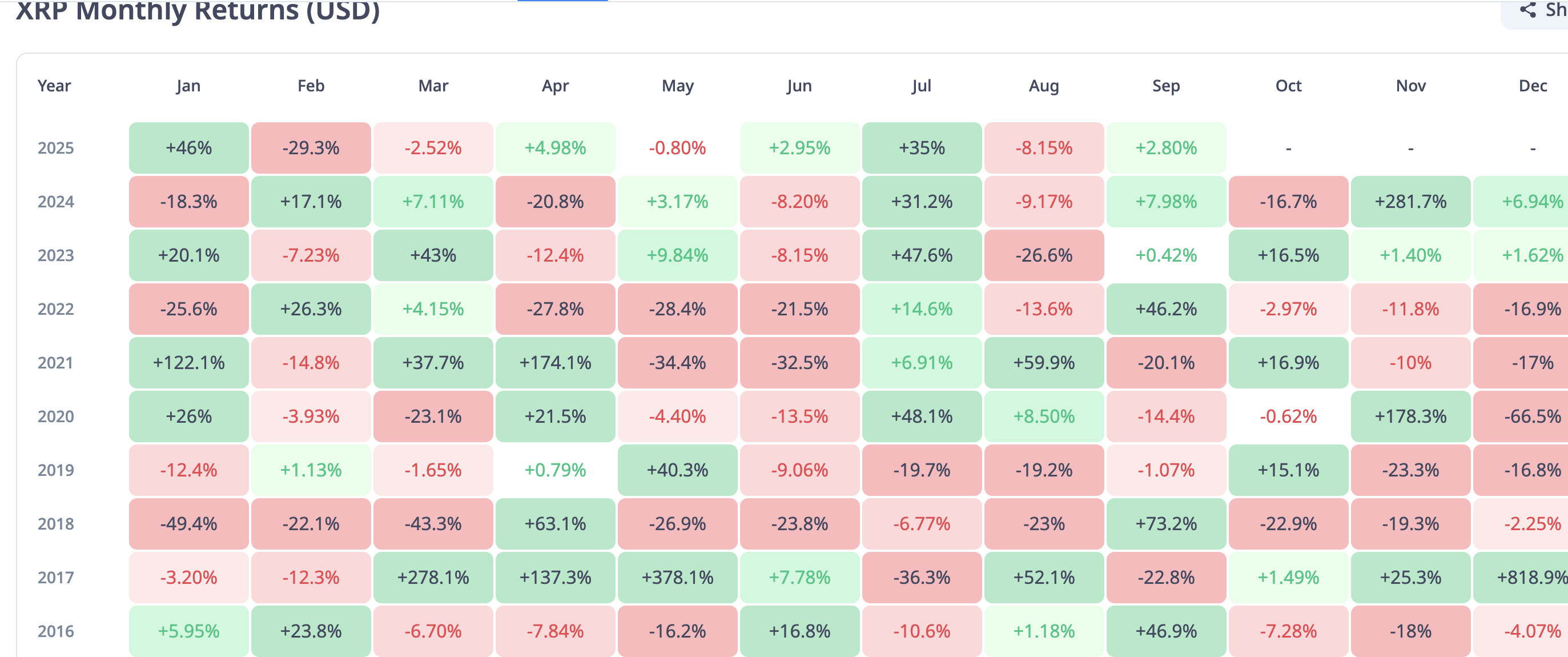
XRP monthly returns | Source: CoinGlass

As for October, returns have been erratic, highlighting the lack of a clear trend. Hence, investors should approach October with an open mind, and focus promptly on technical, fundamentals and macroeconomic data.

XRP derivatives market offers mixed signals 

Retail interest in XRP stabilized at lower levels on Tuesday, following a week of volatility that triggered significant liquidations as the XRP price declined to $2.70.

According to CoinGlass data, Open Interest (OI), representing the notional value of outstanding futures contracts, averages at $7.58 billion at the time of writing, down from $8.96 billion on September 19.

If open interest stabilizes and trends upward, it would indicate that traders have a strong conviction in XRP's ability to reach higher levels above $3.00.

Conversely, declining or suppressed OI implies that investors are losing confidence in the cross-border money remittance token and its ecosystem, likely holding the price from rising above the narrow range. 
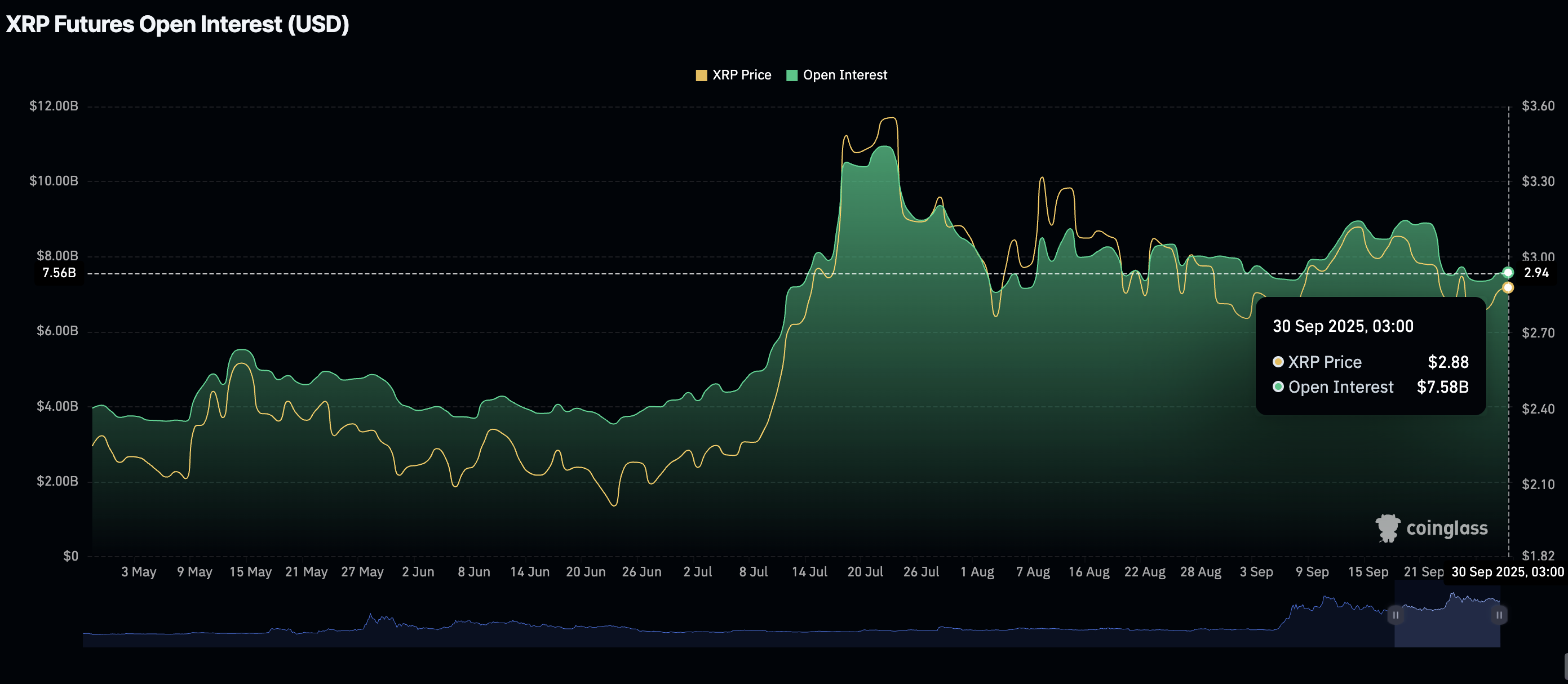
XRP Futures Open Interest | Source: CoinGlass

As the price of XRP consolidates, traders are increasingly piling into long positions, as evidenced by the OI-Weighted Funding Rate sharply rising to 0.0102%. This is an aggregated metric of XRP perpetual futures contracts across multiple exchanges, calculating the weighted average of funding rates.
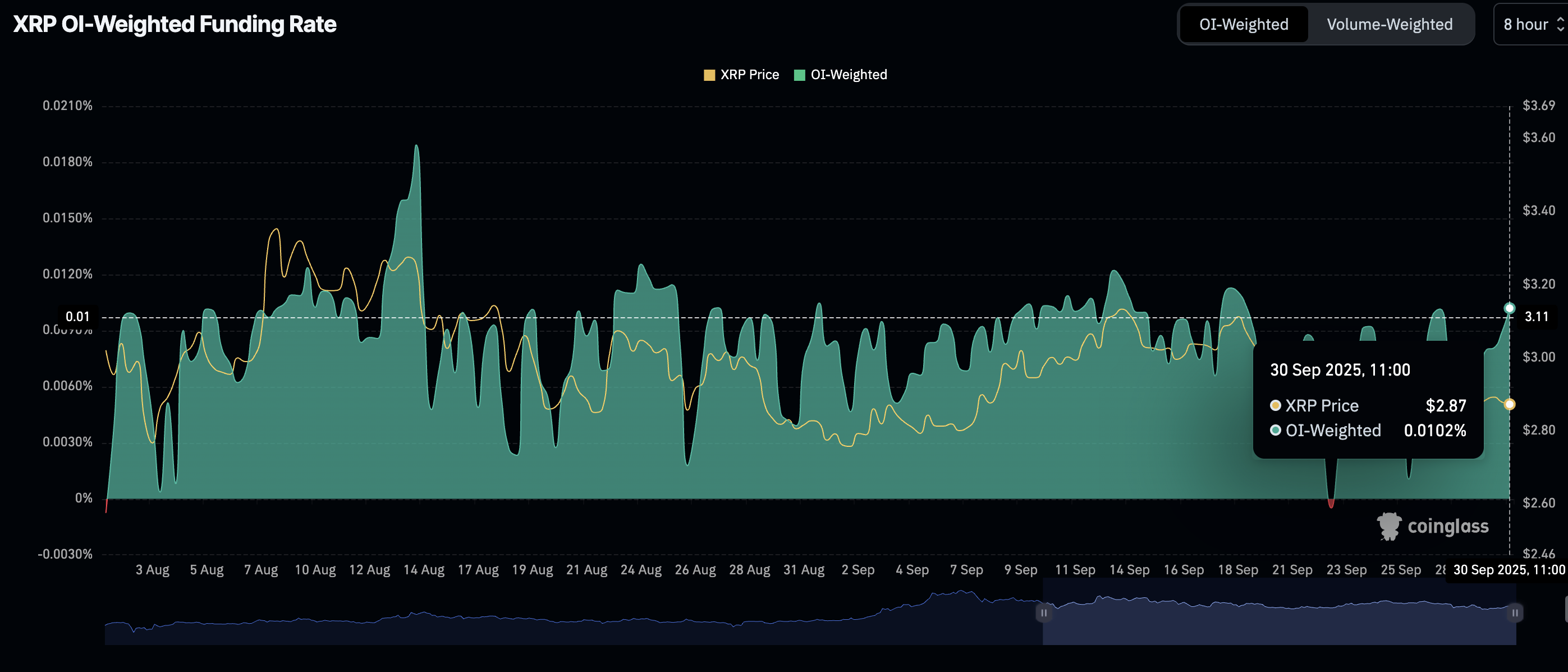
XRP OI-Weighted Funding Rate | Source: CoinGlass

High positive rates indicate that traders are aggressively piling into long positions. Initially, this is a positive signal; however, at extreme levels above 0.1%, it can serve as a warning to reduce risk exposure. For now, XRP OI-Weighted Funding Rate is within the health band, encouraging more traders to increase their exposure, anticipating a price breakout above the critical $3.00 level.

Technical outlook: Can XRP defend support and nurture a short-term breakout?

XRP delicately holds onto the 50-day Exponential Moving Average (EMA) at $2.83, reflecting an increase in downside risks. The Relative Strength Index (RSI) crossover below the signal line on the daily chart suggests that bearish momentum is building. With the RSI holding in the bearish region, it would be difficult for bulls to push past the 50-day EMA resistance.

Investors may consider de-risking further, especially with the Moving Average Convergence Divergence (MACD) having sustained a sell signal since September 22. Risk-off sentiment will prevail if the blue line remains below the red signal line.
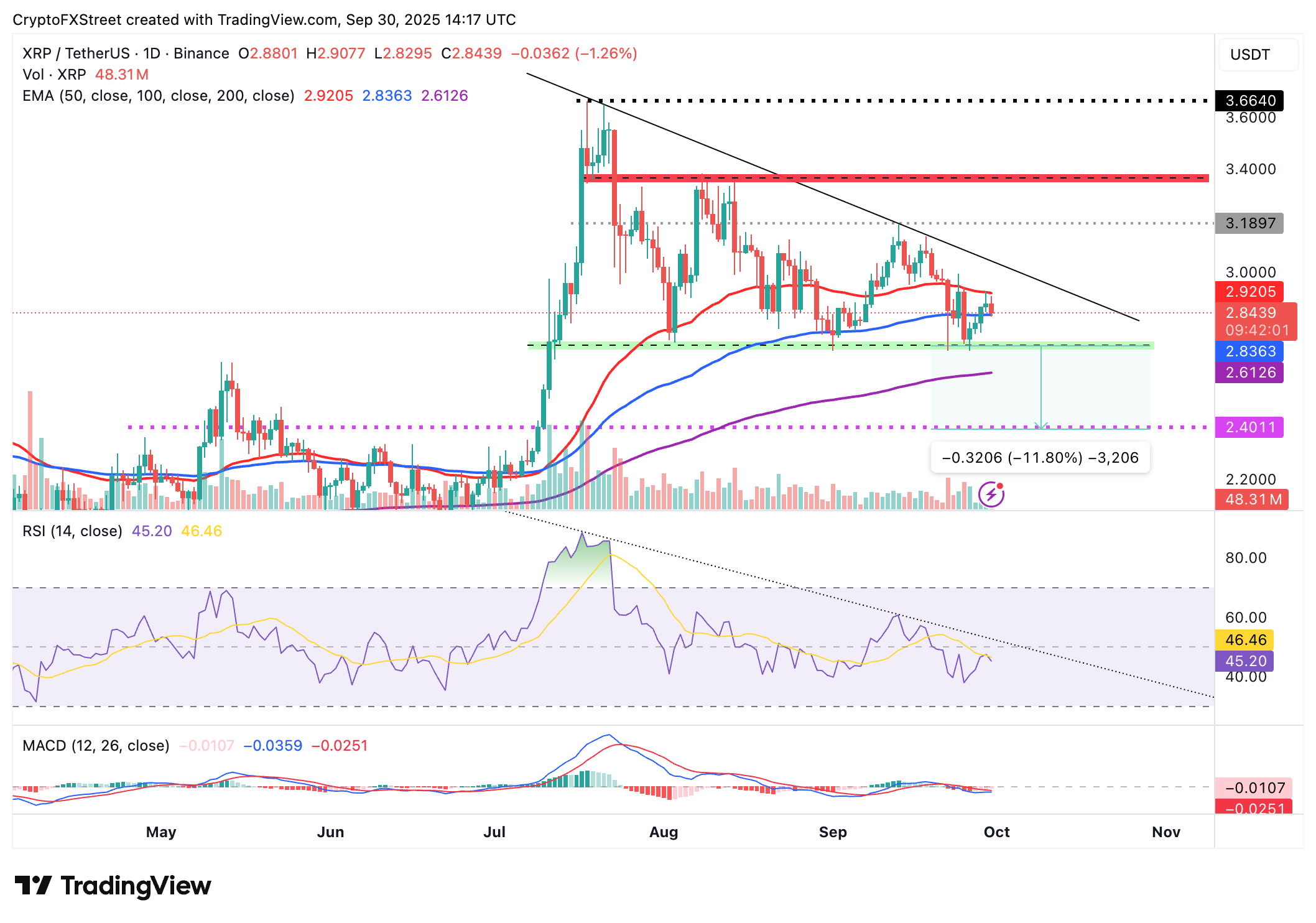
XRP/USDT daily chart

Losing ground below the 100-day EMA at $2.83 could accelerate the decline toward the demand zone at $2.70, which would encourage risk-on sentiment. The 200-day EMA at $2.61 and the round-number support at $2.50 would also serve as tentative support levels.

Ripple FAQs

Ripple is a payments company that specializes in cross-border remittance. The company does this by leveraging blockchain technology. RippleNet is a network used for payments transfer created by Ripple Labs Inc. and is open to financial institutions worldwide. The company also leverages the XRP token.

XRP is the native token of the decentralized blockchain XRPLedger. The token is used by Ripple Labs to facilitate transactions on the XRPLedger, helping financial institutions transfer value in a borderless manner. XRP therefore facilitates trustless and instant payments on the XRPLedger chain, helping financial firms save on the cost of transacting worldwide.

XRPLedger is based on a distributed ledger technology and the blockchain using XRP to power transactions. The ledger is different from other blockchains as it has a built-in inflammatory protocol that helps fight spam and distributed denial-of-service (DDOS) attacks. The XRPL is maintained by a peer-to-peer network known as the global XRP Ledger community.

XRP uses the interledger standard. This is a blockchain protocol that aids payments across different networks. For instance, XRP’s blockchain can connect the ledgers of two or more banks. This effectively removes intermediaries and the need for centralization in the system. XRP acts as the native token of the XRPLedger blockchain engineered by Jed McCaleb, Arthur Britto and David Schwartz.




Market Opportunity
XRP Logo
XRP Price(XRP)
$2.0507
$2.0507$2.0507
-1.86%
USD
XRP (XRP) Live Price Chart
Disclaimer: The articles reposted on this site are sourced from public platforms and are provided for informational purposes only. They do not necessarily reflect the views of MEXC. All rights remain with the original authors. If you believe any content infringes on third-party rights, please contact service@support.mexc.com for removal. MEXC makes no guarantees regarding the accuracy, completeness, or timeliness of the content and is not responsible for any actions taken based on the information provided. The content does not constitute financial, legal, or other professional advice, nor should it be considered a recommendation or endorsement by MEXC.

You May Also Like

South Korea’s $657 Million Exit from Tesla Signals a Big Crypto Pivot

South Korea’s $657 Million Exit from Tesla Signals a Big Crypto Pivot

In a dramatic shift in investment patterns, South Korean retail investors withdrew $657 million from Tesla stock in August 2025, representing the largest monthly outflow in more than two years. At the same time, by mid-2025, they had shifted more than $12 billion into U.S.-listed companies tied to cryptocurrency, indicating a deepening preference for digital […]
Share
Tronweekly2025/09/18 14:00
XRP Whales Accumulate as Retail Pulls Back — Bullish Signal Ahead

XRP Whales Accumulate as Retail Pulls Back — Bullish Signal Ahead

The post XRP Whales Accumulate as Retail Pulls Back — Bullish Signal Ahead appeared on BitcoinEthereumNews.com. XRP Whales Are Accumulating Again — A Setup That
Share
BitcoinEthereumNews2026/01/12 18:50
Leaked Code Reveals MetaMask Is Launching In-Wallet Perpetuals Trading using Hyperliquid

Leaked Code Reveals MetaMask Is Launching In-Wallet Perpetuals Trading using Hyperliquid

MetaMask, the widely used self-custodial crypto wallet, appears set to integrate perpetuals trading directly within its interface through a partnership with Hyperliquid, a fast-growing decentralized derivatives platform. Code updates on MetaMask’s public GitHub repository suggest that the feature is under active development, with references to a new “Perps” trading screen and deposit functionality enabling users to fund perpetual futures accounts in USDC. Leaked Code Hints at MetaMask–Hyperliquid Integration Ahead of Token2049 The development points to a major expansion of MetaMask’s offerings. Currently serving more than 30 million monthly active users, the wallet has long been a gateway for decentralized applications. By embedding perpetuals trading within its interface, MetaMask would allow users to trade leveraged derivatives without leaving the wallet environment, mirroring the seamless experience traditionally offered by centralized exchanges. Hyperliquid, which MetaMask is preparing to integrate, specializes in high-performance perpetual futures trading. Built on its own Layer 1 blockchain, the platform has positioned itself as a leader in decentralized derivatives by offering gas-free transactions and fully on-chain settlements. Its custom HyperEVM architecture supports more than 200,000 orders per second while maintaining transparent order books, a model designed to deliver the speed of centralized platforms while retaining the security of decentralized infrastructure. The leaked GitHub code provides further detail on the integration process. A pull request merged in July added a USDC deposit flow for Hyperliquid’s perpetuals, including minimum deposit requirements, real-time gas fee estimates, slippage tracking, and transaction confirmations. Testing instructions indicated that users could initiate deposits from within the MetaMask wallet, verify fee breakdowns, and receive status updates until successful completion. The timing of the rollout appears close. Developers hinted at a launch in the coming weeks, with speculation that MetaMask could formally announce the feature at Token2049 in September during a Hyperliquid-hosted event. The integration would coincide with Hyperliquid’s rapid rise in the derivatives sector. The exchange recently reported $383 billion in monthly trading volume and $106 million in revenue for August, a 23% increase from July. DefiLlama data shows its annualized revenue now exceeds $1.162 billion, with cumulative perpetual trading volume reaching $2.57 trillion. Hyperliquid has captured an estimated 70% share of the DeFi perpetuals market, consistently outperforming both decentralized and smaller centralized rivals. Its lean operational model relies on automation and smart contracts, enabling the platform to process $330.8 billion annually with a workforce of only 11 employees. For comparison, PayPal employs nearly 29,000 people to handle $1.6 trillion, while Visa’s 28,000 employees process $13 trillion. The exchange’s growth has also been driven by institutional adoption. Partnerships with Anchorage Digital Bank for custody services and Circle for native USDC deployment have helped attract larger players. The decentralized exchange recently slashed spot trading fees by 80%, in a move designed to boost liquidity and deepen its hold over the decentralized finance (DeFi) derivatives market. If confirmed, the MetaMask integration would mark a pivotal step in bringing advanced derivatives trading into mainstream decentralized finance. For MetaMask’s vast user base, it could eliminate the need to rely on centralized venues while further cementing Hyperliquid’s position as a dominant force in crypto derivatives. MetaMask Prepares for Long-Awaited Token Launch After Lubin Confirmation MetaMask’s long-discussed token launch appears closer than ever after Consensys CEO Joseph Lubin confirmed this week that “the Mask token is coming” and could arrive sooner than expected. The Ethereum co-founder linked the rollout to efforts to decentralize parts of the MetaMask platform. The remarks mark the strongest signal yet of an imminent launch, following years of speculation dating back to 2021, when Lubin teased “Wen $MASK?” on social media. Co-founder Dan Finlay had previously suggested a token could be introduced under favorable market conditions, emphasizing that any issuance would be promoted directly inside the wallet. MetaMask has recently expanded its product suite. In July, it partnered with Mastercard and Baanx to release a crypto debit card, offering users direct spending options. On August 6, a governance proposal outlined plans for MetaMask USD (mmUSD), a native stablecoin built with Stripe’s payment rails. The token is expected to launch on Ethereum and Consensys’ Linea network on August 21, supporting DeFi integrations for lending, borrowing, and liquidity. The wallet also unveiled a social login feature on August 27, allowing accounts to be recovered via Google or Apple credentials without compromising self-custody. The function, built on technology from Web3Auth, addresses one of the biggest hurdles for mainstream users by eliminating the risks tied to lost seed phrases. Together, the initiatives suggest MetaMask is positioning itself as more than just a wallet but as a complete financial gateway for decentralized services
Share
CryptoNews2025/09/20 01:05





