Stablecoin development in South Korea has advanced with the launch of KRW1, a won-pegged token issued on the Avalanche blockchain. Seoul-based digital asset firm BDACS announced the launch of KRW1 on September 17, a stablecoin fully backed by South Korean…Stablecoin development in South Korea has advanced with the launch of KRW1, a won-pegged token issued on the Avalanche blockchain. Seoul-based digital asset firm BDACS announced the launch of KRW1 on September 17, a stablecoin fully backed by South Korean…

Won-pegged stablecoin KRW1 launches in South Korea on Avalanche

2025/09/18 15:48
3 min read
For feedback or concerns regarding this content, please contact us at crypto.news@mexc.com

Stablecoin development in South Korea has advanced with the launch of KRW1, a won-pegged token issued on the Avalanche blockchain.

Summary
  • BDACS has launched KRW1, a new South Korean won-pegged stablecoin issued on the Avalanche blockchain.
  • Each KRW1 token is fully backed 1:1 with won held in escrow at Woori Bank, with real-time proof-of-reserves integration. 
  • The rollout follows earlier pilots such as KRWIN, adding momentum to South Korea’s growing stablecoin market.
  • South Korea’s Financial Services Commission (FSC) is drafting rules for stablecoins, expected in October as part of the Virtual Asset User Protection Act.

Seoul-based digital asset firm BDACS announced the launch of KRW1 on September 17, a stablecoin fully backed by South Korean won. Per a press release shared with crypto.news, the rollout follows a successful proof-of-concept conducted in partnership with Woori Bank, one of the country’s major financial institutions.

Each KRW1 token is 1:1 collateralized with won held in escrow at Woori Bank, with real-time API integration enabling verifiable proof of reserves. The token is initially issued on the Avalanche blockchain, which BDACS said was selected for its security and performance, with plans to expand to additional networks.

Beyond issuance, BDACS has built a framework for management and user applications, including peer-to-peer transfers and transaction verification. The company said it expects KRW1 to be used across remittances, payments, investments, and eventually public-sector programs such as emergency relief disbursements.

BDACS CEO Harry Ryoo said KRW1 is intended to serve as core infrastructure for Korea’s digital asset market, with plans to support corporate, institutional, and public sectors.

KRW1’s launch comes as the South Korean market shows growing interest in stablecoins, building on earlier pilots in the country. It follows fanC and Initech’s KRWIN pilot, the first won-pegged stablecoin test, which debuted in August as part of efforts to create a domestic stablecoin market.

Local surveys have highlighted strong demand among citizens, who already rely heavily on dollar-backed tokens such as USDT (Tether) and USDC (USD Coin) for trading and other financial transactions.

Major banks have also been exploring stablecoin initiatives. A group of eight financial institutions has been working on a joint venture for a won-based digital asset, warning that without domestic alternatives, dollar-backed coins could dominate the local market.

Regulators prepare framework for stablecoins in South Korea

The launch of KRW1 also comes as South Korea’s Financial Services Commission (FSC) works on a regulatory framework for stablecoins. As reported earlier by crypto.news, the FSC is drafting a bill that will outline requirements for issuance, collateral management, and internal control systems. 

Expected in October, the legislation will form part of the second phase of the Virtual Asset User Protection Act, first introduced in late 2023. Lawmakers have confirmed they were briefed on the direction of rules for the sector, and the framework is expected to provide the country’s first unified rules for issuance, creating a clearer path for how tokens like KRW1 can operate within South Korea’s financial system.

South Korea’s efforts follow similar initiatives in Japan and Hong Kong, where regulators are also building various policies to support the sector. The push is influenced by the United States’ recent rollout of supportive legislation for the sector, further accelerating global competition.

While dollar-pegged assets continue to dominate the global scene for now, efforts such as the launch of KRW1 and the FSC’s upcoming framework signal that South Korea is positioning itself to establish a foothold in the stablecoin market.

Market Opportunity
TokenFi Logo
TokenFi Price(TOKEN)
$0,002456
$0,002456$0,002456
-%5,10
USD
TokenFi (TOKEN) Live Price Chart
Disclaimer: The articles reposted on this site are sourced from public platforms and are provided for informational purposes only. They do not necessarily reflect the views of MEXC. All rights remain with the original authors. If you believe any content infringes on third-party rights, please contact crypto.news@mexc.com for removal. MEXC makes no guarantees regarding the accuracy, completeness, or timeliness of the content and is not responsible for any actions taken based on the information provided. The content does not constitute financial, legal, or other professional advice, nor should it be considered a recommendation or endorsement by MEXC.

You May Also Like

Franklin Templeton CEO Dismisses 50bps Rate Cut Ahead FOMC
Franklin Templeton CEO Dismisses 50bps Rate Cut Ahead FOMC

The post Franklin Templeton CEO Dismisses 50bps Rate Cut Ahead FOMC appeared on BitcoinEthereumNews.com. Franklin Templeton CEO Jenny Johnson has weighed in on whether the Federal Reserve should make a 25 basis points (bps) Fed rate cut or 50 bps cut. This comes ahead of the Fed decision today at today’s FOMC meeting, with the market pricing in a 25 bps cut. Bitcoin and the broader crypto market are currently trading flat ahead of the rate cut decision. Franklin Templeton CEO Weighs In On Potential FOMC Decision In a CNBC interview, Jenny Johnson said that she expects the Fed to make a 25 bps cut today instead of a 50 bps cut. She acknowledged the jobs data, which suggested that the labor market is weakening. However, she noted that this data is backward-looking, indicating that it doesn’t show the current state of the economy. She alluded to the wage growth, which she remarked is an indication of a robust labor market. She added that retail sales are up and that consumers are still spending, despite inflation being sticky at 3%, which makes a case for why the FOMC should opt against a 50-basis-point Fed rate cut. In line with this, the Franklin Templeton CEO said that she would go with a 25 bps rate cut if she were Jerome Powell. She remarked that the Fed still has the October and December FOMC meetings to make further cuts if the incoming data warrants it. Johnson also asserted that the data show a robust economy. However, she noted that there can’t be an argument for no Fed rate cut since Powell already signaled at Jackson Hole that they were likely to lower interest rates at this meeting due to concerns over a weakening labor market. Notably, her comment comes as experts argue for both sides on why the Fed should make a 25 bps cut or…
Share
BitcoinEthereumNews2025/09/18 00:36
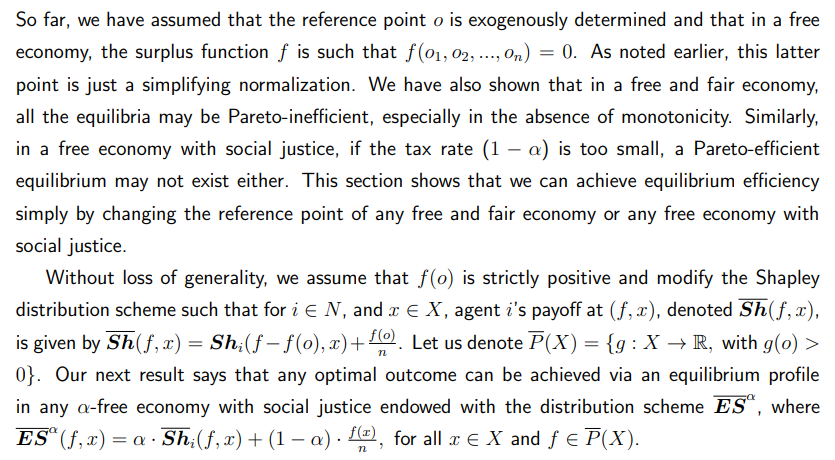
The Role of Reference Points in Achieving Equilibrium Efficiency in Fair and Socially Just Economies


The Role of Reference Points in Achieving Equilibrium Efficiency in Fair and Socially Just Economies

This article explores how a simple change in the reference point can achieve a Pareto-efficient equilibrium in both free and fair economies and those with social justice.
Share
Hackernoon2025/09/17 22:30
Cryptos Signal Divergence Ahead of Fed Rate Decision

Cryptos Signal Divergence Ahead of Fed Rate Decision

The post Cryptos Signal Divergence Ahead of Fed Rate Decision appeared on BitcoinEthereumNews.com. Crypto assets send conflicting signals ahead of the Federal Reserve’s September rate decision. On-chain data reveals a clear decrease in Bitcoin and Ethereum flowing into centralized exchanges, but a sharp increase in altcoin inflows. The findings come from a Tuesday report by CryptoQuant, an on-chain data platform. The firm’s data shows a stark divergence in coin volume, which has been observed in movements onto centralized exchanges over the past few weeks. Bitcoin and Ethereum Inflows Drop to Multi-Month Lows Sponsored Sponsored Bitcoin has seen a dramatic drop in exchange inflows, with the 7-day moving average plummeting to 25,000 BTC, its lowest level in over a year. The average deposit per transaction has fallen to 0.57 BTC as of September. This suggests that smaller retail investors, rather than large-scale whales, are responsible for the recent cash-outs. Ethereum is showing a similar trend, with its daily exchange inflows decreasing to a two-month low. CryptoQuant reported that the 7-day moving average for ETH deposits on exchanges is around 783,000 ETH, the lowest in two months. Other Altcoins See Renewed Selling Pressure In contrast, other altcoin deposit activity on exchanges has surged. The number of altcoin deposit transactions on centralized exchanges was quite steady in May and June of this year, maintaining a 7-day moving average of about 20,000 to 30,000. Recently, however, that figure has jumped to 55,000 transactions. Altcoins: Exchange Inflow Transaction Count. Source: CryptoQuant CryptoQuant projects that altcoins, given their increased inflow activity, could face relatively higher selling pressure compared to BTC and ETH. Meanwhile, the balance of stablecoins on exchanges—a key indicator of potential buying pressure—has increased significantly. The report notes that the exchange USDT balance, around $273 million in April, grew to $379 million by August 31, marking a new yearly high. CryptoQuant interprets this surge as a reflection of…
Share
BitcoinEthereumNews2025/09/18 01:01
