Investors have piled into Solana-linked products and on-chain cash, pushing the network back into the spotlight. Based on reports, the total supply of stablecoins sitting on Solana recently climbed to about $15 billion, a new peak that traders say is adding fuel to activity on the chain. Related Reading: 2%–4% In Crypto? Morgan Stanley Thinks That’s The Smart Move Now Stablecoin Liquidity Hits A Milestone The bulk of that supply is held in USDC, which accounts for roughly 75% of stablecoins on Solana, according to analytics cited by market commentators. That concentration has helped trading desks and decentralized apps move larger sums with less friction than on some rival chains. On top of the on-chain cash, US-listed ETFs tied to Solana and related products have recorded fast early takeup, giving institutions a simpler route into the token and staking rewards. The REX-Osprey SOL + Staking ETF, known by the ticker SSK, passed the $100 million AUM mark within days of launch, showing how appetite for regulated access to Solana can materialize quickly. ETFs Bring Fresh Flows And Visibility Reports show that REX-Osprey’s suite of crypto ETFs has now crossed half a billion dollars in combined assets under management, a sign that product innovation on Wall Street is translating into real capital flows into the sector. Market watchers say ETFs let big investors get exposure without interacting directly with wallets and custody solutions. Network Upgrades, Use Cases Part Of The Move Observers point to recent code upgrades and faster settlement as part of why more stablecoins are parked on Solana. Those changes aim to reduce delays and lower costs for traders who move USDC and other dollar-pegged tokens. Although technical gains in and of itself do not produce price movement, they can enhance a network’s attractiveness for high-frequency activity and for projects focused on tokenized assets that require transaction finality. Related Reading: Bitcoin Breaks $123,000 As Rising Open Interest Signals More Action Ahead Regulatory Framework Remains Relevant Regulation and approvals in the United States have influenced this impulse. Asset managers have filed for Solana ETFs and modified their necessary paperwork with the SEC while awaiting permits to list a product tied to the token. According to a recent reports, multiple firms have updated their submissions while the regulator is still reviewing. The broader political backdrop, including comments from US President Donald Trump and others, has kept attention on how policy could tilt institutional demand. Featured image from Unsplash, chart from TradingViewInvestors have piled into Solana-linked products and on-chain cash, pushing the network back into the spotlight. Based on reports, the total supply of stablecoins sitting on Solana recently climbed to about $15 billion, a new peak that traders say is adding fuel to activity on the chain. Related Reading: 2%–4% In Crypto? Morgan Stanley Thinks That’s The Smart Move Now Stablecoin Liquidity Hits A Milestone The bulk of that supply is held in USDC, which accounts for roughly 75% of stablecoins on Solana, according to analytics cited by market commentators. That concentration has helped trading desks and decentralized apps move larger sums with less friction than on some rival chains. On top of the on-chain cash, US-listed ETFs tied to Solana and related products have recorded fast early takeup, giving institutions a simpler route into the token and staking rewards. The REX-Osprey SOL + Staking ETF, known by the ticker SSK, passed the $100 million AUM mark within days of launch, showing how appetite for regulated access to Solana can materialize quickly. ETFs Bring Fresh Flows And Visibility Reports show that REX-Osprey’s suite of crypto ETFs has now crossed half a billion dollars in combined assets under management, a sign that product innovation on Wall Street is translating into real capital flows into the sector. Market watchers say ETFs let big investors get exposure without interacting directly with wallets and custody solutions. Network Upgrades, Use Cases Part Of The Move Observers point to recent code upgrades and faster settlement as part of why more stablecoins are parked on Solana. Those changes aim to reduce delays and lower costs for traders who move USDC and other dollar-pegged tokens. Although technical gains in and of itself do not produce price movement, they can enhance a network’s attractiveness for high-frequency activity and for projects focused on tokenized assets that require transaction finality. Related Reading: Bitcoin Breaks $123,000 As Rising Open Interest Signals More Action Ahead Regulatory Framework Remains Relevant Regulation and approvals in the United States have influenced this impulse. Asset managers have filed for Solana ETFs and modified their necessary paperwork with the SEC while awaiting permits to list a product tied to the token. According to a recent reports, multiple firms have updated their submissions while the regulator is still reviewing. The broader political backdrop, including comments from US President Donald Trump and others, has kept attention on how policy could tilt institutional demand. Featured image from Unsplash, chart from TradingView

All Eyes On Solana: $15-B Stablecoin Supply, ETF Demand Drive Next Leg Up

2025/10/07 06:30
2 min read
For feedback or concerns regarding this content, please contact us at crypto.news@mexc.com

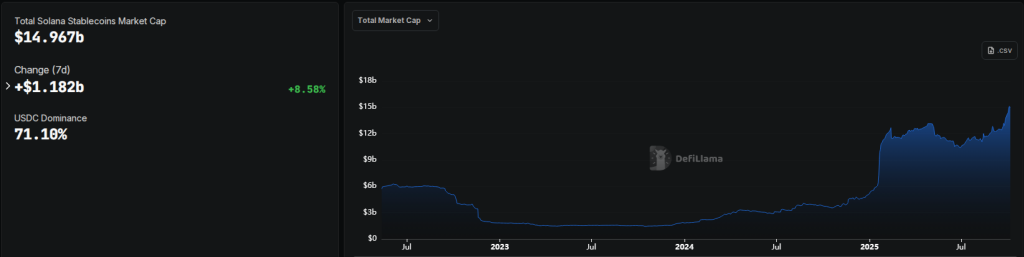
Investors have piled into Solana-linked products and on-chain cash, pushing the network back into the spotlight. Based on reports, the total supply of stablecoins sitting on Solana recently climbed to about $15 billion, a new peak that traders say is adding fuel to activity on the chain.

Stablecoin Liquidity Hits A Milestone

The bulk of that supply is held in USDC, which accounts for roughly 75% of stablecoins on Solana, according to analytics cited by market commentators. That concentration has helped trading desks and decentralized apps move larger sums with less friction than on some rival chains.

On top of the on-chain cash, US-listed ETFs tied to Solana and related products have recorded fast early takeup, giving institutions a simpler route into the token and staking rewards.

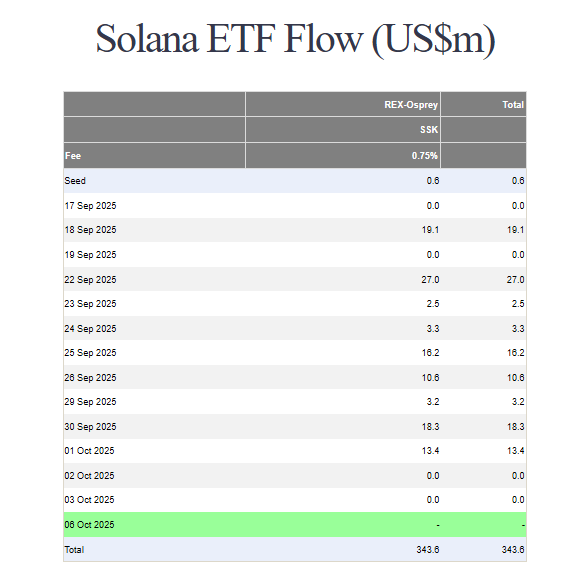
The REX-Osprey SOL + Staking ETF, known by the ticker SSK, passed the $100 million AUM mark within days of launch, showing how appetite for regulated access to Solana can materialize quickly.
ETFs Bring Fresh Flows And Visibility

Reports show that REX-Osprey’s suite of crypto ETFs has now crossed half a billion dollars in combined assets under management, a sign that product innovation on Wall Street is translating into real capital flows into the sector.

Market watchers say ETFs let big investors get exposure without interacting directly with wallets and custody solutions.
Network Upgrades, Use Cases Part Of The Move

Observers point to recent code upgrades and faster settlement as part of why more stablecoins are parked on Solana. Those changes aim to reduce delays and lower costs for traders who move USDC and other dollar-pegged tokens.

Although technical gains in and of itself do not produce price movement, they can enhance a network’s attractiveness for high-frequency activity and for projects focused on tokenized assets that require transaction finality.

Regulatory Framework Remains Relevant

Regulation and approvals in the United States have influenced this impulse. Asset managers have filed for Solana ETFs and modified their necessary paperwork with the SEC while awaiting permits to list a product tied to the token.

According to a recent reports, multiple firms have updated their submissions while the regulator is still reviewing.

The broader political backdrop, including comments from US President Donald Trump and others, has kept attention on how policy could tilt institutional demand.

Featured image from Unsplash, chart from TradingView

Market Opportunity
B Logo
B Price(B)
$0.20498
$0.20498$0.20498
+1.65%
USD
B (B) Live Price Chart
Disclaimer: The articles reposted on this site are sourced from public platforms and are provided for informational purposes only. They do not necessarily reflect the views of MEXC. All rights remain with the original authors. If you believe any content infringes on third-party rights, please contact crypto.news@mexc.com for removal. MEXC makes no guarantees regarding the accuracy, completeness, or timeliness of the content and is not responsible for any actions taken based on the information provided. The content does not constitute financial, legal, or other professional advice, nor should it be considered a recommendation or endorsement by MEXC.

You May Also Like

Shibarium May No Longer Turbocharge Shiba Inu Price Rally, Here’s Reason

Shibarium May No Longer Turbocharge Shiba Inu Price Rally, Here’s Reason

The post Shibarium May No Longer Turbocharge Shiba Inu Price Rally, Here’s Reason appeared on BitcoinEthereumNews.com. Shibarium, the layer-2 blockchain of the Shiba Inu (SHIB) ecosystem, is battling to stay active. Shibarium has slipped from hitting transaction milestones to struggling to record any transactions on its platform, a development that could severely impact SHIB. Shibarium transactions crash from millions to near zero As per Shibariumscan data, the total daily transactions on Shibarium as of Sept. 16 stood at 11,600. This volume of transactions reflects how low the transaction count has dropped for the L2, whose daily average ranged between 3.5 million and 4 million last month. However, in the last week of August, daily transaction volume on Shibarium lost momentum, slipping from 1.3 million to 9,590 as of Aug. 28. This pattern has lingered for much of September, with the highest peak so far being on Sept. 5, when it posted 1.26 million transactions. The low user engagement has greatly affected the transaction count in recent days. In addition, the security breach over the weekend by malicious attackers on Shibarium has probably worsened issues. Although developer Kaal Dhairya reassured the community that the attack to steal millions of BONE tokens was successfully prevented, users’ confidence appears shaken. This has also impacted the price outlook for Shiba Inu, the ecosystem’s native token. Following reports of the malicious attack on Shibarium, SHIB dipped immediately into the red zone. Unlike on previous occasions where investors accumulated on the dip, market participants did not flock to Shiba Inu. Shiba Inu price struggles, can burn mechanism help? With the current near-zero crash in transaction volume for Shibarium, SHIB’s price cannot depend on it to support a rally. It might take a while to rebuild user confidence and for transactions to pick up again. In the meantime, Shiba Inu might have to rely on other means to boost prices from its low levels. This…
Share
BitcoinEthereumNews2025/09/18 07:57
Wormhole Unleashes W 2.0 Tokenomics for a Connected Blockchain Future

Wormhole Unleashes W 2.0 Tokenomics for a Connected Blockchain Future

TLDR Wormhole reinvents W Tokenomics with Reserve, yield, and unlock upgrades. W Tokenomics: 4% yield, bi-weekly unlocks, and a sustainable Reserve Wormhole shifts to long-term value with treasury, yield, and smoother unlocks. Stakers earn 4% base yield as Wormhole optimizes unlocks for stability. Wormhole’s new Tokenomics align growth, yield, and stability for W holders. Wormhole [...] The post Wormhole Unleashes W 2.0 Tokenomics for a Connected Blockchain Future appeared first on CoinCentral.
Share
Coincentral2025/09/18 02:07
Why Is Crypto Market Up Today? 5 Key Reasons Behind the Rally

Why Is Crypto Market Up Today? 5 Key Reasons Behind the Rally

The post Why Is Crypto Market Up Today? 5 Key Reasons Behind the Rally appeared on BitcoinEthereumNews.com. The crypto market is rallying today, with Bitcoin climbing
Share
BitcoinEthereumNews2026/03/11 04:47