The final quarter of 2025 has turned out to be the worst-performing quarter for Bitcoin in nearly a decade. Data from Coinglass confirms that Bitcoin has registeredThe final quarter of 2025 has turned out to be the worst-performing quarter for Bitcoin in nearly a decade. Data from Coinglass confirms that Bitcoin has registered

Q4 2025: Bitcoin Posts Worst Quarterly Loss Since 2018

The final quarter of 2025 has turned out to be the worst-performing quarter for Bitcoin in nearly a decade.

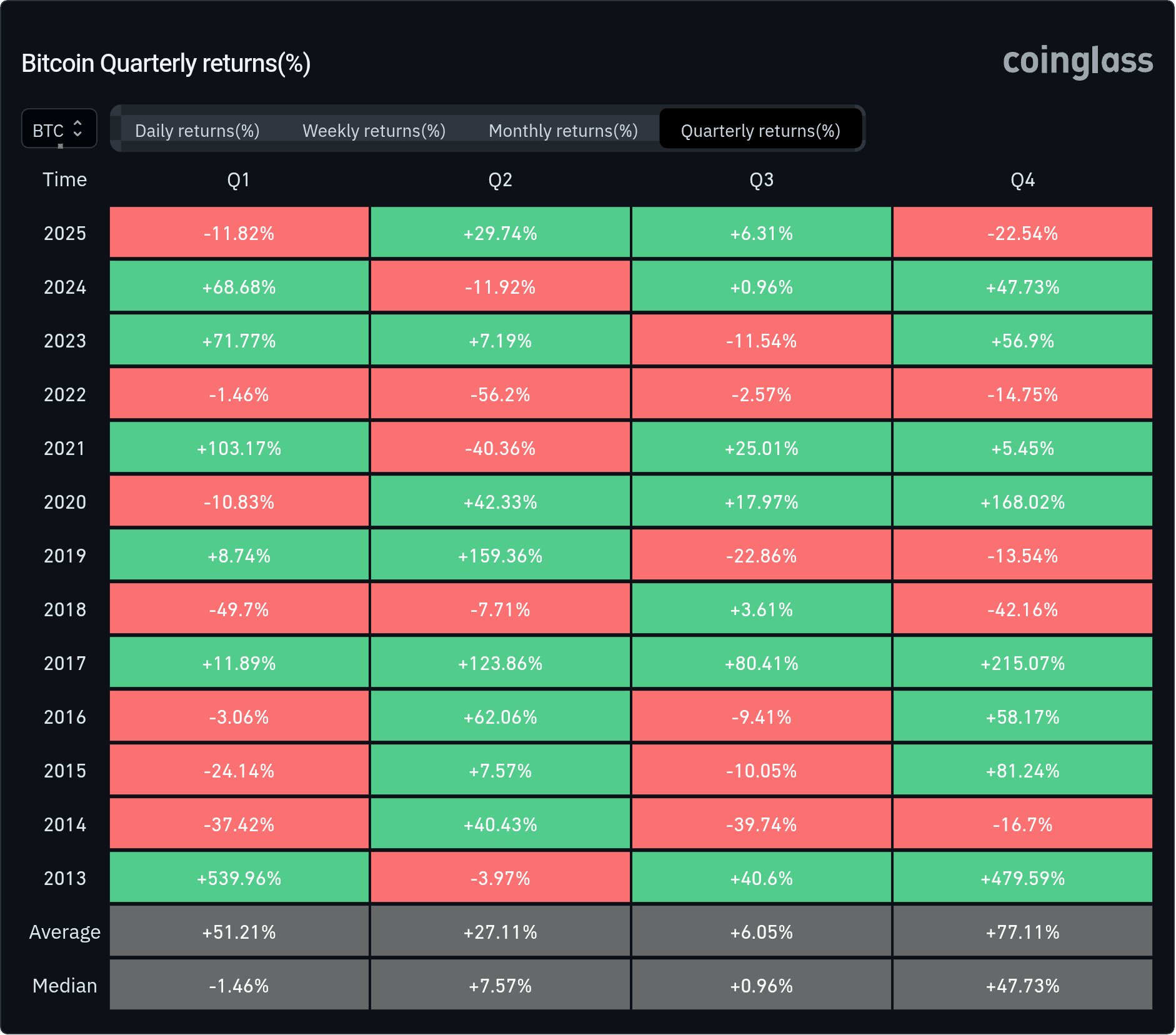
Data from Coinglass confirms that Bitcoin has registered a loss of 22.54% so far in the fourth quarter of 2025, with just a week remaining until the end of the year. The last time Bitcoin experienced such a massive negative performance in Q4 was in 2018, when it ended the year with a Q4 loss of 42.16%.

This is evident in the ongoing bearish performance the market has seen since Bitcoin hit a peak in October this year. Specifically, since October’s $126,198 peak, Bitcoin has declined 30.82% to $87,201.

Bitcoin’s price dip has wiped out over $1 trillion from the global crypto market valuation, falling from over $4.1 trillion a few months ago to $2.91 trillion today.

Bitcoin Worst Quarter Since 2018

Historically, the last quarter of the year is a bullish phase for Bitcoin, with an average gain of 77.11% and a median gain of 47.73%. Since 2013, Bitcoin has posted positive gains in Q4 eight times, with increases as high as 479.59% and as low as 5.45%. It has only registered losses five times, including Q4 2025.

Notably, after Bitcoin dipped 42% in Q4 2018, it saw a recovery in Q1 2019, posting gains of 8.74%. This set the stage for a more massive 159.36% gain by Q2 that year. However, Bitcoin registered a 22.86% loss in Q3 and a 13.54% loss in Q4 of 2019.

This marked another fourth-quarter loss for Bitcoin. The loss carried into 2020, with another 10.83% dip in Q1. From then on, a major recovery followed, with Bitcoin registering outstanding positive gains of 42.33%, 17.97%, and an even more massive 168.02% in Q2, Q3, and Q4, respectively.
Bitcoin historical chart from CoinglassBitcoin historical chart from Coinglass

What Could Happen in Q1 2026?

As it stands, this historical account suggests two possible outcomes for Bitcoin:

It could see a relief in Q1 2026, consistent with recoveries after Q4 losses in 2018 and 2022. Notably, after Bitcoin dipped 14.75% in Q4 2022, it registered a massive 71.77% upside in Q1 2023.

Alternatively, Bitcoin could see another loss in Q1 2026, consistent with its performance after the Q4 2019 loss. However, that loss paved the way for explosive gains in Q2, Q3, and Q4. In other words, should Q1 2026 end bearish for Bitcoin, a rebound could follow for the rest of the year.

What Industry Experts Expect in 2026

According to Citibank, Bitcoin could reach as high as $189,000 in 2026 under an ultra-bullish scenario. It could also reach $143,000 under a moderate scenario, both of which would mark new all-time highs for BTC.

Notably, Bernstein analysts have similar expectations, suggesting BTC could reach $150,000 in 2026 and $200,000 in 2027.

Market Opportunity
Farcana Logo
Farcana Price(FAR)
$0.000726
$0.000726$0.000726
+2.97%
USD
Farcana (FAR) Live Price Chart
Disclaimer: The articles reposted on this site are sourced from public platforms and are provided for informational purposes only. They do not necessarily reflect the views of MEXC. All rights remain with the original authors. If you believe any content infringes on third-party rights, please contact service@support.mexc.com for removal. MEXC makes no guarantees regarding the accuracy, completeness, or timeliness of the content and is not responsible for any actions taken based on the information provided. The content does not constitute financial, legal, or other professional advice, nor should it be considered a recommendation or endorsement by MEXC.

You May Also Like

China Bans Nvidia’s RTX Pro 6000D Chip Amid AI Hardware Push

China Bans Nvidia’s RTX Pro 6000D Chip Amid AI Hardware Push

TLDR China instructs major firms to cancel orders for Nvidia’s RTX Pro 6000D chip. Nvidia shares drop 1.5% after China’s ban on key AI hardware. China accelerates development of domestic AI chips, reducing U.S. tech reliance. Crypto and AI sectors may seek alternatives due to limited Nvidia access in China. China has taken a bold [...] The post China Bans Nvidia’s RTX Pro 6000D Chip Amid AI Hardware Push appeared first on CoinCentral.
Share
Coincentral2025/09/18 01:09
How To Earn Crypto Cashback With Cold Wallet’s Every Transaction

How To Earn Crypto Cashback With Cold Wallet’s Every Transaction

The post How To Earn Crypto Cashback With Cold Wallet’s Every Transaction appeared on BitcoinEthereumNews.com. Crypto has long promised opportunity, but for most users, participation feels more like a penalty than a reward. Every swap, bridge, or simple transaction comes with fees that chip away at your balance. For newcomers, this becomes a barrier to entry, and for long-time users, it creates fatigue. Cold Wallet changes that equation by giving something back every time you act on-chain. Instead of paying fees into a void, you get rewarded with $CWT tokens that build your balance over time.  With over $7.11 million already raised in its presale, currently at stage 18 and priced at $0.01058 per token, Cold Wallet is proving that a fairer system isn’t just possible, it’s already here. At launch, $CWT is projected to list at $0.3517, adding even more incentive for early adopters to get involved now.  Cashback Built Into Every Action Cold Wallet introduces a simple but powerful concept: use the blockchain as usual, and you get cashback for it. Whether you’re paying gas fees, swapping between tokens, or bridging funds across networks, the wallet automatically rewards you with $CWT. There’s no staking contract to manage, no forms to fill out, and no hidden lock-ups to trap your funds. The system works in real time, making the experience seamless and effortless.  Cashback rates are tied to your tier, and with higher holdings of $CWT, you can reclaim even more of your transaction costs, up to 100% of gas fees at the top tier. For everyday users, this means turning unavoidable expenses into an income stream. For power users, it transforms frequent activity into a compounding advantage, giving them a reason to engage more often without the usual frustration of draining fees. The Role of $CWT in the Ecosystem At the heart of Cold Wallet’s cashback model is the $CWT token. Far from…
Share
BitcoinEthereumNews2025/09/26 21:27
Scott Bessent says yuan drop against euro is Europe’s problem, not America’s

Scott Bessent says yuan drop against euro is Europe’s problem, not America’s

The post Scott Bessent says yuan drop against euro is Europe’s problem, not America’s appeared on BitcoinEthereumNews.com. U.S. Treasury Secretary Scott Bessent said in Madrid on Thursday that the slump in China’s currency isn’t a problem for the United States, it’s Europe that should be worried. Speaking during a joint interview with Reuters and Bloomberg, Scott made the comments after meetings with Chinese Vice Premier He Lifeng as part of the U.S.-China trade discussions, which also included talks on TikTok. He made it clear that the yuan, also known as the renminbi, has actually strengthened against the U.S. dollar this year, but collapsed to a record low against the euro. “The RMB is actually stronger this year versus the dollar. Now it’s at an all-time low versus the euro, which is a problem for the Europeans,” Scott, rejecting the idea that Beijing was trying to devalue its currency to gain an unfair edge against Washington. He said Chinese officials haven’t tried anything of the sort with the U.S. and explained the reality behind the currency’s movement: “It’s a closed currency. So they manage the level.” Yuan collapse helps Chinese exports flood europe Since January, the yuan has plunged from 7.5 per euro to over 8.4, triggering concerns across Europe. Meanwhile, against the dollar, it’s gained slightly from 7.3 to 7.1. This divergence has created a lopsided trade dynamic, because while the U.S. has seen its imports from China drop 14% due to aggressive tariffs, Europe has recorded a 6.9% increase in trade with China. So, Scott said the U.S. tariffs are doing what they were meant to do, cutting down the trade deficit. But the redirected flow of Chinese goods is now landing in European markets instead, where the yuan’s weakness is making Chinese exports even cheaper in euro terms. The weakening of the yuan is hitting Europe at a sensitive time, as the European Central Bank…
Share
BitcoinEthereumNews2025/09/19 10:16