Neural vocoder is the final model in the Text to Speech (TTS) pipeline. It turns a mel‑spectrogram into the sound you can actually hear. WaveNet, WaveGlow, HiFi‑GAN, and FastDiff are the four contenders.Neural vocoder is the final model in the Text to Speech (TTS) pipeline. It turns a mel‑spectrogram into the sound you can actually hear. WaveNet, WaveGlow, HiFi‑GAN, and FastDiff are the four contenders.

Inside the Neural Vocoder Zoo: WaveNet to Diffusion in Four Audio Clips

Hey everyone, I’m Oleh Datskiv, Lead AI Engineer at the R&D Data Unit of N-iX. Lately, I’ve been working on text-to-speech systems and, more specifically, on the unsung hero behind them: the neural vocoder.

Let me introduce you to this final step of the TTS pipeline — the part that turns abstract spectrograms into the natural-sounding speech we hear.

Introduction

If you’ve worked with text‑to‑speech in the past few years, you’ve used a vocoder - even if you didn’t notice it. The neural vocoder is the final model in the Text to Speech (TTS) pipeline; it turns a mel‑spectrogram into the sound you can actually hear.

Since the release of WaveNet in 2016, neural vocoders have evolved rapidly. They become faster, lighter, and more natural-sounding. From flow-based to GANs to diffusion, each new approach has pushed the field closer to real-time, high-fidelity speech.

2024 felt like a definitive turning point: diffusion-based vocoders like FastDiff were finally fast enough to be considered for real-time usage, not just batch synthesis as before. That opened up a range of new possibilities. The most notable ones were smarter dubbing pipelines, higher-quality virtual voices, and more expressive assistants, even if you’re not utilizing a high-end GPU cluster.

But with so many options that we now have, the questions remain:

  • How do these models sound side-by-side?
  • Which ones keep latency low enough for live or interactive use?
  • What is the best choice of a vocoder for you?

This post will examine four key vocoders: WaveNet, WaveGlow, HiFi‑GAN, and FastDiff. We’ll explain how each model works and what makes them different. Most importantly, we’ll let you hear the results of their work so you can decide which one you like better. Also, we will share custom benchmarks of model evaluation that were done through our research.

What Is a Neural Vocoder?

At a high level, every modern TTS system still follows the same basic path:
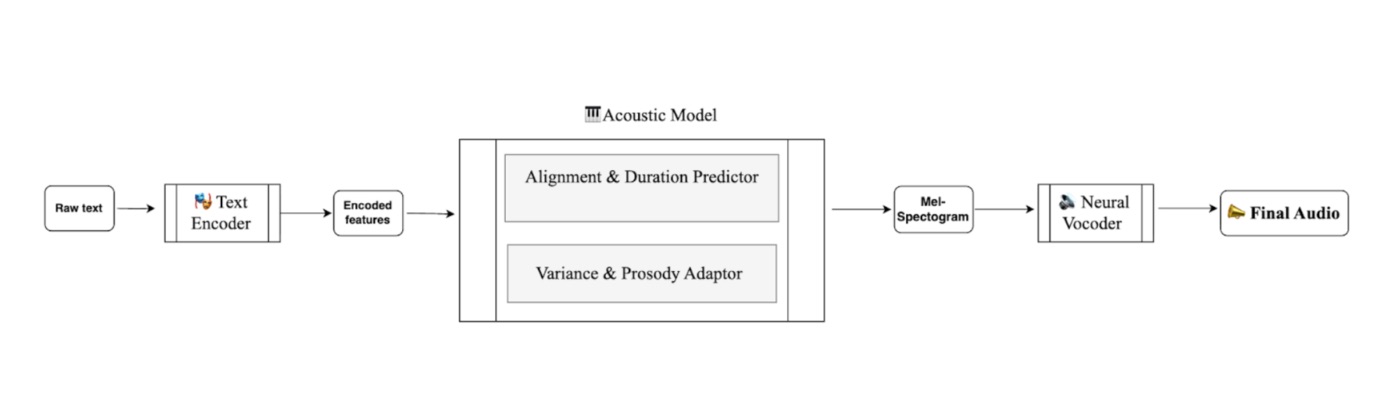
\ Let’s quickly go over what each of these blocks does and why we are focusing on the vocoder today:

  1. Text encoder: It changes raw text or phonemes into detailed linguistic embeddings.
  2. Acoustic model: This stage predicts how the speech should sound over time. It turns linguistic embeddings into mel spectrograms that show timing, melody, and expression. It has two critical sub-components:
  3. Alignment & duration predictor: This component determines how long each phoneme should last, ensuring the rhythm of speech feels natural and human
  4. Variance/prosody adaptor: At this stage, the adaptor injects pitch, energy, and style, shaping the melody, emphasis, and emotional contour of the sentence.
  5. Neural vocoder: Finally, this model converts the prosody-rich mel spectrogram into actual sound, the waveform we can hear.

The vocoder is where good pipelines live or die. Map mels to waveforms perfectly, and the result is a studio-grade actor. Get it wrong, and even with the best acoustic model, you will get metallic buzz in the generated audio. That’s why choosing the right vocoder matters - because they’re not all built the same. Some optimize for speed, others for quality. The best models balance naturalness, speed, and clarity.

The Vocoder Lineup

Now, let's meet our four contenders. Each represents a different generation of neural speech synthesis, with its unique approach to balancing the trade-offs between audio quality, speed, and model size. The numbers below are drawn from the original papers. Thus, the actual performance will vary depending on your hardware and batch size. We will share our benchmark numbers later in the article for a real‑world check.

  1. WaveNet (2016): The original fidelity benchmark

Google's WaveNet was a landmark that redefined audio quality for TTS. As an autoregressive model, it generates audio one sample at a time, with each new sample conditioned on all previous ones. This process resulted in unprecedented naturalness at the time (MOS=4.21), setting a "gold standard" that researchers still benchmark against today. However, this sample-by-sample approach also makes WaveNet painfully slow, restricting its use to offline studio work rather than live applications.

  1. WaveGlow (2019): Leap to parallel synthesis

To solve WaveNet's critical speed problem, NVIDIA's WaveGlow introduced a flow-based, non-autoregressive architecture. Generating the entire waveform in a single forward pass drastically reduced inference time to approximately 0.04 RTF, making it much faster than in real time. While the quality is excellent (MOS≈3.961), it was considered a slight step down from WaveNet's fidelity. Its primary limitations are a larger memory footprint and a tendency to produce a subtle high-frequency hiss, especially with noisy training data.

  1. HiFi-GAN (2020): Champion of efficiency

HiFi-GAN marked a breakthrough in efficiency using a Generative Adversarial Network (GAN) with a clever multi-period discriminator. This architecture allows it to produce extremely high-fidelity audio (MOS=4.36), which is competitive with WaveNet, but is fast from a remarkably small model (13.92 MB). It's ultra-fast on a GPU (<0.006×RTF) and can even achieve real-time performance on a CPU, which is why HiFi-GAN quickly became the default choice for production systems like chatbots, game engines, and virtual assistants.

  1. FastDiff (2025): Diffusion quality at real-time speed

Proving that diffusion models don't have to be slow, FastDiff represents the current state-of-the-art in balancing quality and speed. Pruning the reverse diffusion process to as few as four steps achieves top-tier audio quality (MOS=4.28) while maintaining fast speeds for interactive use (~0.02×RTF on a GPU). This combination makes it one of the first diffusion-based vocoders viable for high-quality, real-time speech synthesis, opening the door for more expressive and responsive applications.

Each of these models reflects a significant shift in vocoder design. Now that we've seen how they work on paper, it's time to put them to the test with our own benchmarks and audio comparisons.

\n Let’s Hear It — A/B Audio Gallery

Nothing beats your ears!

We will use the following sentences from the LJ Speech Dataset to test our vocoders. Later in the article, you can also listen to the original audio recording and compare it with the generated one.

Sentences:

  1. “A medical practitioner charged with doing to death persons who relied upon his professional skill.”
  2. “Nothing more was heard of the affair, although the lady declared that she had never instructed Fauntleroy to sell.”
  3. “Under the new rule, visitors were not allowed to pass into the interior of the prison, but were detained between the grating.”

The metrics we will use to evaluate the model’s results are listed below. These include both objective and subjective metrics:

  • Naturalness (MOS): How human-like does it sound (rated by real people on a 1/5 scale)
  • Clarity (PESQ / STOI): Objective scores that help measure intelligibility and noise/artifacts. The higher, the better.
  • Speed (RTF): An RTF of 1 means it takes 1 second to generate 1 second of audio. For anything interactive, you’ll want this at 1 or below

Audio Players

(Grab headphones and tap the buttons to hear each model.)

| Sentence | Ground truth | WaveNet | WaveGlow | HiFi‑GAN | FastDiff | |----|:---:|:---:|:---:|:---:|:---:| | S1 | ▶️ | ▶️ | ▶️ | ▶️ | ▶️ | | S2 | ▶️ | ▶️ | ▶️ | ▶️ | ▶️ | | S3 | ▶️ | ▶️ | ▶️ | ▶️ | ▶️ |

\n Quick‑Look Metrics

Here, we will show you the results obtained for the models we evaluate.

| Model | RTF ↓ | MOS ↑ | PESQ ↑ | STOI ↑ | |----|:---:|:---:|:---:|:---:| | WaveNet | 1.24 | 3.4 | 1.0590 | 0.1616 | | WaveGlow | 0.058 | 3.7 | 1.0853 | 0.1769 | | HiFi‑GAN | 0.072 | 3.9 | 1.098 | 0.186 | | FastDiff | 0.081 | 4.0 | 1.131 | 0.19 |

\n *For the MOS evaluation, we used voices from 150 participants with no background in music.

** As an acoustic model, we used Tacotron2 for WaveNet and WaveGlow, and FastSpeech2 for HiFi‑GAN and FastDiff.

\n Bottom line

Our journey through the vocoder zoo shows that while the gap between speed and quality is shrinking, there’s no one-size-fits-all solution. Your choice of a vocoder in 2025 and beyond should primarily depend on your project's needs and technical requirements, including:

  • Runtime constraints (Is it an offline generation or a live, interactive application?)
  • Quality requirements (What’s a higher priority: raw speed or maximum fidelity?)
  • Deployment targets (Will it run on a powerful cloud GPU, a local CPU, or a mobile device?)

As the field progresses, the lines between these choices will continue to blur, paving the way for universally accessible, high-fidelity speech that is heard and felt.

Market Opportunity
Hifi Finance Logo
Hifi Finance Price(HIFI)
$0.03399
$0.03399$0.03399
+30.08%
USD
Hifi Finance (HIFI) Live Price Chart
Disclaimer: The articles reposted on this site are sourced from public platforms and are provided for informational purposes only. They do not necessarily reflect the views of MEXC. All rights remain with the original authors. If you believe any content infringes on third-party rights, please contact service@support.mexc.com for removal. MEXC makes no guarantees regarding the accuracy, completeness, or timeliness of the content and is not responsible for any actions taken based on the information provided. The content does not constitute financial, legal, or other professional advice, nor should it be considered a recommendation or endorsement by MEXC.

You May Also Like

Atlassian’s Monumental DX Acquisition: Revolutionizing Developer Productivity for a Billion-Dollar Future

Atlassian’s Monumental DX Acquisition: Revolutionizing Developer Productivity for a Billion-Dollar Future

BitcoinWorld Atlassian’s Monumental DX Acquisition: Revolutionizing Developer Productivity for a Billion-Dollar Future In a move that sends ripples across the tech industry, impacting everything from foundational infrastructure to the cutting-edge innovations seen in blockchain and cryptocurrency development, productivity software giant Atlassian has made its largest acquisition to date. This isn’t just another corporate buyout; it’s a strategic investment in the very fabric of how software is built. The Atlassian acquisition of DX, a pioneering developer productivity platform, for a staggering $1 billion, signals a profound commitment to optimizing engineering workflows and understanding the true pulse of development teams. For those invested in the efficiency and scalability of digital ecosystems, this development underscores the growing importance of robust tooling at every layer. Unpacking the Monumental Atlassian Acquisition: A Billion-Dollar Bet on Developer Efficiency On a recent Thursday, Atlassian officially announced its agreement to acquire DX for $1 billion, a sum comprising both cash and restricted stock. This substantial investment highlights Atlassian’s belief in the critical role of developer insights in today’s fast-paced tech landscape. For years, Atlassian has been synonymous with collaboration and project management tools, powering teams worldwide with products like Jira, Confluence, and Trello. However, recognizing a growing need, the company has now decisively moved to integrate a dedicated developer productivity insight platform into its formidable product suite. This acquisition isn’t merely about expanding market share; it’s about deepening Atlassian’s value proposition by providing comprehensive visibility into the health and efficiency of engineering operations. The strategic rationale behind this billion-dollar move is multifaceted. Atlassian co-founder and CEO Mike Cannon-Brookes shared with Bitcoin World that after a three-year attempt to build an in-house developer productivity insight tool, his Sydney-based company realized the immense value of an external, existing solution. This candid admission speaks volumes about the complexity and specialized nature of developer productivity measurement. DX emerged as the natural choice, not least because an impressive 90% of DX’s existing customers were already leveraging Atlassian’s project management and collaboration tools. This pre-existing synergy promises a smoother integration and immediate value for a significant portion of the combined customer base. What is the DX Platform and Why is it a Game-Changer? At its core, DX is designed to empower enterprises by providing deep analytics into how productive their engineering teams truly are. More importantly, it helps identify and unblock bottlenecks that can significantly slow down development cycles. Launched five years ago by Abi Noda and Greyson Junggren, DX emerged from a fundamental challenge: the lack of accurate and non-intrusive metrics to understand developer friction. Abi Noda, in a 2022 interview with Bitcoin World, articulated his founding vision: to move beyond superficial metrics that often failed to capture the full picture of engineering challenges. His experience as a product manager at GitHub revealed that traditional measures often felt like surveillance rather than support, leading to skewed perceptions of productivity. DX was built on a different philosophy, focusing on qualitative and quantitative insights that truly reflect what hinders teams, without making developers feel scrutinized. Noda noted, “The assumptions we had about what we needed to help ship products faster were quite different than what the teams and developers were saying was getting in their way.” Since emerging from stealth in 2022, the DX platform has demonstrated remarkable growth, tripling its customer base every year. It now serves over 350 enterprise customers, including industry giants like ADP, Adyen, and GitHub. What makes DX’s success even more impressive is its lean operational model; the company achieved this rapid expansion while raising less than $5 million in venture funding. This efficiency underscores the inherent value and strong market demand for its solution, making it an exceptionally attractive target for Atlassian. Boosting Developer Productivity: Atlassian’s Strategic Vision The acquisition of DX is a clear signal of Atlassian’s strategic intent to not just manage tasks, but to optimize the entire software development lifecycle. By integrating DX’s capabilities, Atlassian aims to offer an end-to-end “flywheel” for engineering teams. This means providing tools that not only facilitate collaboration and project tracking but also offer actionable insights into where processes are breaking down and how they can be improved. Mike Cannon-Brookes elaborated on this synergy, stating, “DX has done an amazing job [of] understanding the qualitative and quantitative aspects of developer productivity and turning that into actions that can improve those companies and give them insights and comparisons to others in their industry, others at their size, etc.” This capability to benchmark and identify specific areas for improvement is invaluable for organizations striving for continuous enhancement. Abi Noda echoed this sentiment, telling Bitcoin World that the combined entities are “better together than apart.” He emphasized how Atlassian’s extensive suite of tools complements the data and information gathered by DX. “We are able to provide customers with that full flywheel to get the data and understand where we are unhealthy,” Noda explained. “They can plug in Atlassian’s tools and solutions to go address those bottlenecks. An end-to-end flywheel that is ultimately what customers want.” This integration promises to create a seamless experience, allowing teams to move from identifying an issue to implementing a solution within a unified ecosystem. The Intersection of Enterprise Software and Emerging Tech Trends This landmark acquisition also highlights a significant trend in the broader enterprise software landscape: a shift towards more intelligent, data-driven solutions that directly impact operational efficiency and competitive advantage. As companies continue to invest heavily in digital transformation, the ability to measure and optimize the output of their most valuable asset — their engineering talent — becomes paramount. DX’s impressive roster of over 350 enterprise customers, including some of the largest and most technologically advanced organizations, is a testament to the universal need for such a platform. These companies recognize that merely tracking tasks isn’t enough; they need to understand the underlying dynamics of their engineering teams to truly unlock their potential. The integration of DX into Atlassian’s ecosystem will likely set a new standard for what enterprise software can offer, pushing competitors to enhance their own productivity insights. Moreover, this move by Atlassian, a global leader in enterprise collaboration, underscores a broader investment thesis in foundational tooling. Just as robust blockchain infrastructure is critical for the future of decentralized finance, powerful and insightful developer tools are essential for the evolution of all software, including the complex applications underpinning Web3. The success of companies like DX, which scale without massive external funding, also resonates with the lean, efficient ethos often celebrated in the crypto space. Navigating the Era of AI Tools: Measuring Impact and ROI Perhaps one of the most compelling aspects of this acquisition, as highlighted by Atlassian’s CEO, is its timely relevance in the era of rapidly advancing AI tools. Mike Cannon-Brookes noted that the rise of AI has created a new imperative for companies to measure its usage and effectiveness. “You suddenly have these budgets that are going up. Is that a good thing? Is that not a good thing? Am I spending the money in the right ways? It’s really, really important and critical.” With AI-powered coding assistants and other generative AI solutions becoming increasingly prevalent in development workflows, organizations are grappling with how to quantify the return on investment (ROI) of these new technologies. DX’s platform can provide the necessary insights to understand if AI tools are genuinely boosting productivity, reducing bottlenecks, or simply adding to complexity. By offering clear data on how AI impacts developer efficiency, DX will help enterprises make smarter, data-driven decisions about their AI investments. This foresight positions Atlassian not just as a provider of developer tools, but as a strategic partner in navigating the complexities of modern software development, particularly as AI integrates more deeply into every facet of the engineering process. It’s about empowering organizations to leverage AI effectively, ensuring that these powerful new tools translate into tangible improvements in output and innovation. The Atlassian acquisition of DX represents a significant milestone for both companies and the broader tech industry. It’s a testament to the growing recognition that developer productivity is not just a buzzword, but a measurable and critical factor in an organization’s success. By combining DX’s powerful insights with Atlassian’s extensive suite of collaboration and project management tools, the merged entity is poised to offer an unparalleled, end-to-end solution for optimizing software development. This strategic move, valued at a billion dollars, underscores Atlassian’s commitment to innovation and its vision for a future where engineering teams are not only efficient but also deeply understood and supported, paving the way for a more productive and insightful era in enterprise software. To learn more about the latest AI market trends, explore our article on key developments shaping AI features. This post Atlassian’s Monumental DX Acquisition: Revolutionizing Developer Productivity for a Billion-Dollar Future first appeared on BitcoinWorld.
Share
Coinstats2025/09/18 21:40
China Bans Nvidia’s RTX Pro 6000D Chip Amid AI Hardware Push

China Bans Nvidia’s RTX Pro 6000D Chip Amid AI Hardware Push

TLDR China instructs major firms to cancel orders for Nvidia’s RTX Pro 6000D chip. Nvidia shares drop 1.5% after China’s ban on key AI hardware. China accelerates development of domestic AI chips, reducing U.S. tech reliance. Crypto and AI sectors may seek alternatives due to limited Nvidia access in China. China has taken a bold [...] The post China Bans Nvidia’s RTX Pro 6000D Chip Amid AI Hardware Push appeared first on CoinCentral.
Share
Coincentral2025/09/18 01:09
UWRO President Nail Saifutdinov: Digital Solutions for Faith Communities and Remembrance Services—Under One International Foundation

UWRO President Nail Saifutdinov: Digital Solutions for Faith Communities and Remembrance Services—Under One International Foundation

UWRO (United World Religions Organization) is an international faith tech foundation working at the intersection of technology, media, and social impact. It creates
Share
Techbullion2025/12/26 20:19