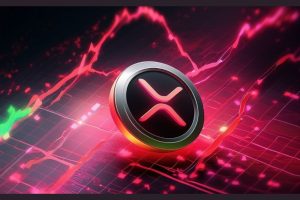
Ripple spent $750 million to buy back shares, but XRP continues to fall: Why are the company's strategies and the token's value "going their separate ways"?
Author: BiyaNews
A recent news item in the crypto industry has caused considerable concern among investors. Blockchain payment giant Ripple announced a massive $750 million stock buyback program, a move expected to boost its valuation to approximately $50 billion. This should have been a shot in the arm, but the market reaction has been quite mixed: on one hand, there's the company's confident display, while on the other hand, the price of its native token, XRP, continues to struggle at low levels, even breaking through key psychological and technical support levels.
This bizarre phenomenon of "company going left, token going right" inevitably raises the question: Is Ripple's "cash power" buyback a "pie in the sky" for shareholders, or "poison" for XRP holders? What deeper logic lies behind this in the crypto market?
The "open strategy" behind share buybacks: confidence, control, and market signals
When a company chooses to repurchase its own shares amidst widespread macroeconomic uncertainty and depressed market sentiment, it's far more than just a simple financial maneuver. It's first and foremost a "declaration of confidence" to shareholders and the market.
From a psychological perspective, share buybacks directly reduce the number of outstanding shares. With profits remaining constant, earnings per share (EPS) will increase accordingly, effectively increasing the "value" of existing shareholders' holdings. Especially given the current stress tests facing global tech stocks and the crypto market, this proactive "market support" can effectively stabilize the emotions of core investors and prevent panic selling. I recall that during the 2022 tech stock bear market, many cash-rich giants like Apple and Google used large-scale buybacks to convey long-term confidence, with immediate results.
On a deeper level, share buybacks are also a strategic move to strengthen control. By repurchasing shares from the open market or early investors, Ripple's management and founding team can further consolidate their control over the company, reduce interference from external shareholders, and pave the way for the execution of its long-term, and sometimes controversial, blockchain strategy. One analyst pointed out that this clearly demonstrates the company's strong confidence in its own growth, particularly its ability to expand blockchain application scenarios.
However, there's always another side to the coin. Where did the funds for this massive buyback come from? Despite Ripple's opaque financial situation as a private company, a disturbing speculation has begun to circulate in the market: Is the company continuously selling its massive XRP reserves to "fund" the buyback? This speculation is not unfounded; it directly hits the most sensitive nerve in the Ripple ecosystem.
XRP's "darkest hour": Technical collapse and loss of confidence
While Ripple was outlining its vision of a $50 billion valuation on its board, XRP traders were staring at a dismal chart. The token price was not only far below the highs of the last bull market, but had recently broken through the key support level of $1.80, briefly dipping below $1.50, forming a textbook bearish pattern.
This weakness has spread from the charts to the on-chain data. Observing on-chain activity reveals that signs of retail investors' "capitulation" are accumulating. A large number of addresses are holding positions in an "unrealized loss" state, especially after XRP experienced a deep correction of more than 16% in February. This continuous decline is most demoralizing, turning holders from "holding with faith" to "questioning their fate," with every rebound becoming an opportunity to reduce positions and escape.
Thus, the crucial question becomes unavoidable: if Ripple is indeed raising funds for buybacks by selling XRP, it's tantamount to continuously creating selling pressure in the open market. This creates a bizarre cycle: the company uses the money from selling tokens to boost the value of its own equity, while token holders bear the cost of price declines. The "seesaw effect" between company strategy and token value has never been clearer.
This divergence didn't happen overnight. Looking back over the past few years, Ripple has been very active in expanding its global business, from collaborating with central banks to explore central bank digital currencies (CBDCs) to expanding payment corridors in the Asia-Pacific and Europe—there has been no shortage of positive news at the company level. However, these positive "fundamentals" are like pebbles thrown into a deep pond, creating increasingly smaller ripples on the surface of XRP's price. The market seems to be learning to price "Ripple as a company" and "XRP tokens" as two separate assets.
The "company-token" paradox in the crypto market: What are we actually investing in?
The divergence between Ripple and XRP actually exposes a long-standing fundamental dilemma in the crypto world: when investing in a blockchain company with a native token, what exactly are we investing in? Is it the company's technology, team, and business contracts, or the token that runs on a decentralized network and whose price is determined by all traders on the network?
In traditional stock markets, company value and stock price are closely linked through equity ownership. Increased company profits and share buybacks lead to higher stock prices, directly benefiting shareholders. However, in Ripple's case, this chain of logic has "decoupled." XRP is legally defined as a non-securities (at least in current US cases), and it does not represent ownership or dividend rights in Ripple. Its value depends more on its utility within the RippleNet payment network, market liquidity, and purely speculative demand.
This creates an awkward situation: no matter how well Ripple performs, if market demand for XRP as a cross-border settlement medium falls short of expectations, or if a more efficient competitor emerges, the price of XRP can still weaken independently. Conversely, even if XRP surges due to market speculation, if Ripple cannot convert this into stable revenue and profit, its equity value may remain stagnant.
I recall that many protocol tokens experienced a similar phase during the DeFi Summer. Protocol usage exploded, but token prices lagged behind or even moved in the opposite direction, until more sophisticated token economic models emerged (such as linking protocol revenue to token buybacks and burns), partially resolving this discrepancy. For Ripple and XRP, establishing a more direct and transparent value transfer mechanism may be key to restoring market confidence.
The road ahead: a triple test of regulation, utility, and market patience.
Looking ahead, Ripple and XRP face multi-dimensional challenges.
First, the sword of Damocles of regulation has not been completely removed. Despite Ripple's key victories in its legal battle with the U.S. SEC, the global regulatory environment remains complex and volatile. Any new unfavorable rulings or tightening policies could simultaneously damage the company's business and token confidence.
Secondly, proof of real-world utility is urgently needed. XRP needs to demonstrate that it is not merely an "experimental product" of Ripple, but an indispensable, efficient, and low-cost component of the global payments system. This requires wider adoption by mainstream financial institutions and substantial, sustainable growth in cross-border payment volume. The recent attempts by some regional banks to use Ripple's technology for cross-border settlements are a positive sign, but the scale remains to be seen.
Finally, the market's patience is being tested. Crypto market cycles are becoming increasingly shorter, and investor attention is highly susceptible to shifts. If XRP fails to demonstrate price dynamism commensurate with Ripple's growth over the long term, funds and attention may flow to other public chains or payment tokens with stronger narratives and faster growth.
For investors, the current situation demands a clearer understanding. You must be clear: are you investing in Ripple, a technology company with strong business capabilities that may go public in the future, or XRP, a crypto asset with a specific purpose? These are two completely different investment logics and risk-reward characteristics.
Perhaps Ripple's buyback program will ultimately succeed in boosting its valuation and paving the way for a future IPO. XRP, too, may find its niche in a large market at some point due to its unique settlement efficiency, carving out its own independent trajectory. But until then, this drama of decoupling between "company" and "token" will continue to test the wisdom and composure of every market participant. The market is constantly changing; the only constant is the question we must relentlessly ask: where does the true source of value lie?
You May Also Like

Here’s How Consumers May Benefit From Lower Interest Rates

The Role of Blockchain in Building Safer Web3 Gaming Ecosystems
- Immutable Ownership of Assets Blockchain records can be manipulated by anyone. If a player owns a sword, skin, or plot of land as an NFT, it is verifiably in their ownership, and it cannot be altered or deleted by the developer or even hacked. This has created a proven track record of ownership, providing control back to the players, unlike any centralised gaming platform where assets can be revoked.
- Decentralized Infrastructure Blockchain networks also have a distributed architecture where game data is stored in a worldwide network of nodes, making them much less susceptible to centralised points of failure and attacks. This decentralised approach makes it exponentially more difficult to hijack systems or even shut off the game’s economy.
- Secure Transactions with Cryptography Whether a player buys an NFT or trades their in-game tokens for other items or tokens, the transactions are enforced by cryptographic algorithms, ensuring secure, verifiable, and irreversible transactions and eliminating the risks of double-spending or fraudulent trades.
- Smart Contract Automation Smart contracts automate the enforcement of game rules and players’ economic exchanges for the developer, eliminating the need for intermediaries or middlemen, and trust for the developer. For example, if a player completes a quest that promises a reward, the smart contract will execute and distribute what was promised.
- Anti-Cheating and Fair Gameplay The naturally transparent nature of blockchain makes it extremely simple for anyone to examine a specific instance of gameplay and verify the economic outcomes from that play. Furthermore, multi-player games that enforce smart contracts on things like loot sharing or win sharing can automate and measure trustlessness and avoid cheating, manipulations, and fraud by developers.
- Cross-Platform Security Many Web3 games feature asset interoperability across platforms. This interoperability is made viable by blockchain, which guarantees ownership is maintained whenever assets transition from one game or marketplace to another, thereby offering protection to players who rely on transfers for security against fraud. Key Security Dangers in Web3 Gaming Although blockchain provides sound first principles of security, the Web3 gaming ecosystem is susceptible to threats. Some of the most serious threats include: