Solana’s validator count has dropped over 70% from its 2023 peak as rising costs and fee competition squeeze smaller operators out of the network. The post SolanaSolana’s validator count has dropped over 70% from its 2023 peak as rising costs and fee competition squeeze smaller operators out of the network. The post Solana

Solana Validator Count Drops 70%, Fueling Decentralisation Concerns

  • Solana’s active validator count has plummeted 68%, dropping from over 2,500 in 2023 to roughly 795 in early 2026.
  • Smaller operators are being priced out by intense competition from zero-fee institutional validators and annual voting costs that now exceed $49,000.
  • Network decentralisation is weakening, as evidenced by the Nakamoto Coefficient falling from 31 to 20, signaling that control is concentrating among fewer large-scale entities.

Solana’s validator network is shrinking fast due to economic reasons.

According to data from Solana Compass, the number of active validators has fallen from about 2,560 in early 2023 to roughly 795 today, a 68% drop. Validators are the machines that vote on blocks and keep the chain running. Fewer validators means fewer independent actors securing the network.
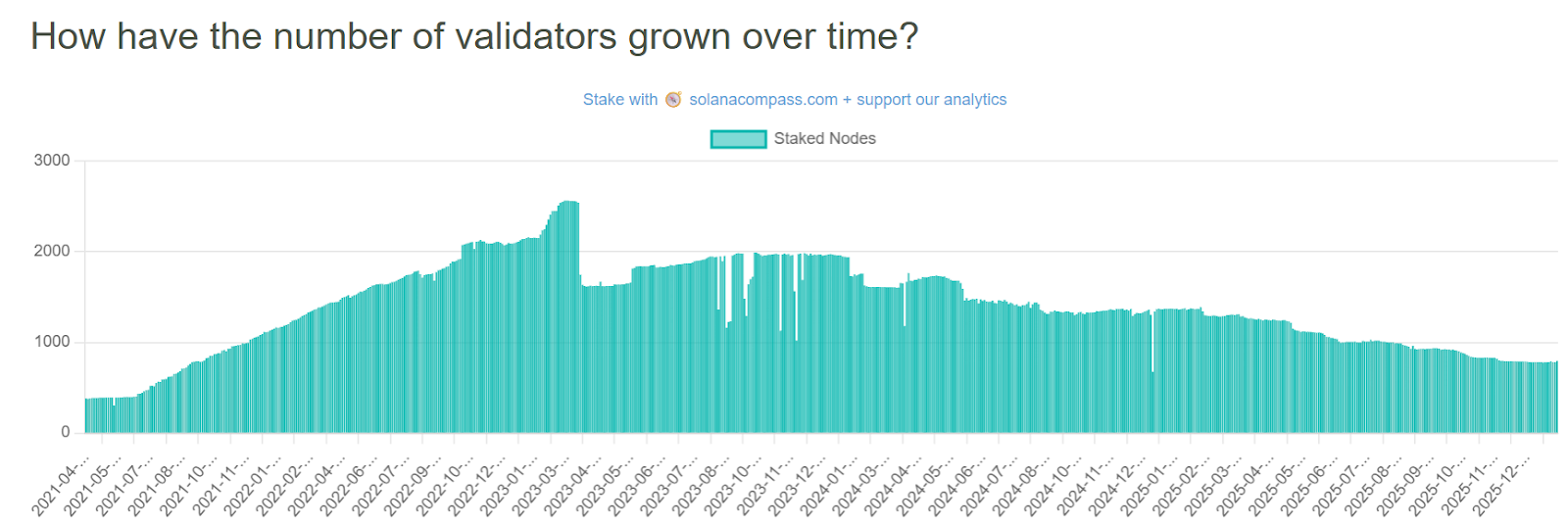
Source: Solana Compass

Some of this decline is harmless cleanup of inactive nodes. But operators say the real problem is that running a validator no longer pays for smaller players. 

Read more: Solana Mobile Launches SKR Token Airdrop for Seeker Smartphone Users

Low Fees Make Operations Less Viable

For instance, Moo, an independent Solana validator, said large validators now charge 0% fees to attract stake, leaving little revenue for independents. When rewards fall below costs, smaller validators shut down.

it is becoming increasingly impossible to operate a validator profitably (…) Many small validators are actively considering shutting down. Not due to lack of belief in Solana, but because the economics no longer work. At this point, the only justification left is altruism. Loving the network and caring about decentralization is not a sustainable business model.

Moo | Elemental – Solana Validator

That pressure also shows up clearly in decentralisation metrics, as the Solana Nakamoto Coefficient, or the minimum number of independent entities needed to control a critical share of the network, has dropped from 31 to 20. In simpler words, control over Solana’s stake is becoming more concentrated in fewer hands.

The cost structure goes something like this: 

  • A validator must stake SOL and continuously send vote transactions to participate in consensus. 
  • Voting alone can cost up to about 1.1 SOL per day. Over a year, that adds up to roughly 401 SOL just to stay online. 
  • At current prices, the first-year requirement excluding hardware and servers is around US$49,000 (AU$75,000). For many small operators, that math doesn’t work anymore.

This doesn’t mean Solana is failing or insecure today. Large validators are professional, well-capitalised, and technically capable, but it does mean decentralisation is drifting toward institutions and large staking providers rather than individuals.

Related: Analyst: Gold’s Surge Signals a Trust Crisis – and Crypto’s Moment

The post Solana Validator Count Drops 70%, Fueling Decentralisation Concerns appeared first on Crypto News Australia.

Disclaimer: The articles reposted on this site are sourced from public platforms and are provided for informational purposes only. They do not necessarily reflect the views of MEXC. All rights remain with the original authors. If you believe any content infringes on third-party rights, please contact service@support.mexc.com for removal. MEXC makes no guarantees regarding the accuracy, completeness, or timeliness of the content and is not responsible for any actions taken based on the information provided. The content does not constitute financial, legal, or other professional advice, nor should it be considered a recommendation or endorsement by MEXC.

You May Also Like

qLabs Fires First Shot in Quantum Crypto Race — Can Coinbase Catch Up?

qLabs Fires First Shot in Quantum Crypto Race — Can Coinbase Catch Up?

The rapid progress of quantum computing is forcing the cryptocurrency industry to confront the problem that has long been treated as theoretical. Blockchains th
Share
CryptoNews2026/01/30 22:53
The Anatomy of a Self-Made Billionaire’s Mindset: How Gurhan Kiziloz Reached a $1.7B Net Worth

The Anatomy of a Self-Made Billionaire’s Mindset: How Gurhan Kiziloz Reached a $1.7B Net Worth

There are many paths to wealth in the modern economy, but the one Gurhan Kiziloz took stands out for a simple reason: he built everything himself. By 2026, the
Share
Coinstats2026/01/30 23:07
Aave DAO to Shut Down 50% of L2s While Doubling Down on GHO

Aave DAO to Shut Down 50% of L2s While Doubling Down on GHO

The post Aave DAO to Shut Down 50% of L2s While Doubling Down on GHO appeared on BitcoinEthereumNews.com. Aave DAO is gearing up for a significant overhaul by shutting down over 50% of underperforming L2 instances. It is also restructuring its governance framework and deploying over $100 million to boost GHO. This could be a pivotal moment that propels Aave back to the forefront of on-chain lending or sparks unprecedented controversy within the DeFi community. Sponsored Sponsored ACI Proposes Shutting Down 50% of L2s The “State of the Union” report by the Aave Chan Initiative (ACI) paints a candid picture. After a turbulent period in the DeFi market and internal challenges, Aave (AAVE) now leads in key metrics: TVL, revenue, market share, and borrowing volume. Aave’s annual revenue of $130 million surpasses the combined cash reserves of its competitors. Tokenomics improvements and the AAVE token buyback program have also contributed to the ecosystem’s growth. Aave global metrics. Source: Aave However, the ACI’s report also highlights several pain points. First, regarding the Layer-2 (L2) strategy. While Aave’s L2 strategy was once a key driver of success, it is no longer fit for purpose. Over half of Aave’s instances on L2s and alt-L1s are not economically viable. Based on year-to-date data, over 86.6% of Aave’s revenue comes from the mainnet, indicating that everything else is a side quest. On this basis, ACI proposes closing underperforming networks. The DAO should invest in key networks with significant differentiators. Second, ACI is pushing for a complete overhaul of the “friendly fork” framework, as most have been unimpressive regarding TVL and revenue. In some cases, attackers have exploited them to Aave’s detriment, as seen with Spark. Sponsored Sponsored “The friendly fork model had a good intention but bad execution where the DAO was too friendly towards these forks, allowing the DAO only little upside,” the report states. Third, the instance model, once a smart…
Share
BitcoinEthereumNews2025/09/18 02:28