Illicit crypto activity across centralised exchanges has plunged to record lows in 2025, marking a pivotal moment for…Illicit crypto activity across centralised exchanges has plunged to record lows in 2025, marking a pivotal moment for…

Illicit crypto activity falls to a historic low in 2025 — the industry hails a new era of clean trading

Illicit crypto activity across centralised exchanges has plunged to record lows in 2025, marking a pivotal moment for an industry long shadowed by concerns over misuse. Independent data from Chainalysis and TRM Labs points to a sharp drop in exposure to wallets linked to scams, hacks and sanctioned entities.

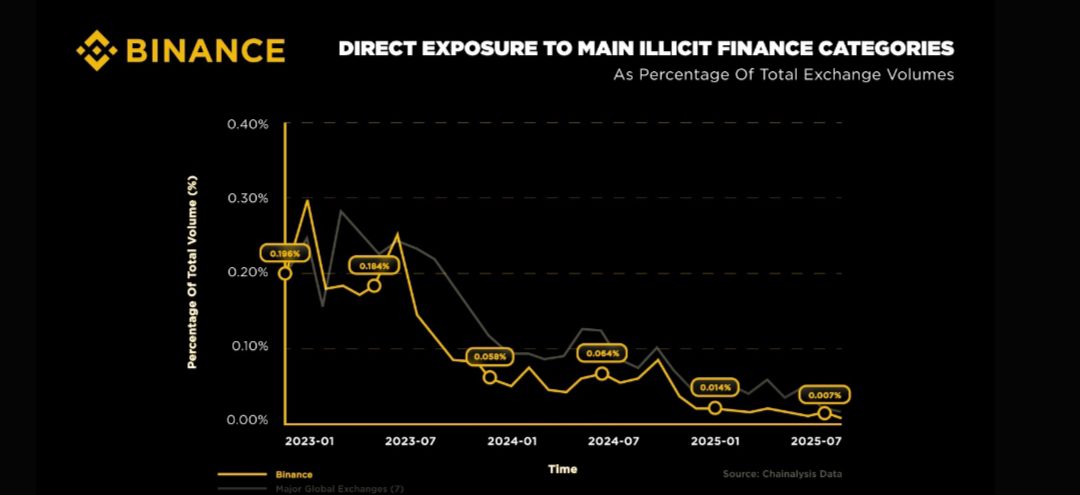
As of June 2025, the seven largest exchanges recorded just 0.018 to 0.023 per cent of total trading activity linked to illicit addresses. This represents a steep decline from levels recorded two years ago. Analysts describe it as evidence of stronger compliance standards and more intelligent transaction monitoring across the crypto ecosystem.

Among the top platforms, Binance stood out. Chainalysis found only 0.007 per cent of Binance’s June 2025 volume came from wallets tied to illicit activity, more than 2.5 times less than the industry average. TRM Labs’ independent analysis corroborates this, placing Binance’s “direct exposure” at 0.016 per cent, versus roughly 0.023 per cent for its peers.

As Binance processes daily volumes comparable to all its six largest competitors combined, maintaining these low ratios is especially significant.
Illicit crypto activity falls to a historic low in 2025 — the industry hails a new era of clean tradingIllicit crypto activity falls to a historic low in 2025

“Direct exposure” here refers to the share of an exchange’s volume that interacts with wallets verified to be involved in scams, hacks, sanctions-evading operations or other illicit activities. A lower figure suggests that suspicious transactions are being caught, blocked or reported before they can circulate broadly.

What the sharp decline in illicit crypto activities means for the ecosystem 

Industry-wide, this decline reflects more than just Binance’s progress. It points to broader changes, better compliance protocols, improved tracking technology, and greater coordination between exchanges, analytics firms and law enforcement.

Illicit crypto activity falls to a historic low in 2025 — the industry hails a new era of clean tradingIllicit crypto activity falls to a historic low in 2025

Between January 2023 and June 2025, Binance reportedly cut its illicit exposure by 96–98 per cent. Even as its daily trading volume soared (with 217 million trades daily and over $90 billion processed), it kept illicit flows at near-negligible levels.

According to the reports, achievements like this are underpinned by structured compliance programmes. Binance alone now employs over 1,280 staff in compliance, risk and investigations; that’s about 22 per cent of its workforce. The exchange also leverages AI-powered monitoring systems, responds to hundreds of thousands of law-enforcement requests, conducts investigator trainings, and participates in multi-exchange anti-money laundering networks such as the Beacon Network and the T3+ programme.

Also read: Stablecoins shed $6 billion in November, its largest monthly drop since 2022

Crucially, the data provides context against claims that crypto is a primary vehicle for financial crime. Research referenced by NASDAQ, the United Nations and the IMF suggests trillions are laundered annually through traditional banking systems in the form of anonymous fiat transfers, offshore accounts and shell companies. Compared to this, while traces of illicit activity still exist, the sheer scale of global crypto trading means illicit volume is now a tiny fraction of overall activity. 

Illicit crypto activity falls to a historic low in 2025 — the industry hails a new era of clean tradingIllicit crypto activity falls to a historic low in 2025

The near-universal drop in illicit exposure across major exchanges suggests the narrative around crypto as a haven for criminal finance is becoming outdated. Instead, exchanges are evolving into highly monitored, regulated hubs, and users benefit from safer, more transparent markets.

As the industry continues to grow, maintaining these gains is critical. That means continued investment in compliance tools, cooperation with regulators and law-enforcement agencies, and transparent reporting. The 2025 data shows that with diligence and technology, crypto can scale without sacrificing integrity.

Market Opportunity
ERA Logo
ERA Price(ERA)
$0.2207
$0.2207$0.2207
+2.65%
USD
ERA (ERA) Live Price Chart
Disclaimer: The articles reposted on this site are sourced from public platforms and are provided for informational purposes only. They do not necessarily reflect the views of MEXC. All rights remain with the original authors. If you believe any content infringes on third-party rights, please contact service@support.mexc.com for removal. MEXC makes no guarantees regarding the accuracy, completeness, or timeliness of the content and is not responsible for any actions taken based on the information provided. The content does not constitute financial, legal, or other professional advice, nor should it be considered a recommendation or endorsement by MEXC.

You May Also Like

FCA komt in 2026 met aangepaste cryptoregels voor Britse markt

FCA komt in 2026 met aangepaste cryptoregels voor Britse markt

De Britse financiële waakhond, de FCA, komt in 2026 met nieuwe regels speciaal voor crypto bedrijven. Wat direct opvalt: de toezichthouder laat enkele klassieke financiële verplichtingen los om beter aan te sluiten op de snelle en grillige wereld van digitale activa. Tegelijkertijd wordt er extra nadruk gelegd op digitale beveiliging,... Het bericht FCA komt in 2026 met aangepaste cryptoregels voor Britse markt verscheen het eerst op Blockchain Stories.
Share
Coinstats2025/09/18 00:33
Crypto Market Cap Edges Up 2% as Bitcoin Approaches $118K After Fed Rate Trim

Crypto Market Cap Edges Up 2% as Bitcoin Approaches $118K After Fed Rate Trim

The global crypto market cap rose 2% to $4.2 trillion on Thursday, lifted by Bitcoin’s steady climb toward $118,000 after the Fed delivered its first interest rate cut of the year. Gains were measured, however, as investors weighed the central bank’s cautious tone on future policy moves. Bitcoin last traded 1% higher at $117,426. Ether rose 2.8% to $4,609. XRP also gained, rising 2.9% to $3.10. Fed Chair Jerome Powell described Wednesday’s quarter-point reduction as a risk-management step, stressing that policymakers were in no hurry to speed up the easing cycle. His comments dampened expectations of more aggressive cuts, limiting enthusiasm across risk assets. Traders Anticipated Fed Rate Trim, Leaving Little Room for Surprise Rally The Federal Open Market Committee voted 11-to-1 to lower the benchmark lending rate to a range of 4.00% to 4.25%. The sole dissent came from newly appointed governor Stephen Miran, who pushed for a half-point cut. Traders were largely prepared for the move. Futures markets tracked by the CME FedWatch tool had assigned a 96% probability to a 25 basis point cut, making the decision widely anticipated. That advance positioning meant much of the potential boost was already priced in, creating what analysts described as a “buy the rumour, sell the news” environment. Fed Rate Decision Creates Conditions for Crypto, But Traders Still Hold Back Andrew Forson, president of DeFi Technologies, said lower borrowing costs would eventually steer more money toward digital assets. “A lower cost of capital indicates more capital flows into the digital assets space because the risk hurdle rate for money is lower,” he noted. He added that staking products and blockchain projects could become attractive alternatives to traditional bonds, offering both yield and appreciation. Despite the cut, crypto markets remained calm. Open interest in Bitcoin futures held steady and no major liquidation cascades followed the Fed’s decision. Analysts pointed to Powell’s language and upcoming economic data as the key factors for traders before building larger positions. Powell’s Caution Tempers Immediate Impact of Fed Rate Move on Crypto Markets History also suggests crypto rallies after rate cuts often take time. When the Fed eased in Dec. 2024, Bitcoin briefly surged 5% cent before consolidating, with sustained gains arriving only weeks later. This time, market watchers are bracing for a similar pattern. Powell’s insistence on caution, combined with uncertainty around inflation and growth, has kept short-term volatility muted even as sentiment for risk assets improves. BitMine’s Tom Lee this week predicted that Bitcoin and Ether could deliver “monster gains” in the next three months if the Fed continues on an easing path. His view echoes broader expectations that liquidity-sensitive assets will outperform once the cycle gathers pace. For now, the crypto sector has digested the Fed’s move with restraint. Traders remain focused on signals from the central bank’s October meeting to determine whether Wednesday’s step marks the beginning of a broader policy shift or just a one-off adjustment
Share
CryptoNews2025/09/18 13:14
US Senate Releases Draft Crypto Bill Establishing Clear Regulatory Framework for Digital Assets

US Senate Releases Draft Crypto Bill Establishing Clear Regulatory Framework for Digital Assets

TLDR: Bill resolves SEC-CFTC conflict by assigning clear regulatory authority over securities and commodities respectively. Ancillary assets category exempts network
Share
Blockonomi2026/01/14 04:57