Irys, a layer-1 blockchain listed on major exchanges including Coinbase, is under scrutiny after a single entity captured roughly 20% of its airdrop allocation. On November 28, blockchain analytics firm Bubblemaps said it identified about 900 wallets involved in the process. IRYS Slides After 900 Linked Wallets Take $4 Million in Airdrop Tokens According to the firm, these addresses showed no prior on-chain activity. It described the pattern as consistent with coordinated preparation rather than organic network participation. Following the distribution, the cluster network began consolidating the assets. Data shows that roughly 500 of the identified wallets transferred their IRYS allocations to intermediary addresses before routing the funds to Bitget, a centralized exchange. IRYS Token Address Clusters. Source: BubbleMaps The flow of tokens, valued at approximately $4 million, indicates a likely preparation to liquidate the position. Such a move could introduce significant sell-side pressure on the asset’s order book. IRYS price has come under pressure following the disclosures. The token has declined 16% over the past 24 hours and is trading near $0.032 as of press time. Bubblemaps noted that it found no on-chain evidence linking the IRYS team to the wallet cluster. Irys markets itself as an “on-chain AWS” designed for data storage and smart-contract execution. The protocol has raised more than $13 million from venture capital investors and listed its token this week on major exchanges, including Binance and Coinbase. Crypto Needs Stronger Sybil Protection The episode highlights a structural challenge facing crypto projects that rely on airdrops to expand ownership. Indeed, Irys allocated 8% of its total supply to the event. The goal was to distribute tokens to early users and help decentralize the network. Instead, the concentration of tokens in a single cluster shows how airdrops remain vulnerable to actors using large batches of script-generated wallets to capture outsized allocations. When one entity controls 20% of the initial circulating float, market observers say the result is heightened centralization risk and distorted price discovery. Meanwhile, incidents like this point to broader limitations in token distribution practices across permissionless ecosystems. These environments have minimal identity checks and unrestricted network access. This IRYS episode shows how difficult it is to prevent coordinated airdrop capture without stronger filtering, better identity heuristics, or more robust pre-distribution reviews. Without those safeguards, early liquidity events can disproportionately benefit short-term actors. That dynamic can weaken outcomes for long-term holders and overall network stability.Irys, a layer-1 blockchain listed on major exchanges including Coinbase, is under scrutiny after a single entity captured roughly 20% of its airdrop allocation. On November 28, blockchain analytics firm Bubblemaps said it identified about 900 wallets involved in the process. IRYS Slides After 900 Linked Wallets Take $4 Million in Airdrop Tokens According to the firm, these addresses showed no prior on-chain activity. It described the pattern as consistent with coordinated preparation rather than organic network participation. Following the distribution, the cluster network began consolidating the assets. Data shows that roughly 500 of the identified wallets transferred their IRYS allocations to intermediary addresses before routing the funds to Bitget, a centralized exchange. IRYS Token Address Clusters. Source: BubbleMaps The flow of tokens, valued at approximately $4 million, indicates a likely preparation to liquidate the position. Such a move could introduce significant sell-side pressure on the asset’s order book. IRYS price has come under pressure following the disclosures. The token has declined 16% over the past 24 hours and is trading near $0.032 as of press time. Bubblemaps noted that it found no on-chain evidence linking the IRYS team to the wallet cluster. Irys markets itself as an “on-chain AWS” designed for data storage and smart-contract execution. The protocol has raised more than $13 million from venture capital investors and listed its token this week on major exchanges, including Binance and Coinbase. Crypto Needs Stronger Sybil Protection The episode highlights a structural challenge facing crypto projects that rely on airdrops to expand ownership. Indeed, Irys allocated 8% of its total supply to the event. The goal was to distribute tokens to early users and help decentralize the network. Instead, the concentration of tokens in a single cluster shows how airdrops remain vulnerable to actors using large batches of script-generated wallets to capture outsized allocations. When one entity controls 20% of the initial circulating float, market observers say the result is heightened centralization risk and distorted price discovery. Meanwhile, incidents like this point to broader limitations in token distribution practices across permissionless ecosystems. These environments have minimal identity checks and unrestricted network access. This IRYS episode shows how difficult it is to prevent coordinated airdrop capture without stronger filtering, better identity heuristics, or more robust pre-distribution reviews. Without those safeguards, early liquidity events can disproportionately benefit short-term actors. That dynamic can weaken outcomes for long-term holders and overall network stability.

Irys Airdrop Draws Concern After One Entity Captures 20% of Supply

Irys, a layer-1 blockchain listed on major exchanges including Coinbase, is under scrutiny after a single entity captured roughly 20% of its airdrop allocation.

On November 28, blockchain analytics firm Bubblemaps said it identified about 900 wallets involved in the process.

IRYS Slides After 900 Linked Wallets Take $4 Million in Airdrop Tokens

According to the firm, these addresses showed no prior on-chain activity. It described the pattern as consistent with coordinated preparation rather than organic network participation.

Following the distribution, the cluster network began consolidating the assets.

Data shows that roughly 500 of the identified wallets transferred their IRYS allocations to intermediary addresses before routing the funds to Bitget, a centralized exchange.
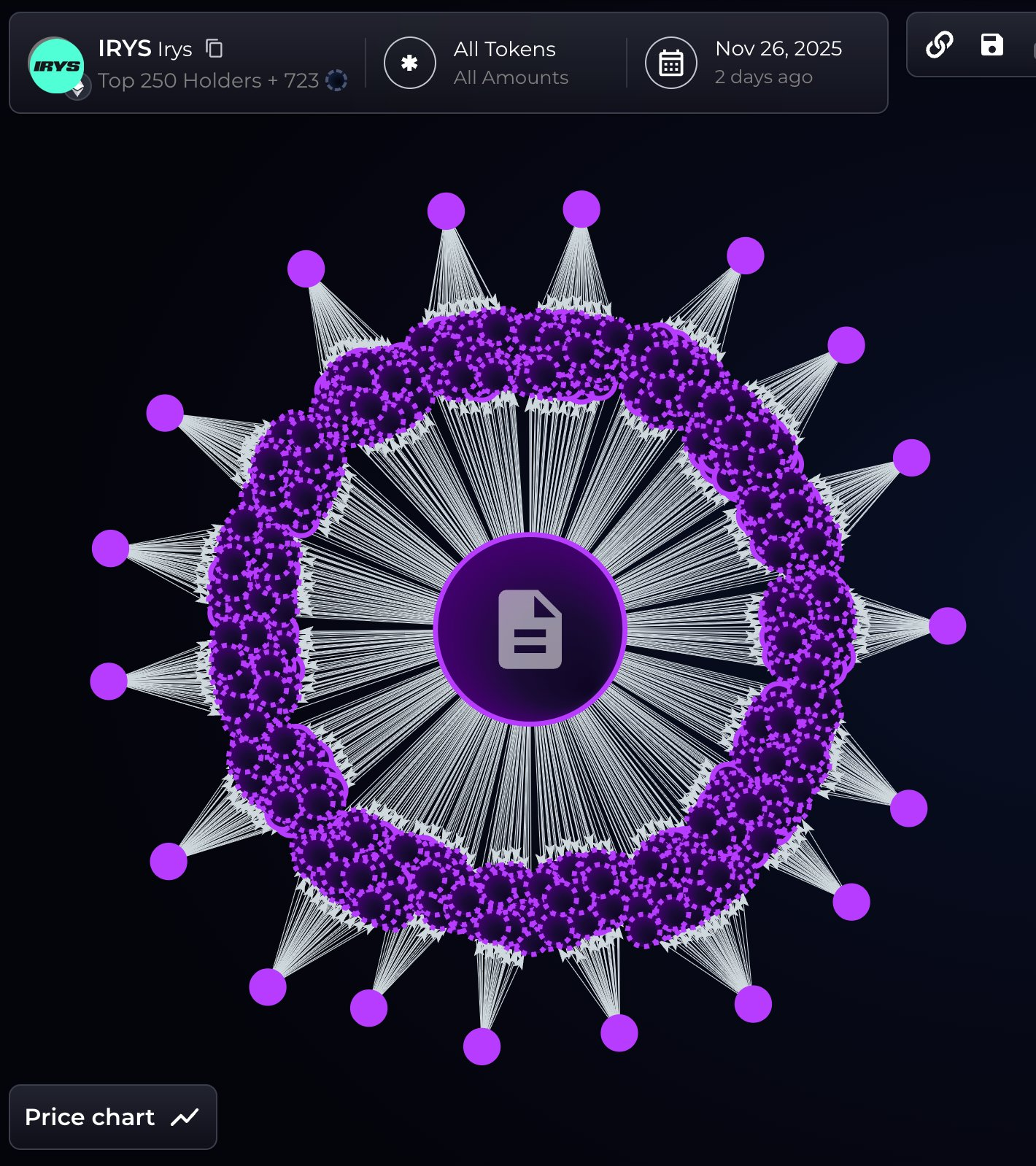
IRYS Token Address Clusters. Source: BubbleMaps

The flow of tokens, valued at approximately $4 million, indicates a likely preparation to liquidate the position. Such a move could introduce significant sell-side pressure on the asset’s order book.

IRYS price has come under pressure following the disclosures. The token has declined 16% over the past 24 hours and is trading near $0.032 as of press time.

Bubblemaps noted that it found no on-chain evidence linking the IRYS team to the wallet cluster.

Irys markets itself as an “on-chain AWS” designed for data storage and smart-contract execution.

The protocol has raised more than $13 million from venture capital investors and listed its token this week on major exchanges, including Binance and Coinbase.

Crypto Needs Stronger Sybil Protection

The episode highlights a structural challenge facing crypto projects that rely on airdrops to expand ownership.

Indeed, Irys allocated 8% of its total supply to the event. The goal was to distribute tokens to early users and help decentralize the network.

Instead, the concentration of tokens in a single cluster shows how airdrops remain vulnerable to actors using large batches of script-generated wallets to capture outsized allocations.

When one entity controls 20% of the initial circulating float, market observers say the result is heightened centralization risk and distorted price discovery.

Meanwhile, incidents like this point to broader limitations in token distribution practices across permissionless ecosystems. These environments have minimal identity checks and unrestricted network access.

This IRYS episode shows how difficult it is to prevent coordinated airdrop capture without stronger filtering, better identity heuristics, or more robust pre-distribution reviews.

Without those safeguards, early liquidity events can disproportionately benefit short-term actors. That dynamic can weaken outcomes for long-term holders and overall network stability.

Market Opportunity
Irys Logo
Irys Price(IRYS)
$0.04952
$0.04952$0.04952
-6.30%
USD
Irys (IRYS) Live Price Chart
Disclaimer: The articles reposted on this site are sourced from public platforms and are provided for informational purposes only. They do not necessarily reflect the views of MEXC. All rights remain with the original authors. If you believe any content infringes on third-party rights, please contact service@support.mexc.com for removal. MEXC makes no guarantees regarding the accuracy, completeness, or timeliness of the content and is not responsible for any actions taken based on the information provided. The content does not constitute financial, legal, or other professional advice, nor should it be considered a recommendation or endorsement by MEXC.

You May Also Like

Is Putnam Global Technology A (PGTAX) a strong mutual fund pick right now?

Is Putnam Global Technology A (PGTAX) a strong mutual fund pick right now?

The post Is Putnam Global Technology A (PGTAX) a strong mutual fund pick right now? appeared on BitcoinEthereumNews.com. On the lookout for a Sector – Tech fund? Starting with Putnam Global Technology A (PGTAX – Free Report) should not be a possibility at this time. PGTAX possesses a Zacks Mutual Fund Rank of 4 (Sell), which is based on various forecasting factors like size, cost, and past performance. Objective We note that PGTAX is a Sector – Tech option, and this area is loaded with many options. Found in a wide number of industries such as semiconductors, software, internet, and networking, tech companies are everywhere. Thus, Sector – Tech mutual funds that invest in technology let investors own a stake in a notoriously volatile sector, but with a much more diversified approach. History of fund/manager Putnam Funds is based in Canton, MA, and is the manager of PGTAX. The Putnam Global Technology A made its debut in January of 2009 and PGTAX has managed to accumulate roughly $650.01 million in assets, as of the most recently available information. The fund is currently managed by Di Yao who has been in charge of the fund since December of 2012. Performance Obviously, what investors are looking for in these funds is strong performance relative to their peers. PGTAX has a 5-year annualized total return of 14.46%, and is in the middle third among its category peers. But if you are looking for a shorter time frame, it is also worth looking at its 3-year annualized total return of 27.02%, which places it in the middle third during this time-frame. It is important to note that the product’s returns may not reflect all its expenses. Any fees not reflected would lower the returns. Total returns do not reflect the fund’s [%] sale charge. If sales charges were included, total returns would have been lower. When looking at a fund’s performance, it…
Share
BitcoinEthereumNews2025/09/18 04:05
The whale "pension-usdt.eth" has reduced its ETH long positions by 10,000 coins, and its futures account has made a profit of $4.18 million in the past day.

The whale "pension-usdt.eth" has reduced its ETH long positions by 10,000 coins, and its futures account has made a profit of $4.18 million in the past day.

PANews reported on January 14th that, according to Hyperbot data monitoring, the whale "pension-usdt.eth" reduced its ETH long positions by 10,000 ETH in the past
Share
PANews2026/01/14 13:45
Senator Warren Tells OCC to Stop World Liberty Bank Review Amid Trump Ties

Senator Warren Tells OCC to Stop World Liberty Bank Review Amid Trump Ties

The post Senator Warren Tells OCC to Stop World Liberty Bank Review Amid Trump Ties appeared on BitcoinEthereumNews.com. U.S. Senator Elizabeth Warren has called
Share
BitcoinEthereumNews2026/01/14 12:55