

What Happens When Money, Credit, And Assets Move On-chain?
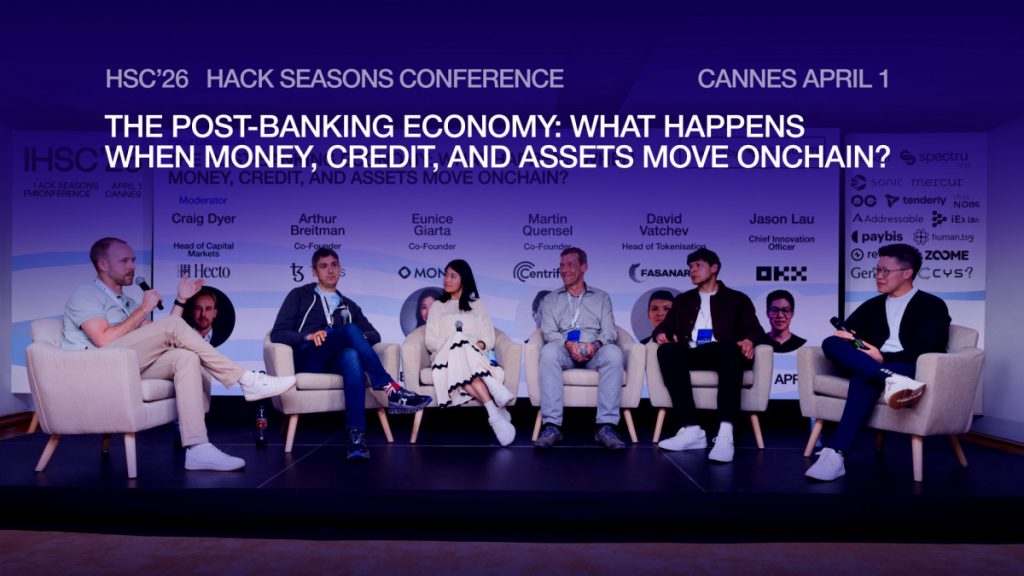
If finance keeps moving on-chain, the biggest change may not be that banks suddenly disappear. It may be that many of the functions people associate with banks, lending, settlement, collateral management, asset access, and payments begin running on a very different set of rails.
That was the central theme of a panel at HSC Cannes on the so-called postbanking economy, where speakers from Tezos, Monad, Centrifuge, Fasanara Capital, OKX, and Hecto discussed what happens when money, credit, and assets migrate from traditional systems into blockchain-based markets.
The dialogue did not lapse into the comforting platitudes of overthrowing banks in a one-night operation. Rather, it remained pegged to a more difficult question, namely, what aspects of finance actually become better as assets are taken on-chain, and what remains to be fixed before that transition can be significant at scale?
Trust still matters, even in a trust-minimized system
Trust was one of the initial problems that the panel addressed. Crypto frequently defines itself as a replacement of the blind trust with mathematical proof, yet Arthur Breitman, the co-founder of Tezos, claimed that this is only as far as it goes in practice.
For ordinary people, trust is still shaped less by cryptographic theory and more by lived experience. Most consumers in developed markets trust their banks because, most of the time, those banks appear to work. But Breitman pointed out that this trust has limits. Accounts can be frozen, capital controls can be imposed, and, in many countries, governments can use the banking system itself as a pressure point. In those moments, the weakness of the traditional model becomes more visible.
Still, blockchain systems are not automatically trusted just because they are open or mathematically auditable. Breitman said what really convinces people is the track record. And the industry still has work to do there. When outsiders look at major bridge hacks, smart contract exploits, and high-profile collapses like Terra, they do not see a mature financial system. They see instability. In that sense, better security standards and better code practices remain fundamental if crypto wants to earn broader trust.
Martin Quensel of Centrifuge added an important nuance. Rather than saying blockchain eliminates trust, he argued it is more accurate to describe it as a process of trust minimization. The system itself may become more verifiable, but the quality of the underlying asset still matters. Bad collateral does not become good collateral because it sits on-chain. A tokenized property, for example, still depends on the real-world legal and physical reality behind it.
Liquidity does not magically appear because an asset is tokenized
The discussion then turned to liquidity, one of the most common promises made around tokenization. In theory, putting assets on-chain should make them easier to trade, easier to borrow against, and easier to move globally. In practice, the panel was united on one point: tokenization does not create liquidity by itself.
Eunice Giarta of Monad said liquidity is only one part of the value proposition. Accessibility and smoother settlement may matter just as much. She used real estate as a clear example. Even if tokenizing a property does not suddenly make it deeply liquid, it could still make settlement far more efficient, reducing some of the paperwork, delays, and friction that define traditional property transfers today.
Quensel made the same point in more structural terms. The market still lacks the deep, secondary-market infrastructure needed to make many tokenized assets feel genuinely liquid. Right now, much of the capital coming into tokenized real-world assets is not entirely new money entering crypto. It often exists on-chain capital reallocating into safer or more diversified products. For tokenization to reach another level, those assets need secondary markets where buyers and sellers can meet without always going back to the issuer.
David Vatchev of Fasanara Capital was even more direct. Turning an asset into a token does not add liquidity to the underlying. A condo is still a condo. A short-duration receivable is still a short-duration receivable. The real work lies in matching token design to the characteristics of the asset beneath it. If the asset self-liquidates quickly and naturally, it is easier to fit into DeFi-style markets. If it is long-duration or hard to price, the mismatch becomes much harder to manage.
Accessibility may be the real breakthrough
For all the caution around trust and liquidity, the panel also highlighted where on-chain finance is already proving useful. The clearest theme was accessibility.
Quensel argued that many of the strongest use cases today come from giving users access to financial products they otherwise would not have. That may mean dollar-based stablecoins in countries with weak currencies, better yield opportunities than local bank deposits, or direct exposure to assets like gold or US Treasuries without layers of intermediaries in between.
Vatchev said the growth of tokenized treasuries illustrates this clearly. DeFi capital, facing compressed yields, wanted access to real-world interest rates but had no easy route to them. On-chain real-world assets helped solve that problem. Jason Lau of OKX added that more basic consumer products may matter just as much in the long run. Stablecoin savings, easy conversion from local currency, cards linked to on-chain balances, and simplified access to DeFi yields may not sound revolutionary in crypto circles, but they are the kinds of financial products that help users slowly get comfortable living on-chain.
Breitman gave another version of the accessibility argument by pointing to uranium, an asset Tezos has helped tokenize through Uranium.io. Before that, most investors had little practical access to the asset unless they were able to trade in large institutional sizes. Tokenization did not solve every market problem, but it lowered the barrier to entry and made the asset more reachable.
The future may not look “postbanking” so much as rewired banking
Despite the panel title, the discussion did not really point toward a future with no banks. If anything, it suggested a future where many banking functions are rebuilt on blockchain infrastructure, while users still choose how much control they want to keep for themselves.
Lau said the industry needs to preserve that choice. Some people will always want full self-custody. Others will prefer regulated intermediaries, customer support, and a familiar interface. Both approaches can coexist on-chain. The important shift is not that everyone becomes their own bank, but that the rails under financial services become more open, more composable, and more global.
That may matter even more in an agent-driven future. Quensel and others suggested that AI agents and autonomous software may become an underestimated driver of on-chain adoption. If software agents are handling transactions, micropayments, and economic activity on their own, blockchain rails may be better suited than traditional banking systems to support that kind of machine-to-machine finance at scale.
Breitman offered one final caution, though. If that world arrives, the benefits for blockchains themselves may not look like what the market expects today. In an agentic economy, software will not care about branding or community narratives. It will route activity to whatever is cheapest, fastest, and most reliable. That could drive much higher volume, but it could also compress the premium many blockchain ecosystems currently enjoy.
Finance may move on-chain without users even noticing
By the end of the session, the panel seemed to converge around a simple idea. In the long run, the distinction between on-chain and off-chain finance may matter less to users than it does today.
The likely future is not one where everyone suddenly talks about blockchain all the time. It is one where parts of financial life quietly become faster, more programmable, and more accessible because blockchain is running underneath them. Some users will choose the full self-custodial route. Others will still interact through platforms, exchanges, and regulated providers. But the rails themselves may gradually become harder to separate from finance as a whole.
At HSC Cannes, that was the most convincing takeaway. The postbanking economy may not arrive as a dramatic break from the past. It may arrive as a slow rewiring of money, credit, and assets, one use case at a time.
The post What Happens When Money, Credit, And Assets Move On-chain? appeared first on Metaverse Post.


추천 콘텐츠

Onchain Real World Assets Reach 468 Billion Showing Growing Institutional Use

DOGE Price Prediction: Dogecoin Eyes $0.10 Breakout Amid Neutral Technical Setup




