Fireblocks expands institutional crypto infrastructure to 150 public blockchains, adding Sui, Canton, HyperEVM and 43 other networks throughout 2025. (Read MoreFireblocks expands institutional crypto infrastructure to 150 public blockchains, adding Sui, Canton, HyperEVM and 43 other networks throughout 2025. (Read More

Fireblocks Hits 150 Blockchain Integrations After Adding 46 Networks in 2025

2026/02/04 02:04
3분 읽기

Fireblocks Hits 150 Blockchain Integrations After Adding 46 Networks in 2025

Zach Anderson Feb 03, 2026 18:04

Fireblocks expands institutional crypto infrastructure to 150 public blockchains, adding Sui, Canton, HyperEVM and 43 other networks throughout 2025.

Fireblocks Hits 150 Blockchain Integrations After Adding 46 Networks in 2025

Digital asset infrastructure provider Fireblocks now supports 150 public blockchains after integrating 46 new networks throughout 2025, positioning the $8 billion company as the broadest institutional gateway to the multi-chain ecosystem.

The expansion addresses a straightforward problem facing institutional players: the blockchain universe keeps fragmenting, and nobody wants to rebuild custody infrastructure every time a promising new chain emerges. Fireblocks' pitch is integrate once, access everything.

What Actually Got Added

The 2025 additions include several strategically significant networks. Canton brings privacy-focused infrastructure specifically designed for regulated financial institutions handling tokenized assets. Sui offers parallel transaction execution that's attracted DeFi builders seeking lower latency. HyperEVM opens direct access to Hyperliquid, currently the most active perpetual DEX—a clear play for trading desks and market makers running derivatives strategies.

Circle's Arc Testnet made the list too, notable because it lets users pay transaction fees directly in USDC rather than native tokens. That's a meaningful friction reducer for payments-focused institutions.

The remaining additions span a wide range: Berachain, Sonic, Unichain, Flow EVM, Monad, and dozens of others targeting everything from gaming to real-world asset tokenization. Some will matter, many won't—but institutional clients don't want to guess which is which before they have access.

Infrastructure Upgrades Behind the Numbers

Supporting 150 chains isn't just a checkbox exercise. Fireblocks reports it rebuilt underlying infrastructure with multi-node architecture, automated failover mechanisms, and self-recovery systems to maintain transaction throughput as network count grows. The company claims reduced end-to-end latency, though specific benchmarks weren't disclosed.

For context, Fireblocks was founded in 2018 after its founders investigated a major Bitcoin theft, which shaped its MPC-based security approach. The company raised $550 million at an $8 billion valuation in January 2022 and has brought in roughly $1.04 billion total. Its client list includes BNY Mellon, Revolut, and Worldpay—names that suggest the institutional adoption thesis is actually playing out.

Why This Matters for Trading Operations

Multi-chain coverage creates optionality. When a new Layer 1 gains traction or a specific chain becomes relevant for a particular asset class, institutions with broad infrastructure access can move faster than those rebuilding from scratch.

The September 2025 launch of Fireblocks' Global Stablecoin Payments Network—covering 100+ countries and 60 currencies—suggests the company sees cross-border settlement as the next battleground, not just custody.

Whether 150 blockchains represents meaningful coverage or checkbox inflation depends on how many of those chains actually see institutional capital flow. But for trading desks evaluating infrastructure partners, breadth increasingly functions as table stakes.

Image source: Shutterstock
  • fireblocks
  • institutional crypto
  • blockchain infrastructure
  • multi-chain
  • digital asset custody
면책 조항: 본 사이트에 재게시된 글들은 공개 플랫폼에서 가져온 것으로 정보 제공 목적으로만 제공됩니다. 이는 반드시 MEXC의 견해를 반영하는 것은 아닙니다. 모든 권리는 원저자에게 있습니다. 제3자의 권리를 침해하는 콘텐츠가 있다고 판단될 경우, service@support.mexc.com으로 연락하여 삭제 요청을 해주시기 바랍니다. MEXC는 콘텐츠의 정확성, 완전성 또는 시의적절성에 대해 어떠한 보증도 하지 않으며, 제공된 정보에 기반하여 취해진 어떠한 조치에 대해서도 책임을 지지 않습니다. 본 콘텐츠는 금융, 법률 또는 기타 전문적인 조언을 구성하지 않으며, MEXC의 추천이나 보증으로 간주되어서는 안 됩니다.

추천 콘텐츠

Young Republicans were more proud to be American under Obama than under Trump: data analyst

Young Republicans were more proud to be American under Obama than under Trump: data analyst

CNN data analyst Harry Enten sorts through revealing polls and surveys of American attitudes, looking for shifts, and his latest finding is an indictment of President
공유하기
Alternet2026/02/10 22:18
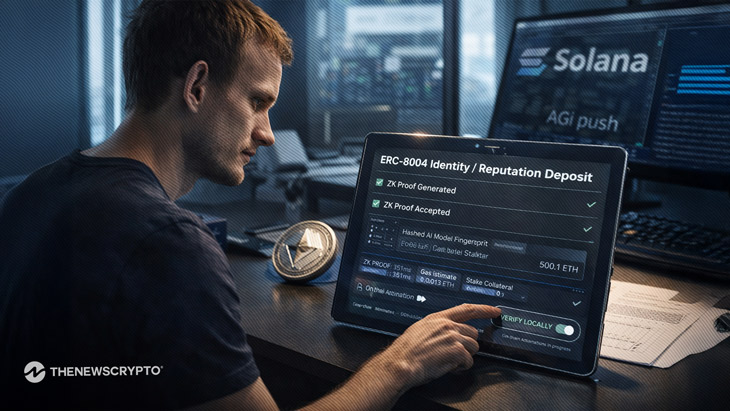
Vitalik Buterin Outlines Ethereum’s AI Framework, Pushes Back Against Solana’s Acceleration Thesis

Vitalik Buterin Outlines Ethereum’s AI Framework, Pushes Back Against Solana’s Acceleration Thesis

Ethereum co-founder Vitalik Buterin has reacted to Solana’s artificial general intelligence acceleration initiative. He did this through the establishment of his
공유하기
Thenewscrypto2026/02/10 18:40
XRP News Today: XRP Tundra Unveils Two-Token Strategy with 25x Return Potential

XRP News Today: XRP Tundra Unveils Two-Token Strategy with 25x Return Potential

The post XRP News Today: XRP Tundra Unveils Two-Token Strategy with 25x Return Potential appeared on BitcoinEthereumNews.com. XRP remains one of the most closely watched assets in the market, both for its role in cross-border settlement and for its potential within the broader digital asset ecosystem. Yet for long-term holders, one gap has persisted: XRP has never had a native staking system. That limitation has left investors with limited options beyond price appreciation, even as competitors like Ethereum and Solana built extensive staking networks. XRP Tundra’s presale is making news for directly addressing that issue. The project has introduced a two-token strategy designed to provide yield opportunities for XRP holders while embedding exponential upside into presale economics. Analysts covering XRP updates have flagged the model as one of the more innovative token launches of 2025, particularly as it blends utility with transparent launch pricing. A Dual-Token Presale With Defined Launch Values At the center of XRP Tundra’s design is a dual-token model. TUNDRA-S, issued on Solana, functions as the utility and yield-generating token. TUNDRA-X, minted on the XRP Ledger, serves as the governance and reserve layer. Every presale purchase of TUNDRA-S automatically delivers free TUNDRA-X, tying investors into both blockchains in a single allocation. In the current Phase 3, TUNDRA-S is priced at $0.041 with a 17% token bonus included. Free TUNDRA-X is valued for reference at $0.0205. Launch values are already fixed at $2.50 for TUNDRA-S and $1.25 for TUNDRA-X, embedding a built-in 25x return potential for presale participants. For investors who have waited years for XRP-related innovation, this clarity has stood out. Staking Introduces Yield for XRP Holders The presale is not only about token distribution. XRP Tundra introduces staking through Cryo Vaults, where XRP can be locked for periods of 7 to 90 days. Rewards increase with longer commitments, while Frost Keys — NFT multipliers — allow participants to enhance yields or shorten lockups.…
공유하기
BitcoinEthereumNews2025/09/26 05:31