The Next Wave: Airtel Africa’s triple play
Cet article est aussi disponible en français
First published 22 Feb, 2026
Airtel Africa’s triple play
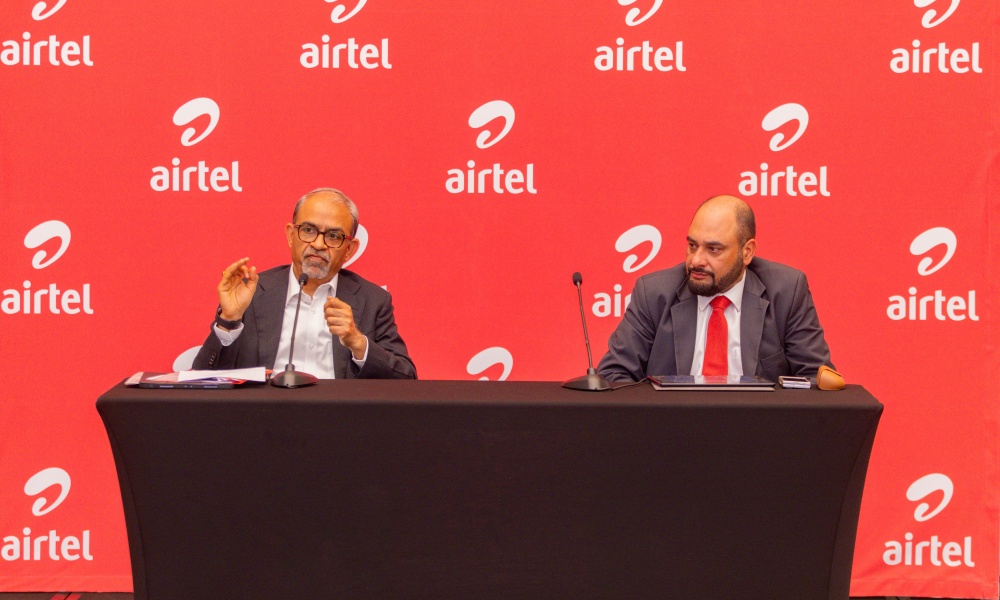
Image: TechCabal
If you are a regular reader of financial publications, you know that the traditional telco business model is currently undergoing a midlife crisis. In the West, telcos are essentially utility companies with too much debt and too little growth, desperately trying to convince investors that they are tech companies because they once installed tech products (e.g., routers).
In Africa, the story is different. A telco is a utility, a bank, the internet, and lately, a sovereign infrastructure.
This week, Airtel Africa Group CEO Sunil Taldar and his Kenyan counterpart Ashish Malhotra held a roundtable in Nairobi. If you look at the flurry of announcements, including the Starlink partnership, the mobile money IPO, and the flirtation with crypto, you can see the blueprint of a company trying to escape the telco trap.
Here is what is actually going on.
The Starlink gambit
The most headline-grabbing news is the deal with SpaceX. Airtel is moving toward a direct-to-cell model using the Starlink satellite constellation.
In the old world of telecom, if you wanted to cover a remote village in an underserved area, you had to build a tower. Building a tower in a remote area is a nightmare because you need a road to get the equipment there, a generator to power it, a security guard to make sure the generator isn’t stolen, and a massive amount of capital expenditure that might take decades to break even.
Airtel is essentially outsourcing the most expensive, least efficient part of its business: the last mile in the middle of nowhere, by partnering with Starlink .
If Airtel can provide high-speed data via satellite to any handset without building a physical mast, it protects its market share from Safaricom’s terrestrial dominance at a fraction of the cost. It’s a classic leapfrog move; why build a road when you can just buy a plane?
“By bypassing the need for conventional towers in remote areas, where rugged geography and infrastructure costs traditionally limit connectivity, the technology is expected to dramatically widen access to digital services across our markets,’’ Taldar said on Thursday.
The mobile money IPO
Airtel has confirmed that the IPO of its mobile money arm is on track for the first half of 2026.
Right now, Airtel Africa trades as a consolidated entity. Investors look at it and see telco risks such as currency devaluations in Nigeria, regulatory headaches in 14 countries, and high infrastructure costs. Because of this, the fintech part of the business, which is high-growth, asset-light, and incredibly sticky, is being hidden by the sluggishness of the voice and data business.
In 2021, when TPG and Mastercard invested in Airtel Money, the unit was valued at roughly $2.6 billion. Today, with an annualised transaction value exceeding $210 billion and a customer base of 52 million, analysts are eyeing a valuation closer to $4 billion.
Taldar is giving investors a pure-play asset that can be valued at the multiples of a global payments company rather than a London-listed utility by carving out the fintech arm. It provides a massive war chest of cash that can be used to pay down dollar-denominated debt or, more interestingly, to fund the next pillar: a digital asset future.
The crypto pivot
The mention of stablecoins and cryptocurrency during the Nairobi roundtable was perhaps the most nuanced part of the briefing. Kenya just passed the Virtual Asset Service Providers Bill, and Airtel is reading the room.
In many African markets, local currencies are volatile. If you are a merchant in Nigeria or Kenya, holding your profits in a dollar-pegged stablecoin is a very rational move. Currently, people do this via peer-to-peer exchanges or grey-market apps.
Airtel wants to institutionalise the grey market by integrating stablecoins into the Airtel Money ecosystem to facilitate crypto trading and provide a value store service. If Airtel Money becomes the wallet for your digital dollars, it becomes the indispensable layer of the African economy.
The synthesis
For years, Safaricom has been the undisputed king of the castle because it owns the ground, the towers and the physical agent network. Airtel is betting that in the next decade, the ground won’t matter as much as the cloud. If you can provide better internet from space and a better wallet in the code, you don’t need to out-spend the incumbent on steel and concrete.
It is a bold, high-stakes strategy. It depends on regulators playing ball with Starlink and the IPO window staying open. But if it works, Taldar won’t just be running much more than a telco for fourteen African economies.
Other things worth noting
1. The Group’s profit after tax doubled to $586 million this year, largely because the foreign-exchange bloodbath in Nigeria has finally started to clot.
2. While they talk about satellites, they are still pouring money into Nxtra, Airtel Africa’s data centre arm. The cloud still needs a physical home, and Airtel is building them in Nairobi and Lagos.
3. Being second in Kenya allows Airtel to be more aggressive with pricing and technology. When you have less to lose, you can afford to disrupt the status quo.
Kenn Abuya
Senior Reporter, TechCabal
Thank you for reading this far. Feel free to email kenn[at]bigcabal.com, with your thoughts about this edition of NextWave. Or just click reply to share your thoughts and feedback.
We’d love to hear from you
Psst! Down here!
Thanks for reading today’s Next Wave. Please share. Or subscribe if someone shared it to you here for free to get fresh perspectives on the progress of digital innovation in Africa every Sunday.
As always feel free to email a reply or response to this essay. I enjoy reading those emails a lot.
TC Daily newsletter is out daily (Mon – Fri) brief of all the technology and business stories you need to know. Get it in your inbox each weekday at 7 AM (WAT).
Follow TechCabal on Twitter, Instagram, Facebook, and LinkedIn to stay engaged in our real-time conversations on tech and innovation in Africa.
 | |
    | |
|
18, Nnobi Street, Surulere, Lagos, Nigeria | View in Map |
| You received this email because you signed up on our website or made purchase from us. If you know longer wish to recieve these emails, please unsubscribe |
추천 콘텐츠

Realty ONE Group Expands Modern Real Estate Platform Across Philippines

BlackRock boosts AI and US equity exposure in $185 billion models