Ondo Finance (ONDO) is the leading real-world asset tokenization protocol by TVL, with $3 billion in managed assets as of early April 2026 and a market capitalization of approximately $1.24 billion. Despite record-breaking protocol growth, the ONDO token trades roughly 88% below its all-time high, creating one of the most debated risk-reward setups in the RWA sector. This guide breaks down the tokenomics, catalysts, competitive position, and price scenarios shaping ONDO through the end of 2026.
ONDO's total value locked reached $3.015 billion in early April 2026, a 13% increase in Q1 alone, while the token price remained near $0.25, producing an MC/TVL ratio of approximately 0.41 that signals potential undervaluation relative to protocol scale.
A 1.94 billion token unlock in January 2026 expanded circulating supply substantially and has acted as a persistent mechanical headwind on price recovery despite strong fundamental growth.
The planned fee-switch vote in H2 2026 is the single most consequential near-term catalyst: if passed, it would route protocol revenue directly to token holders or buybacks for the first time.
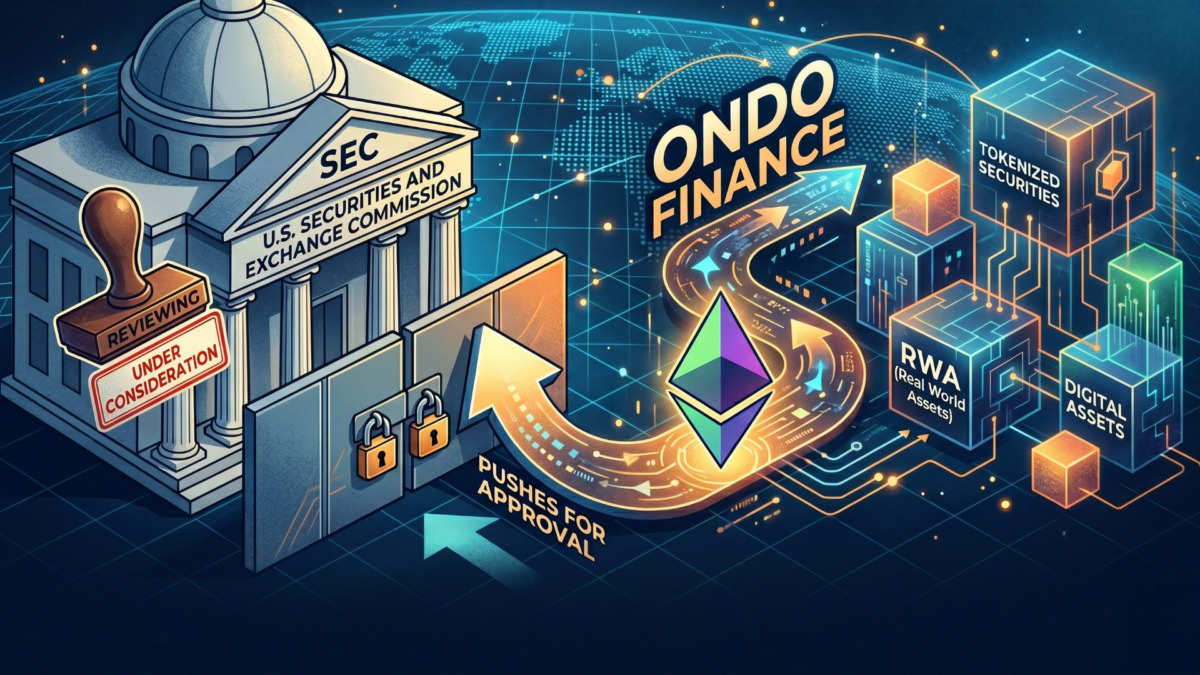
Regulatory tailwinds are significant; the SEC closed its investigation into Ondo without charges in November 2025, 21Shares filed for a spot ONDO ETF in February 2026, and Ondo secured EU passporting rights covering 30 European markets.
ONDO now functions as a pure governance token with no direct cash flow rights, which remains the central structural question for long-term valuation.
The RWA sector has moved decisively beyond pilot projects. As of early 2026, the total value of tokenized real-world assets across public blockchains exceeds $25 billion, driven by a convergence of regulatory clarity, institutional demand, and maturing infrastructure. Ondo Finance sits at the center of this movement: it was the first protocol to bring U.S. Treasuries on-chain at institutional scale, it commands approximately 58% market share in tokenized equities, and its TVL has grown continuously since launch. For a full grounding in how the protocol operates, the
Ondo Finance complete guide to real-world assets covers the product architecture in depth.
The paradox facing ONDO investors in 2026 is sharp: the protocol's assets under management have never been higher, yet the token sits near multi-year lows. Understanding that gap, and whether the catalysts on the horizon are sufficient to close it, is the central analytical task for anyone evaluating ONDO as an investment.
The table below summarises ONDO's core protocol and token metrics as of early April 2026, sourced from TokenTerminal and on-chain data aggregators.
Metric | Value | Context |
TVL (All Chains) | $3.015B | All-time high; +13% in Q1 2026 |
Token Price | ~$0.25 | ~88% below all-time high |
Market Cap | ~$1.24B | Circulating supply basis |
Fully Diluted Valuation | ~$2.50B | Based on 10B max supply |
MC / TVL Ratio | ~0.41 | Below 1.0 historically signals undervaluation |
24h Trading Volume | ~$70.6M | Stable; no major directional flow |
Circulating Supply | ~53% of max | Post-January 2026 unlock |
Tokenized equities volume on Ondo Global Markets surpassed $13 billion in cumulative trading volume by early April 2026, confirming that the protocol's activity metrics have decoupled from its token price in both directions.
The divergence between Ondo's protocol growth and its token price is not irrational; it reflects a structural feature of the ONDO tokenomics that informed investors must understand. ONDO captures zero direct cash flow from the platform's revenue. Management fees and platform charges accrue to Ondo Finance Inc., the corporate entity, not to token holders. A token that governs a $3 billion protocol but receives none of its revenue trades differently from one that does. Until the fee-switch mechanism is activated, ONDO's price is driven primarily by narrative momentum, supply dynamics, and speculative positioning rather than fundamental yield.
The most consequential supply event in ONDO's history occurred in January 2026, when 1.94 billion tokens (equivalent to approximately 19%) of the total 10 billion supply, entered circulation as part of a pre-scheduled vesting release. A portion went to early private sale investors; the majority was earmarked for ecosystem growth and treasury deployment. Large token unlocks of this scale historically create persistent selling pressure in the weeks and months following the event, as early investors who acquired tokens at discounted prices realise gains into market liquidity. Market data in the weeks following the January unlock showed that exchange inflows moderated faster than many expected, suggesting partial absorption by institutional buyers entering at lower prices. Nevertheless, the event mechanically suppressed the token's ability to recover toward its prior range.
With approximately 53% of the 10 billion supply now in circulation, the gap between market cap and fully diluted valuation remains meaningful. At a token price of $0.25, the FDV sits near $2.50 billion, implying that the market must either absorb the remaining ~4.7 billion tokens still to vest or reprice upward substantially to justify the current MC/TVL ratio on a fully diluted basis. The MC/TVL ratio of 0.41 is low by DeFi standards, where ratios above 1.0 are common for protocols with similar dominance profiles. However, this metric must be contextualised: Ondo's TVL represents custodied real-world assets rather than deployed DeFi liquidity, and the revenue model differs fundamentally from fee-generating protocols where TVL and revenue correlate directly.
ONDO grants holders the right to vote on protocol parameters, DAO treasury allocation, and system upgrades through the Ondo DAO.. This is meaningful governance: Ondo's product decisions, fee structures, and chain deployment choices all pass through DAO processes, but the token does not translate that authority into economic rights over the protocol's revenue stream. The ONDO token is structurally comparable to governance tokens in other large DeFi protocols that similarly generate substantial revenue without distributing it to token holders. For a parallel analysis of how governance token economics work in an established Layer-1 context, the
Hyperliquid tokenomics breakdown illustrates the spectrum of value capture models now operating in the market.
Two mechanisms could fundamentally change ONDO's economic profile. The first is the fee switch: the Ondo DAO is scheduled to vote on protocol fee collection in H2 2026. If passed, a portion of the revenue generated by Ondo's managed assets, estimated at $48 million or more annually at prevailing TVL levels, which could flow to token holders directly or be used for programmatic buybacks. The precedent set by other DeFi protocols that have activated similar mechanisms suggests this vote, if successful, could act as a price floor by creating organic demand for the token from fee recipients.
The second mechanism is the proposed Ondo Chain. If launched, the Layer-1 application-specific blockchain would likely require ONDO for network gas fees and validator staking, creating organic utility demand that governance-only tokens lack. Validators staking ONDO to secure the network would reduce circulating supply and generate yield, aligning token holder incentives with protocol security rather than speculation alone. Neither mechanism is guaranteed, and both face regulatory constraints that could delay or modify their implementation.
In February 2026, Swiss asset manager 21Shares filed for a spot ONDO ETF with the SEC, seeking to create a regulated investment vehicle providing direct institutional exposure to the token. The filing follows the successful precedents set by Bitcoin and Ethereum spot ETFs in the United States. An approval would be a landmark event: it would make ONDO accessible to pension funds, wealth managers, and retail brokerage accounts that cannot hold native crypto assets, creating a structural demand channel that does not now exist. The outcome remains uncertain and the SEC's review timeline for novel crypto ETF filings typically extends beyond six months, but the filing itself validates institutional interest in ONDO as an asset class. The
Dogecoin ETF analysis provides relevant context on how ETF filings affect token price dynamics and timeline expectations across the crypto market.
Ondo secured EU passporting rights in 2026, allowing it to offer tokenized products to retail investors across 30 European Economic Area markets. Combined with the SEC's formal closure of its two-year investigation into Ondo without charges in November 2025, the regulatory overhang that suppressed institutional engagement has largely cleared. The EU passporting is particularly significant: it opens a compliant distribution channel into one of the world's largest retail investment markets without requiring Ondo to restructure its product architecture. Regulatory de-risking of this magnitude historically correlates with improved institutional positioning, even when it does not produce immediate price reactions.
In early 2026, Franklin Templeton tokenized several ETF products directly on the Ondo platform, migrating traditional assets under management onto Ondo's infrastructure rather than simply using Ondo products as reserve backing. This represents a qualitative step beyond the BlackRock BUIDL relationship: it positions Ondo as the settlement and distribution layer for established asset managers rather than merely a downstream product issuer. The Q1 2026 TVL data, showing $2.677 billion on March 31 rising to $3.015 billion by April 9, a 13% move in under two weeks, reflecting the inflow impact of these institutional integrations. Concurrent listings of tokenized stocks and ETFs on MEXC expanded retail distribution to non-U.S. users at scale during the same period.
Price predictions for governance tokens in emerging asset classes carry wide uncertainty bands. The scenarios below are built from specific, identifiable catalysts and use the MC/TVL ratio as an anchoring framework rather than technical chart patterns, which are less reliable for assets undergoing structural fundamental shifts. For comparison on how long-horizon crypto price scenarios are constructed using adoption and tokenomics drivers, the
Dogecoin 2030 outlook methodology offers a useful reference for scenario-building discipline.
Scenario | Price Target (End-2026) | MC Implied | Primary Drivers |
Bull Case | $1.80 – $3.10 | $8.8B – $15.2B | Fee-switch passes; spot ETF approved; Ondo Chain launch confirmed; RWA sector TVL exceeds $50B |
Base Case | $0.85 – $1.20 | $4.2B – $5.9B | Fee-switch passes but ETF delayed; Global Markets volume sustains; unlock absorption completes |
Bear Case | $0.20 – $0.45 | $1.0B – $2.2B | Fee-switch fails or delayed to 2027; Fed rate cuts compress Treasury yields; unlock selling continues |
The bull scenario requires two independent catalysts to materialise in parallel: a successful fee-switch vote in H2 2026 and either SEC approval of the 21Shares ETF or formal confirmation of the Ondo Chain launch timeline. Fee collection would create fundamental demand for ONDO at prevailing TVL levels, generating an annualised yield mechanism that attracts value investors who have avoided the token purely on governance grounds. ETF approval would simultaneously open institutional distribution channels. Under this combination, a re-rating toward an MC/TVL ratio of 1.0 or above, consistent with fee-generating DeFi protocols of similar scale, would support prices in the $1.80 to $3.10 range.
The base case assumes the fee-switch passes but the ETF process extends into 2027, and Ondo Chain remains at the specification stage through year-end. TVL continues growing at a moderated pace as Franklin Templeton and similar institutional integrations deepen, and the January unlock selling is fully absorbed by mid-year. Under this scenario, ONDO re-rates modestly as the fee-switch announcement creates forward yield expectations, but the absence of the ETF demand channel and the continued FDV discount cap the upside. Prices in the $0.85 to $1.20 range would represent a recovery from current levels without requiring either the ETF or the chain to deliver.
The bear case materialises if the fee-switch vote is delayed or defeated by DAO participants concerned about regulatory implications of distributing revenue to token holders under U.S. securities law, a legitimate concern given the SEC's approach to similar mechanisms in other protocols. Simultaneously, Federal Reserve rate cuts would compress Treasury bill yields, reducing the attractiveness of USDY and OUSG relative to competing on-chain instruments and potentially slowing TVL growth. Under persistent unlock selling without a revenue catalyst, ONDO could remain range-bound near current prices or decline further, with the $0.20 to $0.45 range representing continued discount to protocol fundamentals.
BlackRock's USD Institutional Digital Liquidity Fund (BUIDL) is the largest single tokenized money-market instrument by assets, holding approximately $2.14 billion by late Q1 2026. BUIDL and Ondo occupy an unusual dual relationship: they compete in the tokenized Treasury space for institutional capital, but BUIDL also serves as the reserve backing for Ondo's OUSG product. This makes BlackRock simultaneously Ondo's most formidable competitor and one of its key infrastructure partners. The distinction matters for price analysis: Ondo's competitive moat lies not in the Treasury yield product itself, where BlackRock's brand and balance sheet are dominant, but in the tokenized equity layer and multi-chain composability that BUIDL cannot replicate.
Securitize, which operates as BlackRock's tokenization partner and also runs independent compliant fund issuance, and Superstate, managing over $719 million in tokenized assets by early 2026, compete directly with Ondo in the primary issuance market for tokenized securities. Both firms have established relationships with traditional asset managers and are growing their AUM at rates comparable to Ondo's early trajectory. The primary differentiator for Ondo against this cohort is cross-chain composability: USDY and tokenized equities from Ondo are live across eight blockchain ecosystems with DeFi integration, while Securitize and Superstate remain primarily Ethereum-native with limited DeFi composability.
Centrifuge occupies a complementary rather than directly competing niche, focusing on illiquid private credit instruments such as real estate debt, supply chain receivables, and invoice factoring, rather than the liquid public securities that anchor Ondo's product suite. With approximately $256 million in tokenized value, Centrifuge is significantly smaller but serves institutional allocators who need on-chain access to private credit markets rather than public securities. The two protocols do not directly cannibalize each other's core user bases, though both compete for the broader institutional RWA allocation that is migrating on-chain.
The honest answer to whether ONDO is a good investment depends entirely on the investor's time horizon and their assessment of the fee-switch probability. For an investment framework, the
data-driven approach to evaluating crypto investment cases is a useful methodological parallel for thinking through the bull and bear cases systematically.
Structural strengths supporting the long-term thesis are substantial. Ondo leads the fastest-growing segment of the crypto market by institutional adoption. Its regulatory positioning (SEC investigation closed, EU passporting secured, compliance-first product architecture) reduces a risk category that has historically destroyed value in competing protocols. The MC/TVL ratio of 0.41 is objectively low for a category leader. And the fee-switch, if activated, would transform ONDO from a pure governance instrument into a yield-bearing asset overnight.
Structural risks are equally real. The FDV at $2.50 billion implies significant future dilution as remaining tokens vest. The absence of direct cash flow to token holders is not merely a temporary feature; it may be a permanent constraint if U.S. securities regulators classify fee distribution as a securities violation, which would force the DAO to choose between revenue sharing and regulatory compliance. Treasury yield compression from Federal Reserve rate cuts would reduce the appeal of Ondo's core yield products and could slow TVL growth materially. Finally, concentration risk is high: Ondo's dominance in tokenized equities rests on a narrow window of first-mover advantage that larger, better-capitalised competitors are actively working to close.
The net assessment for a financially literate investor is that ONDO represents a high-conviction asymmetric bet on the fee-switch catalyst and institutional adoption momentum, carrying real downside risk from supply dynamics and the value-capture structural ambiguity.
ONDO is the governance token for the Ondo DAO, granting holders voting rights over protocol parameters, treasury allocation, and system upgrades. It does not provide direct economic rights to protocol revenue.
The combination of the January 2026 mega-unlock adding 1.94 billion tokens to circulating supply, the absence of direct revenue distribution to holders, and broader RWA sector sentiment cooling from speculative peaks are the primary drivers. The protocol's fundamentals have grown substantially during the same period, creating the current gap between TVL and token price.
Scenario analysis suggests a range of $0.20 to $0.45 in the bear case, $0.85 to $1.20 in the base case, and $1.80 to $3.10 in the bull case, depending primarily on whether the fee-switch vote passes and whether the 21Shares spot ETF receives SEC approval.
The fee switch refers to a proposed DAO governance vote scheduled for H2 2026 that would route a portion of Ondo's protocol revenue to ONDO token holders or use it for programmatic buybacks. If passed, it would be the first time the token captures direct economic value from the protocol, fundamentally changing its investment thesis.
In February 2026, Swiss asset manager 21Shares filed for a spot ONDO ETF with the SEC. If approved, it would allow institutional and retail investors to gain ONDO exposure through regulated brokerage accounts without holding the native token directly, creating a significant new demand channel.
Ondo Finance operates under a compliance-first architecture. Its products use Regulation S exemptions, Regulation D Rule 506(c), and offshore SPV structures to maintain legal compliance across jurisdictions. The SEC formally closed its investigation into the protocol without charges in November 2025. Ondo also holds EU passporting rights covering 30 EEA markets.
The primary competitors are BlackRock's BUIDL fund in the tokenized Treasury space, Securitize and Superstate in the compliant fund issuance market, and Centrifuge in the adjacent private credit tokenization segment. Ondo's differentiation lies in its cross-chain composability and its dominance in tokenized public equities.
No. In its current structure, ONDO does not earn yield or receive protocol revenue. The fee-switch vote in H2 2026 could change this if passed by the DAO.
Ondo Finance has built something genuinely rare in the crypto market: a protocol where the fundamentals have materially outpaced speculative sentiment. A $3 billion TVL at a $1.24 billion market cap, category leadership in the fastest-growing segment of institutional DeFi, and a regulatory clearance record that no competitor can match: these are not speculative attributes. The ONDO token's challenge is structural: until the fee-switch bridges the gap between protocol revenue and token holder economics, market participants are effectively betting on governance rights in a profit-generating business they cannot yet claim. The H2 2026 fee-switch vote is consequently the most important event in ONDO's near-term price history. A successful vote transforms the investment thesis. A failed or delayed vote extends the disconnect between fundamentals and price. For investors with a six to eighteen month horizon and conviction in both the RWA sector's growth trajectory and Ondo's ability to execute its monetisation roadmap, the current entry point offers asymmetric exposure to one of crypto's most credible institutional stories.
For a deeper understanding of the USDY yield mechanics that underpin Ondo's TVL growth, the
Ondo Finance yield explained guide covers the product architecture and return structure in full.