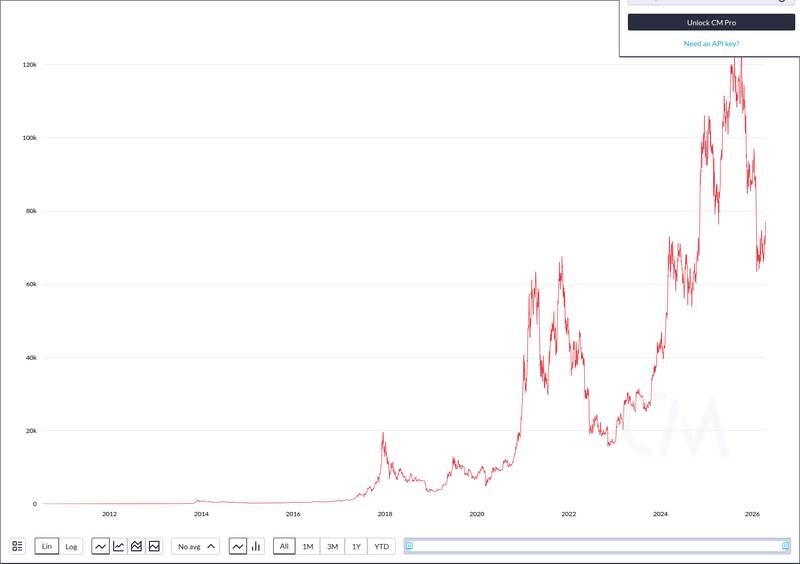
Bitcoin's dramatic pullback from its $126,000 all-time high has left investors wondering: will Bitcoin go back up? After dropping over 27% to the $89,000-$95,000 range, market uncertainty hasBitcoin's dramatic pullback from its $126,000 all-time high has left investors wondering: will Bitcoin go back up? After dropping over 27% to the $89,000-$95,000 range, market uncertainty has
Bitcoin's dramatic pullback from its $126,000 all-time high has left investors wondering: will Bitcoin go back up?
After dropping over 27% to the $89,000-$95,000 range, market uncertainty has intensified.
This article examines Bitcoin's current position, analyzes key recovery factors, and provides expert price predictions for 2026 to help you make informed investment decisions.
Major financial institutions are treating Bitcoin's correction as a buying opportunity rather than a reason to exit.
Harvard University's recent move to triple its Bitcoin ETF position demonstrates sophisticated investors view current prices as attractive entry points.
Spot Bitcoin ETFs have created permanent infrastructure for institutional capital flows, providing a demand floor that didn't exist in previous market cycles.
Corporate treasuries continue exploring Bitcoin allocation strategies, recognizing the cryptocurrency's potential as a portfolio diversifier.
This institutional backing represents a fundamental shift from retail-dominated markets of earlier cycles.
Lower interest rates historically drive investors toward risk assets like Bitcoin as fixed-income returns become less attractive.
The U.S. M2 money supply has resumed expansion after contracting during 2022-2023, providing additional liquidity that often flows into alternative assets.
A weakening dollar thesis gains traction as fiscal concerns mount, reinforcing Bitcoin's narrative as a hedge against currency devaluation.
Bitcoin's Relative Strength Index has dropped into oversold territory, historically signaling potential reversal points.
The cryptocurrency is testing critical support near the $90,000-$95,000 zone, where substantial buying interest has emerged in previous dips.
While short-term moving averages show bearish momentum, the long-term 200-day moving average near $100,000 provides a key psychological and technical level.
Previous Bitcoin cycles demonstrate that corrections of 25-35% are normal during bull markets and often precede renewed upward moves.
On-chain data reveals short-term holder behavior patterns similar to past cyclical bottoms, suggesting capitulation may be nearing completion.
The 2024 U.S. presidential election brought a pro-cryptocurrency administration into power, signaling potential regulatory clarity ahead.
Political support for Bitcoin has strengthened, with discussions around establishing a national Bitcoin strategic reserve gaining serious consideration.
Regulatory frameworks globally are maturing beyond initial skepticism toward more balanced approaches that acknowledge cryptocurrency's role in modern finance.
Clear regulatory guidelines reduce uncertainty that has historically suppressed institutional adoption and price performance.
Japan's recent tax reforms and other jurisdictions' evolving crypto policies suggest a global trend toward acceptance rather than restriction.
Market analysts present three distinct scenarios for Bitcoin's trajectory through 2026, each with different probability assessments and price targets.
The base case scenario, assigned 40-50% probability, projects Bitcoin trading between $110,000 and $130,000 by late 2026.
This outlook assumes steady but unspectacular institutional adoption continues, macroeconomic conditions remain mixed with neither strong tailwinds nor headwinds, and Bitcoin maintains key support levels around $90,000 without breaking down.
The bullish scenario, given 20-30% probability, envisions Bitcoin reaching $150,000 to $200,000 if several positive catalysts align simultaneously.
This would require aggressive Bitcoin ETF inflows returning to early 2025 levels, favorable regulatory developments accelerating adoption, successful Federal Reserve rate cuts improving risk asset appetite, and a technical breakout above $105,000 confirming renewed bullish momentum.
Notable experts have published optimistic forecasts, including Anthony Scaramucci's projection of $170,000 and Cathie Wood's Ark Invest estimate of $150,000 near-term with $1 million long-term potential.
The bearish scenario, also assigned 20-30% probability, would see Bitcoin declining to $40,000-$60,000 range, though this requires significant negative catalysts like a major stock market crash, global credit shock, unexpected regulatory crackdowns, or technical breakdown below the critical $84,000 support level.
The question "will Bitcoin go back up" ultimately requires personal risk assessment aligned with your investment timeline and financial situation.
Dollar-cost averaging represents the most prudent approach in the current volatile environment, allowing investors to build positions gradually rather than attempting to time the perfect entry.
The $85,000-$90,000 range represents a strong accumulation zone where institutional buyers have historically shown interest, while the $90,000-$100,000 range offers moderate risk-reward for patient investors.
Risk management remains essential—cryptocurrency should represent a limited portion of a diversified portfolio, with allocation based on individual risk tolerance.
Your investment horizon significantly impacts strategy: short-term traders face high uncertainty with possible further dips over 3-6 months, medium-term investors (1-2 years) may benefit from strong recovery probability, while long-term holders (5+ years) can rely on Bitcoin's historical appreciation trend.
Several warning signs could derail recovery expectations, including sustained price breaks below $84,000, major regulatory crackdowns in key markets, global financial crises disrupting all risk assets, or significant loss of institutional confidence triggering sustained outflows.
Will Bitcoin go back up? The evidence strongly suggests yes, despite unavoidable short-term uncertainty.
Current corrections fall within normal parameters for Bitcoin's four-year cycle, while institutional demand and supply constraints create favorable recovery conditions.
Realistic 2026 price targets range from $110,000 to $150,000, with extreme bearish scenarios like $10,000 highly improbable given Bitcoin's matured market infrastructure.
Investors should view volatility as opportunity, implementing disciplined strategies like dollar-cost averaging while maintaining proper portfolio allocation.
Bitcoin's long-term trajectory remains intact—the question isn't if recovery happens, but when patient investors position themselves to benefit.
Ready to start your Bitcoin investment journey? MEXC offers secure, user-friendly cryptocurrency trading with competitive fees and robust security features.
What is Bitcoin Pizza Day? The Complete Story of the 10,000 BTC Pizza Purchase
Are you curious about one of the most infamous stories in cryptocurrency history? This article explores Bitcoin Pizza Day, the remarkable tale of how someone spent 10,000 BTC on two pizzas. Whether
BTC/Bitcoin and USD1: A Comprehensive Guide to Zero-Fee Trading on MEXC
Key Takeaways BTC is the largest cryptocurrency by market capitalization, while USD1 is a fiat-backed stablecoin issued by World Liberty Financial MEXC offers the BTC/USD1 trading pair with zero
Hyperliquid Leverage Limits Explained: How to Manage Risk on a Perp DEX
What Are Hyperliquid's Leverage Limits? Hyperliquid offers up to 40x leverage on major perpetual pairs including BTC and HYPE for smaller retail positions. A tiered margin system reduces effective
Does MEXC Require KYC? Complete Guide to MEXC KYC Verification
Key Takeaways MEXC KYC requirements include government-issued photo ID for Primary KYC (80 BTC limit) and facial verification for Advanced KYC (200 BTC limit) MEXC KYC verification typically
The Latest Bitcoin (BTC) price has shown significant movement over the past week. In this article, we'll examine its current Bitcoin price today, 7-day price performance, and the market factors
What is BTC Bull Token $BTCBULL? An Introduction to Cryptocurrency
What Exactly is BTC Bull Token $BTCBULL? BTC Bull Token $BTCBULL is a blockchain-based cryptocurrency that powers the decentralized BTC-linked ecosystem focused on rewarding holders during Bitcoin
Bitcoin Spikes to $68,700: Is Trump's Iran De-Escalation the Catalyst Crypto Has Been Waiting For?
Published: April 1, 2026 Author: MEXC Crypto Pulse Team Overview Bitcoin (BTC) surged to a short-term high of $68,700 in late March 2026 before consolidating in the $67,000–$68,500 range, fueled by
Bitcoin (BTC) Price Prediction: Market Forecast and Analysis
Understanding the price prediction of Bitcoin (BTC) gives traders and investors a forward-looking perspective on potential market trends. Bitcoin price predictions aren't guarantees, but they provide
In 2010, This Bitcoin Faucet Gave Away 5 BTC Per CAPTCHA
A look back at the 2010 Bitcoin faucet that handed out 5 BTC per CAPTCHA, why it existed, and what the giveaway says about early crypto markets.
Bitcoin Price Plummets: BTC Falls Below Critical $74,000 Support Level
BitcoinWorld Bitcoin Price Plummets: BTC Falls Below Critical $74,000 Support Level Global cryptocurrency markets witnessed a significant correction on Thursday
Bitcoin Halts Gains as US-Iran War, Hormuz Closure Make a Comeback
The post Bitcoin Halts Gains as US-Iran War, Hormuz Closure Make a Comeback appeared on BitcoinEthereumNews.com. Bitcoin foreshadows fresh market mayhem as it appears
Current BTC Price Action Shows Dramatic Underperformance: Analyst
The post Current BTC Price Action Shows Dramatic Underperformance: Analyst appeared on BitcoinEthereumNews.com. The current Bitcoin (BTC) market cycle is “dramatically
Ethereum Code Review: Is It a Scam or a Legitimate Trading Platform?
If you've searched for the Ethereum Code platform, you probably want one answer: is it safe to invest your money there?This article breaks down exactly what the Ethereum Code trading app claims to off
Ethereum Market Cap Explained: What It Is and Why It Matters
If you've ever looked up ETH and wondered why the price alone doesn't tell the full story, you're not alone.The Ethereum market cap is the number that actually shows you how big Ethereum is as a netwo
Ethereum Investing Guide: Risks, Strategies, and Whether It's Worth It
If you've been wondering whether investing in Ethereum makes sense, you're not alone.This guide walks you through what Ethereum actually is, why it works differently from Bitcoin, what the real risks
Ethereum Price History by Year: Every Major Bull Run and Crash Explained
Ethereum has gone from a $0.31 ICO token to one of the most closely watched assets in global finance.Its price history isn't just a chart — it's a record of every major shift in the crypto market, fro