Bittensor (TAO) Analysis: Is This AI Crypto Network Worth Your Investment in 2025?
Key Takeaways
- Bittensor operates with a maximum supply of 21 million TAO tokens, mirroring Bitcoin’s scarcity model, with its inaugural halving reducing daily issuance from 7,200 to 3,600 tokens in December 2025.
- Unlike many crypto AI ventures, Bittensor launched without a premine or initial coin offering, establishing a more equitable distribution framework.
- With a fully diluted valuation exceeding $6.6 billion, the market has already priced in substantial future growth expectations.
- The platform operates through specialized subnets functioning as distinct AI service marketplaces, though the mechanism for TAO value accrual from these markets remains ambiguous.
- Token issuance persists post-halving, indicating that holder dilution continues at a reduced velocity rather than stopping entirely.
Bittensor represents a complex departure from conventional AI tokens. The platform functions as an interconnected ecosystem of subnets, each operating autonomous AI service markets spanning inference capabilities, storage solutions, and data processing. TAO serves as the native currency underpinning this entire infrastructure.
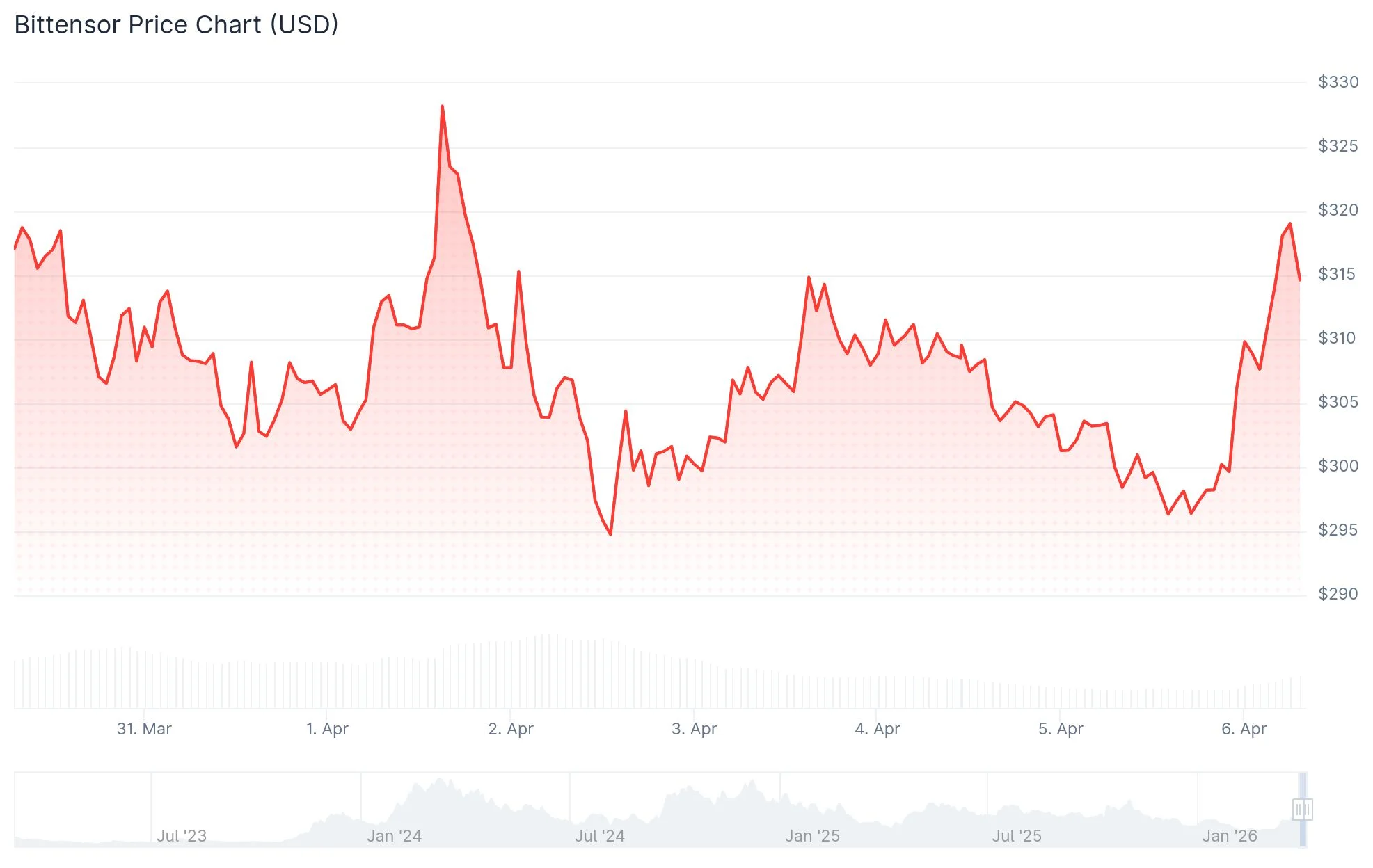 Bittensor (TAO) Price
The initiative has cultivated a dedicated community. However, innovative technology architecture doesn’t automatically translate into compelling investment fundamentals.
TAO’s economic model distinguishes itself within the crypto AI landscape. The protocol implements a fixed ceiling of 21 million tokens, paralleling Bitcoin’s supply constraints. The Opentensor Foundation has verified the absence of premined tokens or private sales, eliminating a prevalent risk factor common to nascent token projects.
Bittensor implements a programmatic halving mechanism. The inaugural halving occurred mid-December 2025, reducing daily token emissions from approximately 7,200 TAO to 3,600 TAO, per Grayscale’s analysis.
Tokenomics Appear Sound, Yet Inflation Persists
Despite the reduced emission schedule, fresh tokens continuously enter circulation. Current holders continue experiencing dilution effects, albeit at a decelerated rate.
CoinGecko metrics position TAO’s fully diluted valuation north of $6.6 billion. Numerous investors focus exclusively on circulating supply metrics while overlooking the comprehensive supply landscape. For TAO, understanding total supply implications remains critical.
A capped supply model doesn’t inherently validate current pricing. It simply establishes a known upper boundary.
The Value Capture Question Remains Unanswered
This represents the fundamental concern. While Bittensor may facilitate thriving AI marketplaces within its subnet infrastructure, there’s no guarantee TAO effectively captures the economic output these markets generate.
TAO functions within staking mechanisms and network incentive structures. This provides utility. However, internal network utility differs substantially from robust external demand driven by fundamental value rather than speculative interest.
Across numerous crypto ecosystems, network activity can expand while token prices primarily respond to market sentiment. Bittensor confronts this identical structural challenge.
The subnet architecture introduces additional complexity. This intricacy complicates investor efforts to monitor actual network developments and distinguish between genuine growth versus emission-inflated metrics.
Grayscale research highlighted that token emissions can artificially inflate usage statistics, creating misleading impressions of network adoption.
TAO’s inaugural halving executed in December 2025, halving the daily token influx into markets.
Bottom Line Assessment
Bittensor ranks among the more credible initiatives within crypto AI development. Its token distribution proves cleaner than competing projects, the fair launch model eliminates common red flags, and the subnet framework presents genuine innovation. Nevertheless, TAO commands a multi-billion dollar valuation, ongoing dilution persists, and the token’s capacity to capture tangible economic value from network activity remains unresolved.
The post Bittensor (TAO) Analysis: Is This AI Crypto Network Worth Your Investment in 2025? appeared first on Blockonomi.


You May Also Like

This bot turned $16 into $16,000 trading for only 5 minutes

China Orders Jack Dorsey’s Bitchat Pulled from Apple App Store