

Polymarket Bets Briefly Appear on Google News Before Being Removed
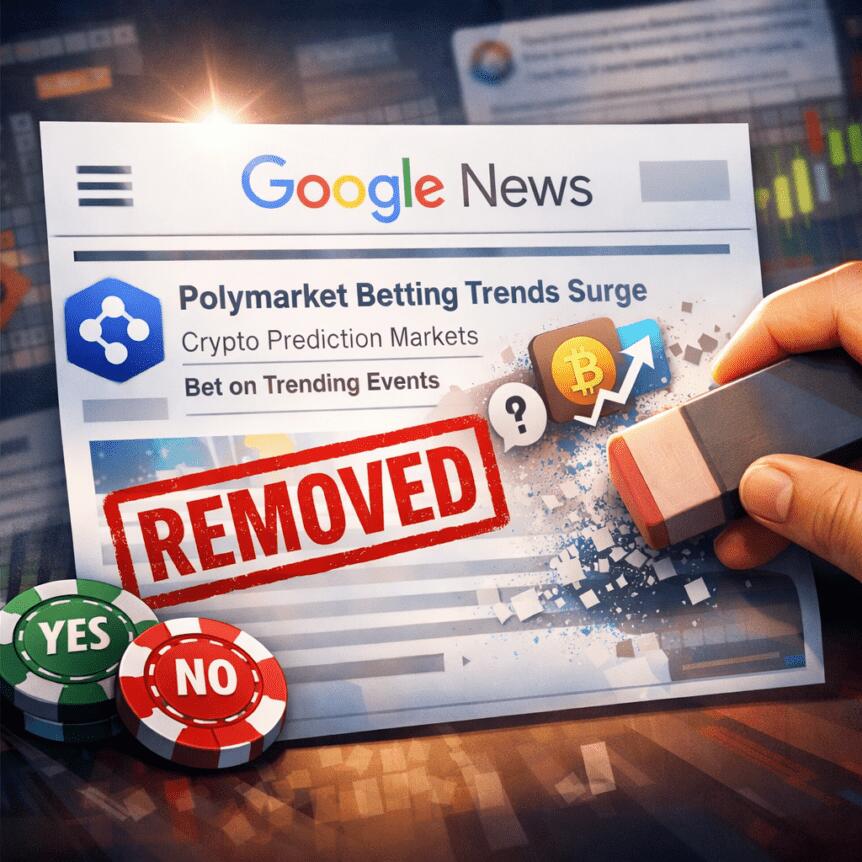
Polymarket briefly appeared in Google News results alongside established outlets when users searched for event-driven questions, but Google later confirmed the listing was an error and has since been removed. The incident, now described by Google as a temporary misindexing, comes as Polymarket and its rival Kalshi push to embed prediction-market data into mainstream platforms, deploying a mix of partnerships and wallet integrations to broaden access while navigating a shifting regulatory backdrop.
Before its removal, Polymarket links surfaced under mainstream coverage for queries such as “will ships transit the strait,” pairing market bets with accompanying news results. A Futurism report highlighted how a search on the Strait of Hormuz returned Polymarket outcomes alongside Reuters and The Guardian stories. In a subsequent test run by Cointelegraph, the same query did not surface Polymarket results, underscoring how fragile such appearances can be in search ecosystems.
Key takeaways
- Google News briefly surfaced Polymarket results for event-driven queries, but the listing was characterized by Google as an error and has been removed from News.
- Polymarket has been expanding its media presence through partnerships and platform integrations, including a Google Finance collaboration with Kalshi, plus high-profile ties with X and wallet projects like MetaMask and World App.
- Investor realities in prediction markets remain mixed: a small share of traders achieves meaningful profits, while the vast majority do not sustain high monthly earnings over time.
- Expect ongoing experimentation at the intersection of media, social platforms, and prediction markets, with regulatory uncertainty continuing to shape adoption.
Media surfaces and the fragile edge of prediction markets
The Google News incident illustrates how quickly prediction-market data can surface within mainstream information channels, even if only briefly. The Verge reported that Google said the appearance was an error and that Polymarket no longer shows up in News. While such episodes may be short-lived, they reveal an underlying strategy: Polymarket and Kalshi are intent on linking their forecasting markets with traditional media signals to boost discoverability and credibility beyond crypto-native audiences.
Historically, search and news integrations have been a proving ground for how reliably prediction-market content can coexist with standard journalism. The example cited by Futurism—where a search for an ongoing geopolitical question produced Polymarket bets next to established outlets—demonstrates both the potential reach and the volatility of such integrations. The takeaway for traders and users is that discovery channels may be temporary and context-dependent, reinforcing the notion that prediction markets work best when embedded in trusted, regulated environments rather than as fleeting search-index byproducts.
A push to embed Polymarket in mainstream platforms
Polymarket and Kalshi have been pursuing broad media and data distribution strategies for more than a year. Notably, Google partnered with both platforms to bring their data into Google Finance, a collaboration that signals an appetite to translate prediction-market signals into familiar financial interfaces. The move places outcome-based markets alongside traditional financial data streams, potentially widening the audience beyond crypto enthusiasts.
The momentum isn’t limited to Google. In June, Elon Musk’s X publicly announced a partnership naming Polymarket as its official prediction-market partner, a move framed as integrating forecast-based thinking into the social-media experience. This collaboration suggests a broader ambition to normalize prediction markets as a forecasting tool within digital communities and real-time events, rather than relegating them to niche crypto spaces.
Further, in October, MetaMask said it would integrate Polymarket as part of a broader push to broaden access beyond a crypto wallet to a more inclusive “democratized finance” gateway. World App, the digital wallet and identity platform from Sam Altman’s World project, also added Polymarket to its app ecosystem. Taken together, these partnerships illustrate a concerted effort to place Polymarket’s forecasting markets where users already manage identities and finances, reducing friction for entry and usage.
These moves are generally framed as ways to diversify user bases and improve liquidity by tapping into platforms with established user engagement. However, they also bring new layers of regulatory scrutiny, given the evolving legal status of prediction markets in different jurisdictions and the potential for consumer protection concerns when forecasting political or geopolitical outcomes. Still, the cross-platform strategy signals a clear editorial and product direction: forecast-based markets want to be as accessible and visible as traditional financial data, even when their underlying contracts remain distinct in risk and structure.
Profitability realities for Polymarket traders
Beyond platform reach, discussions about profitability on Polymarket have highlighted a more sober picture. A Crypto analytics perspective highlighted that only a small portion of traders achieve meaningful and sustained profits. Specifically, about 1% of traders exceeded $5,000 in profit in a single month, but only 0.015% managed to maintain that level for four consecutive months. On cumulative terms, roughly 0.033% of wallets surpassed $100,000 in total profits, a signal that professional or highly active traders dominate the higher echelons of profitability while most participants struggle to maintain consistent gains.
These figures mirror broader questions about the economics of prediction markets: while the concept is compelling—crowdsourced forecasting with real-time risk pricing—the practical path to sustained profitability is narrow, given the blend of volatility, liquidity, and information asymmetries that characterize event-driven markets. For investors and builders, the takeaway is that the field still rewards specialized strategies and disciplined risk management, rather than broad, casual participation. The data also underline why media partnerships and easier access points matter: lower barriers to entry can attract more participants, but sustaining profitability requires skill, data access, and sound discipline.
For readers seeking deeper context, previous coverage from Cointelegraph highlighted how traders with disciplined approaches have navigated Polymarket’s liquidity and event-focused markets, though profitability remains uneven and sensitive to event outcomes, market sentiment, and timing.
What to watch next for Polymarket and the prediction-market space
Looking ahead, the convergence of media visibility, platform integrations, and heightened public discourse around forecasting raises several questions. Will more mainstream technology platforms adopt prediction-market data as a standard feature, and if so, what safeguards and regulatory guardrails will accompany such integrations? How will trader behavior adapt as interfaces become more familiar to non-crypto users, and what does that mean for liquidity and volatility during high-stakes events?
Observers should monitor whether these partnerships translate into tangible increases in mainstream adoption or if they remain primarily branding and distribution plays. The ongoing regulatory environment will likely shape both the speed and scope of embedding forecast markets within consumer platforms. For now, Polymarket’s outreach through Google Finance, X, MetaMask, and World App marks a notable push to reposition forecast markets as part of the broader financial-information ecosystem—and a test of how far mainstream platforms will go in embracing probability-based forecasting as a normal feature of everyday decision making.
As the ecosystem evolves, readers should stay attentive to how search indexing quirks, regulatory updates, and platform policy changes influence accessibility and reliability of Polymarket’s markets, and what that means for traders seeking to navigate this unique, high-variance corner of crypto finance.
Readers should watch ongoing developments in media integrations and platform partnerships, as they will influence access, liquidity, and the perceived legitimacy of prediction markets within both crypto-native and mainstream audiences.
This article was originally published as Polymarket Bets Briefly Appear on Google News Before Being Removed on Crypto Breaking News – your trusted source for crypto news, Bitcoin news, and blockchain updates.


You May Also Like

Fuel costs hit job quality despite drop in joblessness

AI-Powered Autonomous Cyberattacks Prompt Regulatory Emergency, New Defense Platform Claims 100% Prevention




