Russian ruble-backed stablecoin A7A5 has helped move over $6 billion across borders since August 2025, despite some of its key operators being hit by Western sanctions. According to a recent report by the Financial Times, A7A5 allegedly has close ties…Russian ruble-backed stablecoin A7A5 has helped move over $6 billion across borders since August 2025, despite some of its key operators being hit by Western sanctions. According to a recent report by the Financial Times, A7A5 allegedly has close ties…

Russia-backed A7A5 stablecoin moved over $6B despite US sanctions: report

4 min read

Russian ruble-backed stablecoin A7A5 has helped move over $6 billion across borders since August 2025, despite some of its key operators being hit by Western sanctions.

Summary
  • Over $6.1 billion in transactions were allegedly processed through A7A5 stablecoin wallets after U.S. sanctions were imposed on affiliated entities.
  • More than 80% of A7A5’s supply was reportedly destroyed and reissued following sanctions on Grinex-linked wallets.
  • A7A5 was granted formal digital asset status in Russia and is backed one-to-one by rubles held at Promsvyazbank.

According to a recent report by the Financial Times, A7A5 allegedly has close ties with multiple entities already sanctioned by the United States, including crypto exchanges Grinex and Garantex, as well as Russia’s state-backed Promsvyazbank.

A7A5 re-minted after Grinex sanction

U.S. regulators imposed sanctions on Grinex in August, as authorities believed it was a successor of another blacklisted platform, Garantex, which has been known to facilitate illicit transactions tied to hacking, terrorism, and drug trafficking. Garantex was initially sanctioned in March of 2022 as part of Washington’s crackdown on Russian financial channels following the invasion of Ukraine.

Notably, blockchain data reviewed by the Financial Times showed that more than 80% of the total A7A5 supply was destroyed and reissued right after fresh sanctions were announced on wallets linked to Grinex. Wallet balances were set to zero using a smart contract function called “destroyBlackFunds,” which labeled the tokens as “dirtyShares” and removed them from circulation.
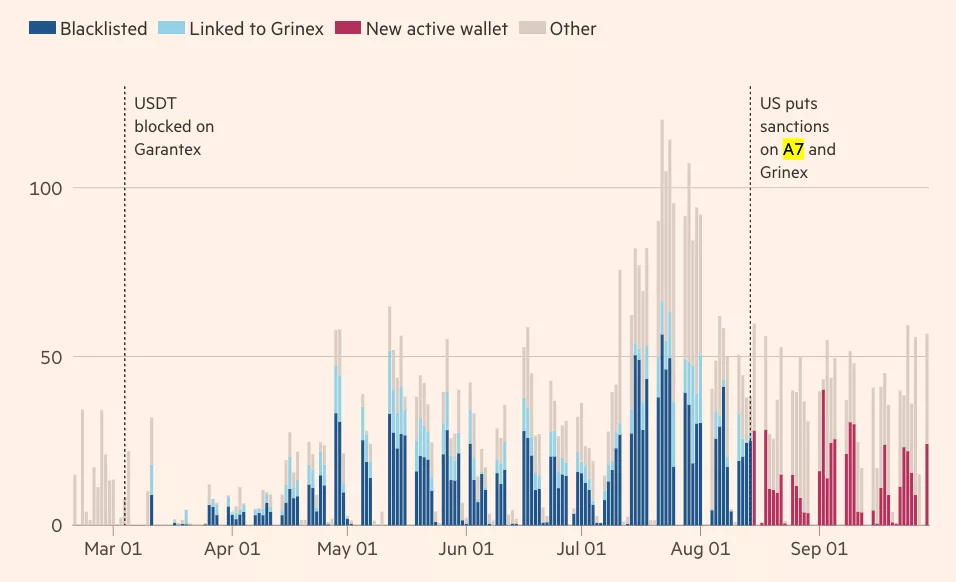
Daily volume of A7A5 transferred by wallet type.

The report alleges this was an effort to wipe the slate clean and erase any transactional history before the same value was minted again in new addresses identified as ‘TNpJj.’

Unlike a standard token transfer, which maintains a visible on-chain link between the source and destination, this method effectively severs that connection, making it far more difficult to trace the movement of funds and identify ties to sanctioned entities, the report said.

Since then, more than $6.1 billion worth of transactions have been routed through the new TNpJj wallet using A7A5.

Grinex, which is a Kyrgyzstan-based exchange, has denied any connections to Garantex, but past investigations have uncovered several on-chain evidence suggesting the two had a close relationship.

Back in March, Swiss blockchain analytics firm Global Ledger found several large transactions directed towards Grinex using the A7A5 stablecoin soon after Garantex went offline. The report also cited an unnamed Grinex staff member who reportedly admitted in private conversations that Garantex customers were physically visiting Grinex’s office to move funds between the two platforms.

Garantex officially ceased operations in March this year, shortly after stablecoin issuer Tether froze approximately 2.5 billion USDT from the exchange. 

“Setting up the new wallet suggests the operators of A7A5, which trades on Tron and Ethereum blockchains, have drawn lessons from the takedown of Garantex,” the Financial Times report said.

A7A5’s connection with multiple sanctioned entities 

Transaction activity on the TNpJj wallet reportedly mirrored that of earlier sanctioned accounts connected to Grinex, sharing many of the same counterparties and following similar trading hours, the report added.

A7A5 is registered in Kyrgyzstan through a company called Old Vector, which was also sanctioned by the United States in August for its role in issuing and managing the stablecoin.

The stablecoin was recently granted formal digital financial asset status by Russian authorities, a move that effectively legitimized its use for trade settlements, allowing exporters and importers to transact officially through a platform owned by Promsvyazbank, which backs each token with a ruble held in reserve.

The state-owned bank, already under Western sanctions, also holds a 49% stake in the A7 cross-border payments network, which was reportedly involved with early-stage development of A7A5.

Despite these allegations, A7A5 developers have touted the stablecoin as an independent and transparent project, with A7A5 executive Oleg Ogienko recently telling media that the project operates legally under Kyrgyzstan’s regulatory framework and has no involvement in illicit activity.

Oleg’s comments came as TOKEN2049, a major cryptocurrency event held in Singapore, removed all references to A7A5 from its website and speaker list following a media inquiry regarding sanctions. Ogienko had been scheduled to appear at the event but was quietly pulled from the agenda after confirming on the sidelines that A7A5 was indeed targeted by Western sanctions.

Previous estimates have suggested that over $9.3 billion in transactions were facilitated by the stablecoin within just four months of its launch.

Market Opportunity
Movement Logo
Movement Price(MOVE)
$0.02611
$0.02611$0.02611
-3.29%
USD
Movement (MOVE) Live Price Chart
Disclaimer: The articles reposted on this site are sourced from public platforms and are provided for informational purposes only. They do not necessarily reflect the views of MEXC. All rights remain with the original authors. If you believe any content infringes on third-party rights, please contact service@support.mexc.com for removal. MEXC makes no guarantees regarding the accuracy, completeness, or timeliness of the content and is not responsible for any actions taken based on the information provided. The content does not constitute financial, legal, or other professional advice, nor should it be considered a recommendation or endorsement by MEXC.

You May Also Like

Which Altcoins Stand to Gain from the SEC’s New ETF Listing Standards?

Which Altcoins Stand to Gain from the SEC’s New ETF Listing Standards?

On Wednesday, the US SEC (Securities and Exchange Commission) took a landmark step in crypto regulation, approving generic listing standards for spot crypto ETFs (exchange-traded funds). This new framework eliminates the case-by-case 19b-4 approval process, streamlining the path for multiple digital asset ETFs to enter the market in the coming weeks. Grayscale’s Multi-Crypto Milestone Grayscale secured a first-mover advantage as its Digital Large Cap Fund (GDLC) received approval under the new listing standards. Products that will be traded under the ticker GDLC include Bitcoin, Ethereum, XRP, Solana, and Cardano. “Grayscale Digital Large Cap Fund $GDLC was just approved for trading along with the Generic Listing Standards. The Grayscale team is working expeditiously to bring the FIRST multi-crypto asset ETP to market with Bitcoin, Ethereum, XRP, Solana, and Cardano,” wrote Grayscale CEO Peter Mintzberg. The approval marks the US’s first diversified, multi-crypto ETP, signaling a shift toward broader portfolio products rather than single-asset ETFs. Bloomberg’s Eric Balchunas explained that around 12–15 cryptocurrencies now qualify for spot ETF consideration. However, this is contingent on the altcoins having established futures trading on Coinbase Derivatives for at least six months. This includes well-known altcoins like Dogecoin (DOGE), Litecoin (LTC), and Chainlink (LINK), alongside the majors already included in Grayscale’s GDLC. Altcoins in the Spotlight Amid New Era of ETF Eligibility Several assets have already met the key condition, regulated futures trading on Coinbase. For example, Solana futures launched in February 2024, making the token eligible as of August 19. “The SEC approved generic ETF listing standards. Assets with a regulated futures contract trading for 6 months qualify for a spot ETF. Solana met this criterion on Aug 19, 6 months after SOL futures launched on Coinbase Derivatives,” SolanaFloor indicated. Crypto investors and communities also identified which tokens stand to gain. Chainlink community liaison Zach Rynes highlighted that LINK could soon see its own ETF. He noted that both Bitwise and Grayscale have already filed applications. Meanwhile, the Litecoin Foundation indicated that the new standards provide the regulatory framework for LTC to be listed on US exchanges. Hedera is also in the spotlight, with digital asset investor Mark anticipating an HBAR ETF. Market observers see the decision as a potential turning point for broader adoption, bringing the much-needed clarity and accessibility for investors. At the same time, it boosts confidence in the market’s maturity. The general sentiment is that with the SEC’s approval, the next phase of crypto ETFs is no longer a question of ‘if,’ but ‘when.’ The shift to generic listing standards could expand the US-listed digital asset ETFs roster beyond Bitcoin and Ethereum. Such a move would usher in new investment vehicles covering a dozen or more altcoins. This represents the clearest path yet toward mainstream, regulated access to diversified crypto exposure. More importantly, it comes without the friction of direct custody. “We’re gonna be off to the races in a matter of weeks,” ETF analyst James Seyffart quipped.
Share
Coinstats2025/09/18 12:57
‘High Risk’ Projects Dominate Crypto Press Releases, Report Finds

‘High Risk’ Projects Dominate Crypto Press Releases, Report Finds

The post ‘High Risk’ Projects Dominate Crypto Press Releases, Report Finds appeared on BitcoinEthereumNews.com. More than six in 10 crypto press releases published
Share
BitcoinEthereumNews2026/02/04 13:09
Why Vitalik Says L2s Aren’t Ethereum Shards Now?

Why Vitalik Says L2s Aren’t Ethereum Shards Now?

The post Why Vitalik Says L2s Aren’t Ethereum Shards Now? appeared on BitcoinEthereumNews.com. Vitalik says Ethereum’s scaling and higher gas limits mean L2s no
Share
BitcoinEthereumNews2026/02/04 13:18