The Bank of England has cautioned that loosening proposed stablecoin regulations could threaten financial stability and trigger a credit crunch, as officials seek to balance innovation with risk in the transition to digital money. Deputy Governor Sarah Breeden said the U.K. faces a “different set of risks” from the United States as it integrates stablecoins into its financial system. “We have to manage those carefully as we bring in this new form of money,” she told Reuters on Tuesday. The comments followed the bank’s release of a long-awaited consultation outlining a regulatory framework for systemic stablecoins, tokens expected to be widely used for payments. The plan includes temporary holding caps of £20,000 ($26,000) for individuals and £10 million ($13 million) for firms, alongside a requirement for issuers to keep 40% of their reserves at the central bank in non-interest-bearing accounts. Will the U.K.’s Stablecoin Limits Prevent a Credit Crunch — or Create One? Breeden said the measure is designed to reduce stress on banks from deposit outflows into stablecoins. “Look at what happened with SVB and Circle; those numbers are broadly in line with that,” she said, referring to USDC’s depeg in 2023 after $3.3 billion of its reserves were trapped at Silicon Valley Bank. Officials fear that large-scale transfers of deposits from commercial banks into stablecoins could weaken banks’ lending capacity, leading to a credit crunch that could raise borrowing costs and slow growth. Governor Andrew Bailey recently warned that such outflows could cause “a precipitous drop in credit for businesses and households.” The proposed limits mark a softer stance than the Bank’s 2023 plan, which would have required stablecoin issuers to hold all reserves at the BoE. Still, the crypto industry says the current version remains overly restrictive. Coinbase executive Tom Duff Gordon called the limits “bad for UK savers, bad for the City, and bad for sterling,” adding that “no other major jurisdiction has deemed caps necessary.” Industry groups also questioned how such limits could be enforced without real-time tracking or digital ID systems. Simon Jennings, head of the UK Cryptoasset Business Council, said, “Limits simply don’t work in practice.” The Bank’s consultation comes as the U.K. seeks to keep pace with U.S. developments. Earlier this year, President Donald Trump signed the GENIUS Act, establishing a federal stablecoin regime without ownership caps. Breeden said Britain is “moving just as quickly” and expects to finalize its framework in 2026. UK Eyes Global Stablecoin Leadership with New BoE-FCA Oversight Blueprint Under the U.K.’s dual-tier system, the BoE will oversee systemic payment stablecoins, while the Financial Conduct Authority (FCA) regulates non-systemic ones used mainly in trading. Issuers will be required to deposit part of their reserves with the central bank, earning returns on the remainder through short-term government securities. The initiative reflects growing government interest in blockchain modernization. In September, Chancellor Rachel Reeves and U.S. Treasury Secretary Scott Bessent agreed to deepen transatlantic cooperation on crypto oversight. London has also launched a Digital Securities Sandbox, where firms including HSBC, J.P. Morgan, and the London Stock Exchange Group plan to issue regulated stablecoins and digital gilts. However, disagreements persist between the Bank and Treasury over how strict the rules should be. Reform UK leader Nigel Farage called the BoE’s proposed limits “frankly ridiculous,” pledging to cut crypto capital gains tax to 10% and establish a £5 billion Bitcoin reserve if elected. The global stablecoin market has now surpassed $312 billion, dominated by dollar-backed tokens from Tether and Circle, while sterling-based stablecoins remain under £600,000 in circulation.Source: DefiLlama Despite their limited footprint, officials say stablecoins could soon play a key role in domestic and cross-border payments as regulation takes shapeThe Bank of England has cautioned that loosening proposed stablecoin regulations could threaten financial stability and trigger a credit crunch, as officials seek to balance innovation with risk in the transition to digital money. Deputy Governor Sarah Breeden said the U.K. faces a “different set of risks” from the United States as it integrates stablecoins into its financial system. “We have to manage those carefully as we bring in this new form of money,” she told Reuters on Tuesday. The comments followed the bank’s release of a long-awaited consultation outlining a regulatory framework for systemic stablecoins, tokens expected to be widely used for payments. The plan includes temporary holding caps of £20,000 ($26,000) for individuals and £10 million ($13 million) for firms, alongside a requirement for issuers to keep 40% of their reserves at the central bank in non-interest-bearing accounts. Will the U.K.’s Stablecoin Limits Prevent a Credit Crunch — or Create One? Breeden said the measure is designed to reduce stress on banks from deposit outflows into stablecoins. “Look at what happened with SVB and Circle; those numbers are broadly in line with that,” she said, referring to USDC’s depeg in 2023 after $3.3 billion of its reserves were trapped at Silicon Valley Bank. Officials fear that large-scale transfers of deposits from commercial banks into stablecoins could weaken banks’ lending capacity, leading to a credit crunch that could raise borrowing costs and slow growth. Governor Andrew Bailey recently warned that such outflows could cause “a precipitous drop in credit for businesses and households.” The proposed limits mark a softer stance than the Bank’s 2023 plan, which would have required stablecoin issuers to hold all reserves at the BoE. Still, the crypto industry says the current version remains overly restrictive. Coinbase executive Tom Duff Gordon called the limits “bad for UK savers, bad for the City, and bad for sterling,” adding that “no other major jurisdiction has deemed caps necessary.” Industry groups also questioned how such limits could be enforced without real-time tracking or digital ID systems. Simon Jennings, head of the UK Cryptoasset Business Council, said, “Limits simply don’t work in practice.” The Bank’s consultation comes as the U.K. seeks to keep pace with U.S. developments. Earlier this year, President Donald Trump signed the GENIUS Act, establishing a federal stablecoin regime without ownership caps. Breeden said Britain is “moving just as quickly” and expects to finalize its framework in 2026. UK Eyes Global Stablecoin Leadership with New BoE-FCA Oversight Blueprint Under the U.K.’s dual-tier system, the BoE will oversee systemic payment stablecoins, while the Financial Conduct Authority (FCA) regulates non-systemic ones used mainly in trading. Issuers will be required to deposit part of their reserves with the central bank, earning returns on the remainder through short-term government securities. The initiative reflects growing government interest in blockchain modernization. In September, Chancellor Rachel Reeves and U.S. Treasury Secretary Scott Bessent agreed to deepen transatlantic cooperation on crypto oversight. London has also launched a Digital Securities Sandbox, where firms including HSBC, J.P. Morgan, and the London Stock Exchange Group plan to issue regulated stablecoins and digital gilts. However, disagreements persist between the Bank and Treasury over how strict the rules should be. Reform UK leader Nigel Farage called the BoE’s proposed limits “frankly ridiculous,” pledging to cut crypto capital gains tax to 10% and establish a £5 billion Bitcoin reserve if elected. The global stablecoin market has now surpassed $312 billion, dominated by dollar-backed tokens from Tether and Circle, while sterling-based stablecoins remain under £600,000 in circulation.Source: DefiLlama Despite their limited footprint, officials say stablecoins could soon play a key role in domestic and cross-border payments as regulation takes shape

Bank of England Warns Weak Stablecoin Rules Could Trigger a ‘Credit Crunch’

2025/11/12 19:43
4 min read

The Bank of England has cautioned that loosening proposed stablecoin regulations could threaten financial stability and trigger a credit crunch, as officials seek to balance innovation with risk in the transition to digital money.

Deputy Governor Sarah Breeden said the U.K. faces a “different set of risks” from the United States as it integrates stablecoins into its financial system. “We have to manage those carefully as we bring in this new form of money,” she told Reuters on Tuesday.

The comments followed the bank’s release of a long-awaited consultation outlining a regulatory framework for systemic stablecoins, tokens expected to be widely used for payments.

The plan includes temporary holding caps of £20,000 ($26,000) for individuals and £10 million ($13 million) for firms, alongside a requirement for issuers to keep 40% of their reserves at the central bank in non-interest-bearing accounts.

Will the U.K.’s Stablecoin Limits Prevent a Credit Crunch — or Create One?

Breeden said the measure is designed to reduce stress on banks from deposit outflows into stablecoins. “Look at what happened with SVB and Circle; those numbers are broadly in line with that,” she said, referring to USDC’s depeg in 2023 after $3.3 billion of its reserves were trapped at Silicon Valley Bank.

Officials fear that large-scale transfers of deposits from commercial banks into stablecoins could weaken banks’ lending capacity, leading to a credit crunch that could raise borrowing costs and slow growth.

Governor Andrew Bailey recently warned that such outflows could cause “a precipitous drop in credit for businesses and households.”

The proposed limits mark a softer stance than the Bank’s 2023 plan, which would have required stablecoin issuers to hold all reserves at the BoE. Still, the crypto industry says the current version remains overly restrictive.

Coinbase executive Tom Duff Gordon called the limits “bad for UK savers, bad for the City, and bad for sterling,” adding that “no other major jurisdiction has deemed caps necessary.”

Industry groups also questioned how such limits could be enforced without real-time tracking or digital ID systems. Simon Jennings, head of the UK Cryptoasset Business Council, said, “Limits simply don’t work in practice.”

The Bank’s consultation comes as the U.K. seeks to keep pace with U.S. developments. Earlier this year, President Donald Trump signed the GENIUS Act, establishing a federal stablecoin regime without ownership caps.

Breeden said Britain is “moving just as quickly” and expects to finalize its framework in 2026.

UK Eyes Global Stablecoin Leadership with New BoE-FCA Oversight Blueprint

Under the U.K.’s dual-tier system, the BoE will oversee systemic payment stablecoins, while the Financial Conduct Authority (FCA) regulates non-systemic ones used mainly in trading.

Issuers will be required to deposit part of their reserves with the central bank, earning returns on the remainder through short-term government securities.

The initiative reflects growing government interest in blockchain modernization. In September, Chancellor Rachel Reeves and U.S. Treasury Secretary Scott Bessent agreed to deepen transatlantic cooperation on crypto oversight.

London has also launched a Digital Securities Sandbox, where firms including HSBC, J.P. Morgan, and the London Stock Exchange Group plan to issue regulated stablecoins and digital gilts.

However, disagreements persist between the Bank and Treasury over how strict the rules should be.

Reform UK leader Nigel Farage called the BoE’s proposed limits “frankly ridiculous,” pledging to cut crypto capital gains tax to 10% and establish a £5 billion Bitcoin reserve if elected.

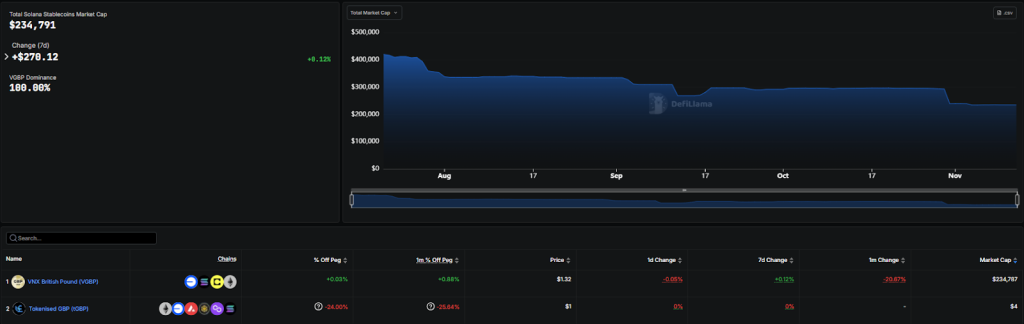
The global stablecoin market has now surpassed $312 billion, dominated by dollar-backed tokens from Tether and Circle, while sterling-based stablecoins remain under £600,000 in circulation.
Source: DefiLlama

Despite their limited footprint, officials say stablecoins could soon play a key role in domestic and cross-border payments as regulation takes shape.

Market Opportunity
Lorenzo Protocol Logo
Lorenzo Protocol Price(BANK)
$0.04083
$0.04083$0.04083
+1.18%
USD
Lorenzo Protocol (BANK) Live Price Chart
Disclaimer: The articles reposted on this site are sourced from public platforms and are provided for informational purposes only. They do not necessarily reflect the views of MEXC. All rights remain with the original authors. If you believe any content infringes on third-party rights, please contact service@support.mexc.com for removal. MEXC makes no guarantees regarding the accuracy, completeness, or timeliness of the content and is not responsible for any actions taken based on the information provided. The content does not constitute financial, legal, or other professional advice, nor should it be considered a recommendation or endorsement by MEXC.

You May Also Like

Grayscale ETF Tracking XRP, Solana and Cardano to Hit Wall Street After SEC Pause

Grayscale ETF Tracking XRP, Solana and Cardano to Hit Wall Street After SEC Pause

The post Grayscale ETF Tracking XRP, Solana and Cardano to Hit Wall Street After SEC Pause appeared on BitcoinEthereumNews.com. In brief The SEC said that Grayscale’s Digital Large Cap Fund conversion into an ETF is approved for listing and trading. The fund tracks the price of Bitcoin, Ethereum, Solana, XRP, and Cardano. Other ETFs tracking XRP and Dogecoin began trading on Thursday. An exchange-traded fund from crypto asset manager Grayscale that tracks the price of XRP, Solana, and Cardano—along with Bitcoin and Ethereum—was primed for its debut on the New York Stock Exchange, following long-sought approval from the SEC.  In an order on Wednesday, the regulator permitted the listing and trading of Grayscale’s Digital Large Cap Fund (GDLC), following an indefinite pause in July. The SEC meanwhile approved of generic listing standards for commodity-based products, paving the way for other crypto ETFs. A person familiar with the matter told Decrypt that GDLC is expected to begin trading on Friday. Unlike spot Bitcoin and Ethereum ETFs that debuted in the U.S. last year, GDLC is modeled on an index tracking the five largest and most liquid digital assets. Bitcoin represents 72% of the fund’s weighting, while Ethereum makes up 17%, according to Grayscale’s website. XRP, Solana, and Cardano account for 5.6%, 4%, and 1% of the fund’s exposure, respectively.  “The Grayscale team is working expeditiously to bring the FIRST multi-crypto asset ETP to market,” CEO Peter Mintzberg said on X on Wednesday, thanking the SEC for its “unmatched efforts in bringing the regulatory clarity our industry deserves.” Decrypt reached out to Grayscale for comment but did not immediately receive a response. Meanwhile, Dogecoin and XRP ETFs from Rex Shares and Osprey funds began trading on Thursday. The funds are registered under the Investment Company Act of 1940, a distinct set of rules compared to the process most asset managers have sought approval for crypto-focused products under. Not long ago,…
Share
BitcoinEthereumNews2025/09/19 04:19
SoftBank (SFTBY) Stock; Slight Dip Amid AMD Collaboration on AI Infrastructure

SoftBank (SFTBY) Stock; Slight Dip Amid AMD Collaboration on AI Infrastructure

TLDRs; SoftBank stock slips slightly as AI GPU collaboration with AMD is announced. The partnership tests GPU partitioning for efficient multi-tenant AI infrastructure
Share
Coincentral2026/02/16 15:29
Why Bittensor (TAO) Is Today’s Best-Performing Crypto

Why Bittensor (TAO) Is Today’s Best-Performing Crypto

The post Why Bittensor (TAO) Is Today’s Best-Performing Crypto appeared on BitcoinEthereumNews.com. Bittensor’s TAO token climbed nearly 8% to become the top gainer
Share
BitcoinEthereumNews2026/02/16 14:47