According to Messari’s Q3 2025 report, Filecoin’s total data stored through active deals reached 1,110 pebibytes (PiB), a marginal 1% decline from 1,120 PiB in Q2. The number of active deals also slipped slightly to 35.2 million. This small drop highlights a continued focus on higher-value storage rather than simply increasing raw supply. Average daily […]According to Messari’s Q3 2025 report, Filecoin’s total data stored through active deals reached 1,110 pebibytes (PiB), a marginal 1% decline from 1,120 PiB in Q2. The number of active deals also slipped slightly to 35.2 million. This small drop highlights a continued focus on higher-value storage rather than simply increasing raw supply. Average daily […]

Filecoin Storage Utilization Hits 36% as Verified Deals Dominate in Q3 2025
2025/11/15 16:00
Filecoin
  1. Filecoin’s total active storage remained stable at 1,110 PiB despite a slowdown in new deals.
  2. Storage utilization rose to 36% as smaller miners exited, reflecting network consolidation.
  3. Verified and high-volume datasets continued to dominate, supported by enterprise and research onboarding.

According to Messari’s Q3 2025 report, Filecoin’s total data stored through active deals reached 1,110 pebibytes (PiB), a marginal 1% decline from 1,120 PiB in Q2. The number of active deals also slipped slightly to 35.2 million. This small drop highlights a continued focus on higher-value storage rather than simply increasing raw supply.

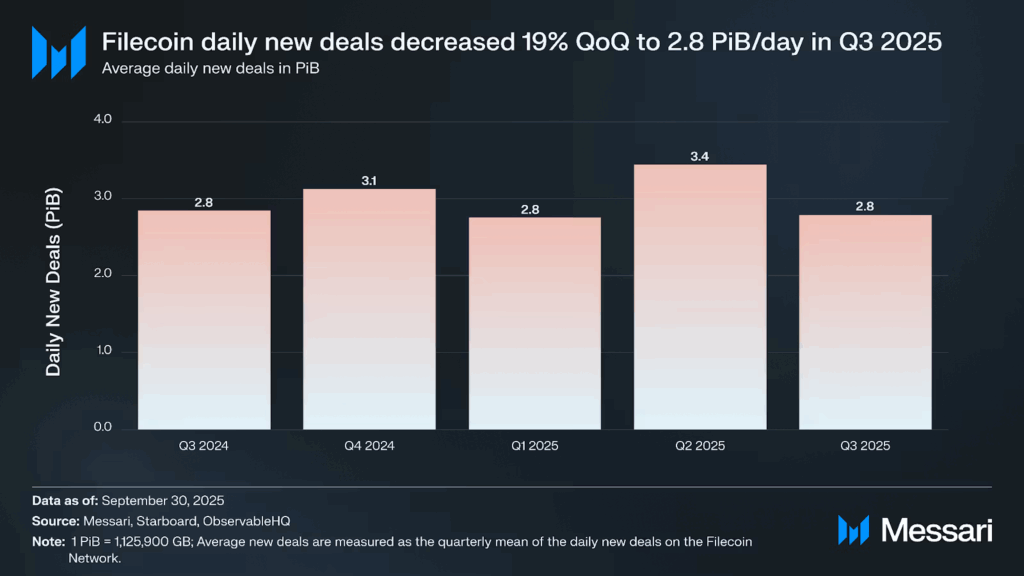
Average daily new storage deals declined 19% quarter-over-quarter, falling from 3.4 PiB to 2.8 PiB. The slowdown in new data onboarding contrasts with the relative stability of total active storage.
Source: Messari

Experts suggest this indicates that while fewer new deals are being added, existing verified datasets remain intact, reflecting long-term demand from enterprise and research clients.

The rollout of Filecoin Plus (Fil+) Allocator Pathways in late Q2 prioritized larger, verified clients. As a result, smaller and short-term deals have become rare, while high-value storage dominates.

Additionally, the Network v27 “Golden Week” upgrade simplified miner operations but temporarily slowed new deal formation. Consolidation among miners also contributed, as many smaller operators left the network amid stricter operational and collateral requirements.

Efficiency Gains Amid Capacity Reduction

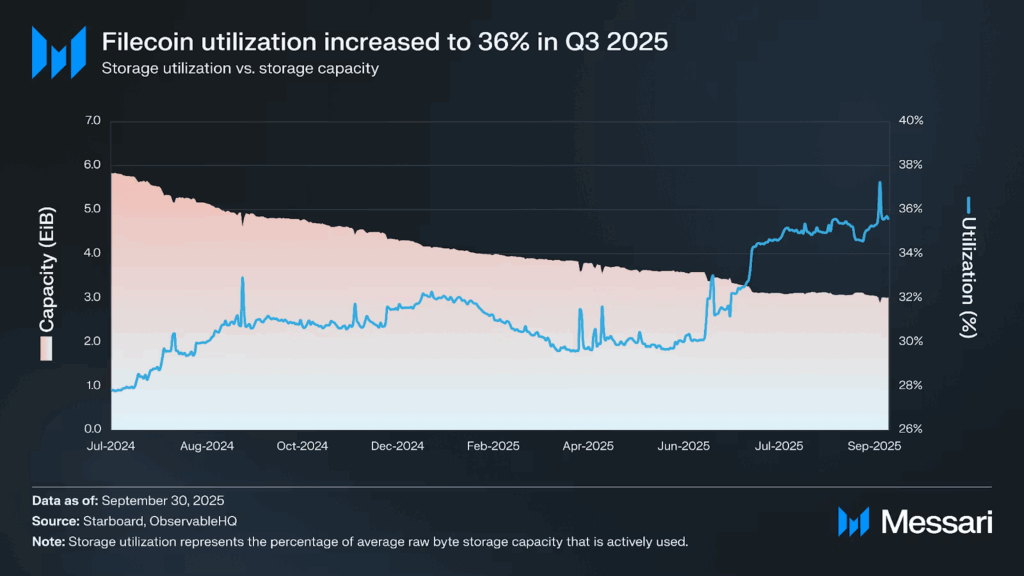
The storage usage ratio for Filecoin has also shown improvement, going to 36% during the third quarter, up from the second quarter’s 32%, even though the total committed capacity declined by 10% to 3.0 EiB.
Source: Messari

Many of the smaller and less efficient storage providers left the network after the v27 change, which deprecated old sealing and aggregation schemes. Although the capacity and the new deals are decreasing, the remaining storage capacity is being utilized efficiently.

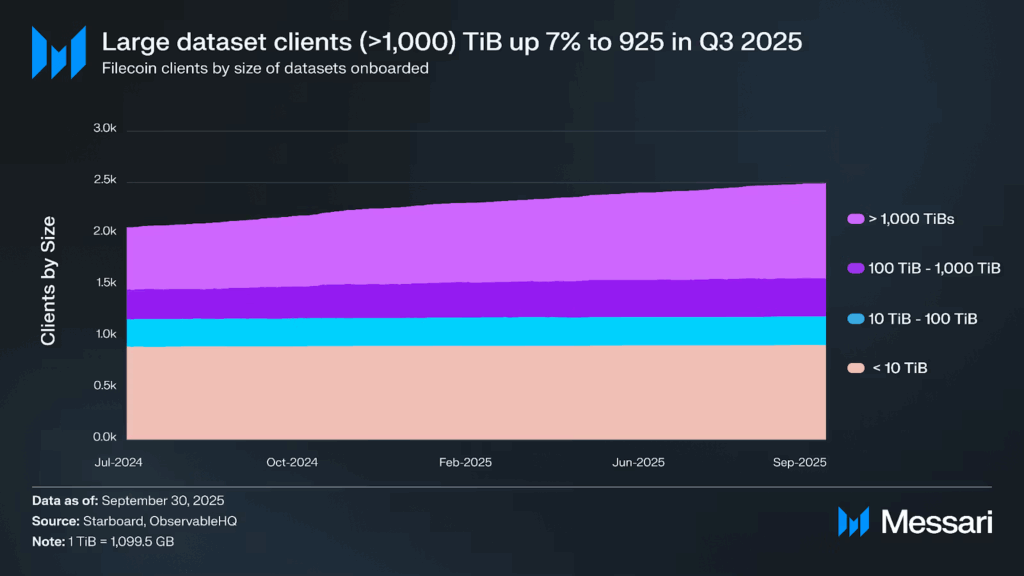
At the end of the Q3 period, Filecoin supported a total of 2,491 datasets, a growth of 3%, up from 2,416 at the end of the last quarter. What is significant is that the number of datasets over 1,000 TiB has grown to 925, reflecting a rise of 7%.
Source: Messari

This is enabled through ongoing Filecoin Plus adoption, the new integration tools that make data ingestion easier, and workloads that are enterprise-centric.

The FVM has also added further capabilities to the network by facilitating the Ethereum-style smart contract functionality on the storage level. This further provides developers with the capability of automating functions such as data onboarding, pricing, and retrieval and computation.

Filecoin Records $62.4M in Q3 Inflows, Down From Q2

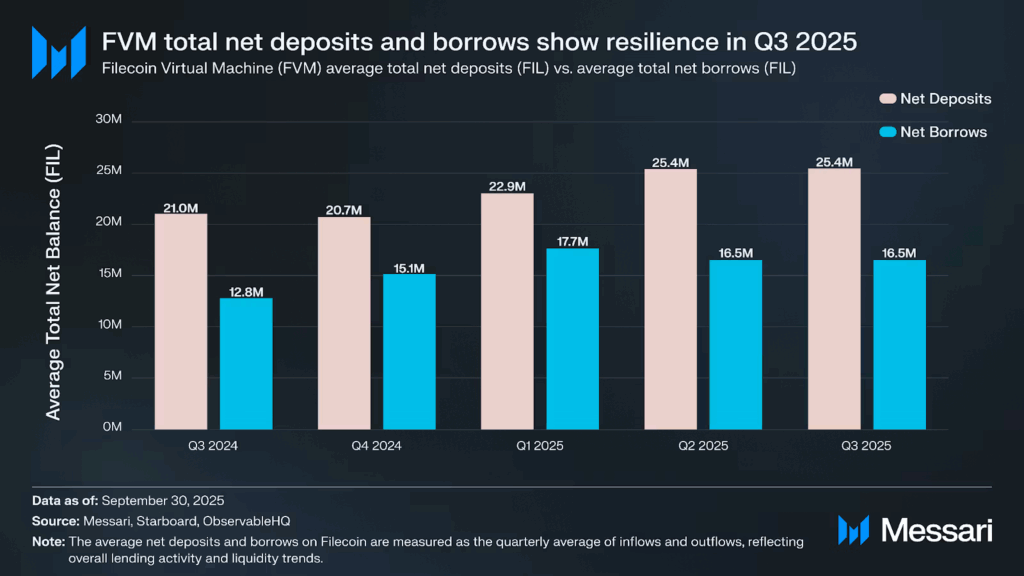
The third quarter of 2025 reported a total inflow of $62.4 million for Filecoin, a decline of 6.5% from the $66.8 million inflow of the second quarter. The outflows and borrowings were also lower, sliding from $43.4 million to $40.5 million.
Source: Messari

The trend for FIL token transactions was the reverse, however, with the inflows slightly up at 25.43 million FIL and the outflows slightly lower at 16.52 million FIL. The difference between the USD and FIL-denominated transaction amounts is caused by a drop of 5% in the FIL token’s price, which declined to $2.19 from $2.30.

Also Read: Filecoin (FIL) Price Prediction 2025: Can This Hidden Gem Soar to $5.56?

Disclaimer: The articles reposted on this site are sourced from public platforms and are provided for informational purposes only. They do not necessarily reflect the views of MEXC. All rights remain with the original authors. If you believe any content infringes on third-party rights, please contact service@support.mexc.com for removal. MEXC makes no guarantees regarding the accuracy, completeness, or timeliness of the content and is not responsible for any actions taken based on the information provided. The content does not constitute financial, legal, or other professional advice, nor should it be considered a recommendation or endorsement by MEXC.

You May Also Like

The Channel Factories We’ve Been Waiting For

The Channel Factories We’ve Been Waiting For

The post The Channel Factories We’ve Been Waiting For appeared on BitcoinEthereumNews.com. Visions of future technology are often prescient about the broad strokes while flubbing the details. The tablets in “2001: A Space Odyssey” do indeed look like iPads, but you never see the astronauts paying for subscriptions or wasting hours on Candy Crush.  Channel factories are one vision that arose early in the history of the Lightning Network to address some challenges that Lightning has faced from the beginning. Despite having grown to become Bitcoin’s most successful layer-2 scaling solution, with instant and low-fee payments, Lightning’s scale is limited by its reliance on payment channels. Although Lightning shifts most transactions off-chain, each payment channel still requires an on-chain transaction to open and (usually) another to close. As adoption grows, pressure on the blockchain grows with it. The need for a more scalable approach to managing channels is clear. Channel factories were supposed to meet this need, but where are they? In 2025, subnetworks are emerging that revive the impetus of channel factories with some new details that vastly increase their potential. They are natively interoperable with Lightning and achieve greater scale by allowing a group of participants to open a shared multisig UTXO and create multiple bilateral channels, which reduces the number of on-chain transactions and improves capital efficiency. Achieving greater scale by reducing complexity, Ark and Spark perform the same function as traditional channel factories with new designs and additional capabilities based on shared UTXOs.  Channel Factories 101 Channel factories have been around since the inception of Lightning. A factory is a multiparty contract where multiple users (not just two, as in a Dryja-Poon channel) cooperatively lock funds in a single multisig UTXO. They can open, close and update channels off-chain without updating the blockchain for each operation. Only when participants leave or the factory dissolves is an on-chain transaction…
Share
BitcoinEthereumNews2025/09/18 00:09
American Bitcoin’s $5B Nasdaq Debut Puts Trump-Backed Miner in Crypto Spotlight

American Bitcoin’s $5B Nasdaq Debut Puts Trump-Backed Miner in Crypto Spotlight

The post American Bitcoin’s $5B Nasdaq Debut Puts Trump-Backed Miner in Crypto Spotlight appeared on BitcoinEthereumNews.com. Key Takeaways: American Bitcoin (ABTC) surged nearly 85% on its Nasdaq debut, briefly reaching a $5B valuation. The Trump family, alongside Hut 8 Mining, controls 98% of the newly merged crypto-mining entity. Eric Trump called Bitcoin “modern-day gold,” predicting it could reach $1 million per coin. American Bitcoin, a fast-rising crypto mining firm with strong political and institutional backing, has officially entered Wall Street. After merging with Gryphon Digital Mining, the company made its Nasdaq debut under the ticker ABTC, instantly drawing global attention to both its stock performance and its bold vision for Bitcoin’s future. Read More: Trump-Backed Crypto Firm Eyes Asia for Bold Bitcoin Expansion Nasdaq Debut: An Explosive First Day ABTC’s first day of trading proved as dramatic as expected. Shares surged almost 85% at the open, touching a peak of $14 before settling at lower levels by the close. That initial spike valued the company around $5 billion, positioning it as one of 2025’s most-watched listings. At the last session, ABTC has been trading at $7.28 per share, which is a small positive 2.97% per day. Although the price has decelerated since opening highs, analysts note that the company has been off to a strong start and early investor activity is a hard-to-find feat in a newly-launched crypto mining business. According to market watchers, the listing comes at a time of new momentum in the digital asset markets. With Bitcoin trading above $110,000 this quarter, American Bitcoin’s entry comes at a time when both institutional investors and retail traders are showing heightened interest in exposure to Bitcoin-linked equities. Ownership Structure: Trump Family and Hut 8 at the Helm Its management and ownership set up has increased the visibility of the company. The Trump family and the Canadian mining giant Hut 8 Mining jointly own 98 percent…
Share
BitcoinEthereumNews2025/09/18 01:33