Recently, the Hyperliquid HIP3 protocol has become incredibly popular, with stocks, gold, and even Pokémon cards and CS skins now available for trading. This has made Hyperliquid incredibly successful, but many people have overlooked the fact that Arbitrum's liquidity has also seen a significant surge in the past. Is it true that the more popular Hyperliquid becomes, the more Arbitrum can "quietly make a fortune"? Why is that? 1) A fundamental fact is that most of the USDC held by Hyperliquid is bridged from Arbitrum. Whenever Hyperliquid launches a TSLA stock contract or a gold perp, a massive amount of USDC flows in from Arbitrum. This connection is not incidental, but a structural dependency. These bridging activities directly contributed to Arbitrum's daily transaction volume and ecosystem activity, propelling Arbitrum to maintain its leading position in layer 2. 2) Of course, some might say that Arbitrum is merely a stepping stone for Hyperliquid's funding, a one-way street where funds simply pass through. Then why doesn't Hyperliquid choose Solana or Base, but instead deeply integrates with Arbitrum? The reasons are as follows: 1. Lowest technical adaptation cost: Hyperliquid requires a liquidity entry point with good EVM compatibility to securely accept stablecoins, while Arbitrum's Nitro architecture can keep bridging latency within 1 minute and the gas fee is less than $0.01, so users can hardly feel the friction cost. 2. Unparalleled Liquidity Depth: Arbitrum's native USDC circulating supply reaches $8.06 billion, the highest among all Layer 2 platforms. Furthermore, Arbitrum has mature protocols like GMX and Gains that have formed a complete closed loop encompassing lending, trading, derivatives, and yield aggregation. Essentially, Hyperliquid's choice of Arbitrum is not merely about a bridging channel, but about accessing a mature liquidity network. 3. The synergistic effect of the ecosystem is irreplaceable: Some of the new stock PERP, gold PERP, and even government bond tokens launched in HIP3 already existed on Arbitrum as RWA assets, and were used for lending and farming through DeFi protocols such as Morpho, Pendle, and Euler. This allows users to stake RWA assets as collateral on Arbitrum to borrow USDC, and then bridge to Hyperliquid to trade stock PERP with 5x or even 10x leverage. This isn't just a one-way transfer of funds; it's a cross-ecosystem liquidity aggregation. 3) In my view, the relationship between Hyperliquid and Arbitrum is not a simple liquidity "parasitic relationship," but rather a strategic complementarity. Hyperliquid, as the application chain of Perp Dex, continues to stimulate transaction activity, while Arbitrum provides a continuous influx of liquidity. For Arbitrum, it also needs phenomenal applications like Hyperliquid to overcome the lack of product dynamism in the Ethereum ecosystem. This reminds me of when Arbitrum was promoting the Orbit layer3 framework, its main selling point was the "general layer2 + specialized application chain" approach. Orbit allowed any team to quickly deploy their own Layer3 application chain, enjoying Arbitrum's security and liquidity while customizing performance parameters according to business needs. While Hyperliquid chose a path of building its own layer 1 and deeply binding with Arbitrum, which seems different from directly deploying layer 3, a closer analysis of the relationship between the HIP-3 ecosystem and Arbitrum reveals an interesting conclusion: the HIP-3 ecosystem has, to some extent, become the de facto layer 3 application chain of Arbitrum. Ultimately, the core logic of Layer 3 is to maintain its own performance advantages while outsourcing security and liquidity to Layer 2. Clearly, Hyperliquid cannot currently offer the liquidity advantages of the HIP3 ecosystem, but Arbitrum can. Isn't this just a variant of the layer 3 operating mode?Recently, the Hyperliquid HIP3 protocol has become incredibly popular, with stocks, gold, and even Pokémon cards and CS skins now available for trading. This has made Hyperliquid incredibly successful, but many people have overlooked the fact that Arbitrum's liquidity has also seen a significant surge in the past. Is it true that the more popular Hyperliquid becomes, the more Arbitrum can "quietly make a fortune"? Why is that? 1) A fundamental fact is that most of the USDC held by Hyperliquid is bridged from Arbitrum. Whenever Hyperliquid launches a TSLA stock contract or a gold perp, a massive amount of USDC flows in from Arbitrum. This connection is not incidental, but a structural dependency. These bridging activities directly contributed to Arbitrum's daily transaction volume and ecosystem activity, propelling Arbitrum to maintain its leading position in layer 2. 2) Of course, some might say that Arbitrum is merely a stepping stone for Hyperliquid's funding, a one-way street where funds simply pass through. Then why doesn't Hyperliquid choose Solana or Base, but instead deeply integrates with Arbitrum? The reasons are as follows: 1. Lowest technical adaptation cost: Hyperliquid requires a liquidity entry point with good EVM compatibility to securely accept stablecoins, while Arbitrum's Nitro architecture can keep bridging latency within 1 minute and the gas fee is less than $0.01, so users can hardly feel the friction cost. 2. Unparalleled Liquidity Depth: Arbitrum's native USDC circulating supply reaches $8.06 billion, the highest among all Layer 2 platforms. Furthermore, Arbitrum has mature protocols like GMX and Gains that have formed a complete closed loop encompassing lending, trading, derivatives, and yield aggregation. Essentially, Hyperliquid's choice of Arbitrum is not merely about a bridging channel, but about accessing a mature liquidity network. 3. The synergistic effect of the ecosystem is irreplaceable: Some of the new stock PERP, gold PERP, and even government bond tokens launched in HIP3 already existed on Arbitrum as RWA assets, and were used for lending and farming through DeFi protocols such as Morpho, Pendle, and Euler. This allows users to stake RWA assets as collateral on Arbitrum to borrow USDC, and then bridge to Hyperliquid to trade stock PERP with 5x or even 10x leverage. This isn't just a one-way transfer of funds; it's a cross-ecosystem liquidity aggregation. 3) In my view, the relationship between Hyperliquid and Arbitrum is not a simple liquidity "parasitic relationship," but rather a strategic complementarity. Hyperliquid, as the application chain of Perp Dex, continues to stimulate transaction activity, while Arbitrum provides a continuous influx of liquidity. For Arbitrum, it also needs phenomenal applications like Hyperliquid to overcome the lack of product dynamism in the Ethereum ecosystem. This reminds me of when Arbitrum was promoting the Orbit layer3 framework, its main selling point was the "general layer2 + specialized application chain" approach. Orbit allowed any team to quickly deploy their own Layer3 application chain, enjoying Arbitrum's security and liquidity while customizing performance parameters according to business needs. While Hyperliquid chose a path of building its own layer 1 and deeply binding with Arbitrum, which seems different from directly deploying layer 3, a closer analysis of the relationship between the HIP-3 ecosystem and Arbitrum reveals an interesting conclusion: the HIP-3 ecosystem has, to some extent, become the de facto layer 3 application chain of Arbitrum. Ultimately, the core logic of Layer 3 is to maintain its own performance advantages while outsourcing security and liquidity to Layer 2. Clearly, Hyperliquid cannot currently offer the liquidity advantages of the HIP3 ecosystem, but Arbitrum can. Isn't this just a variant of the layer 3 operating mode?

Does Hyperliquid's popularity mean Arbitrum is "winning by default"?

2025/12/04 08:00
3 min read

Recently, the Hyperliquid HIP3 protocol has become incredibly popular, with stocks, gold, and even Pokémon cards and CS skins now available for trading. This has made Hyperliquid incredibly successful, but many people have overlooked the fact that Arbitrum's liquidity has also seen a significant surge in the past.

Is it true that the more popular Hyperliquid becomes, the more Arbitrum can "quietly make a fortune"? Why is that?

1) A fundamental fact is that most of the USDC held by Hyperliquid is bridged from Arbitrum. Whenever Hyperliquid launches a TSLA stock contract or a gold perp, a massive amount of USDC flows in from Arbitrum. This connection is not incidental, but a structural dependency.

These bridging activities directly contributed to Arbitrum's daily transaction volume and ecosystem activity, propelling Arbitrum to maintain its leading position in layer 2.

2) Of course, some might say that Arbitrum is merely a stepping stone for Hyperliquid's funding, a one-way street where funds simply pass through. Then why doesn't Hyperliquid choose Solana or Base, but instead deeply integrates with Arbitrum? The reasons are as follows:

1. Lowest technical adaptation cost: Hyperliquid requires a liquidity entry point with good EVM compatibility to securely accept stablecoins, while Arbitrum's Nitro architecture can keep bridging latency within 1 minute and the gas fee is less than $0.01, so users can hardly feel the friction cost.

2. Unparalleled Liquidity Depth: Arbitrum's native USDC circulating supply reaches $8.06 billion, the highest among all Layer 2 platforms. Furthermore, Arbitrum has mature protocols like GMX and Gains that have formed a complete closed loop encompassing lending, trading, derivatives, and yield aggregation. Essentially, Hyperliquid's choice of Arbitrum is not merely about a bridging channel, but about accessing a mature liquidity network.

3. The synergistic effect of the ecosystem is irreplaceable: Some of the new stock PERP, gold PERP, and even government bond tokens launched in HIP3 already existed on Arbitrum as RWA assets, and were used for lending and farming through DeFi protocols such as Morpho, Pendle, and Euler. This allows users to stake RWA assets as collateral on Arbitrum to borrow USDC, and then bridge to Hyperliquid to trade stock PERP with 5x or even 10x leverage. This isn't just a one-way transfer of funds; it's a cross-ecosystem liquidity aggregation.

3) In my view, the relationship between Hyperliquid and Arbitrum is not a simple liquidity "parasitic relationship," but rather a strategic complementarity.

Hyperliquid, as the application chain of Perp Dex, continues to stimulate transaction activity, while Arbitrum provides a continuous influx of liquidity. For Arbitrum, it also needs phenomenal applications like Hyperliquid to overcome the lack of product dynamism in the Ethereum ecosystem.

This reminds me of when Arbitrum was promoting the Orbit layer3 framework, its main selling point was the "general layer2 + specialized application chain" approach. Orbit allowed any team to quickly deploy their own Layer3 application chain, enjoying Arbitrum's security and liquidity while customizing performance parameters according to business needs.

While Hyperliquid chose a path of building its own layer 1 and deeply binding with Arbitrum, which seems different from directly deploying layer 3, a closer analysis of the relationship between the HIP-3 ecosystem and Arbitrum reveals an interesting conclusion: the HIP-3 ecosystem has, to some extent, become the de facto layer 3 application chain of Arbitrum.

Ultimately, the core logic of Layer 3 is to maintain its own performance advantages while outsourcing security and liquidity to Layer 2. Clearly, Hyperliquid cannot currently offer the liquidity advantages of the HIP3 ecosystem, but Arbitrum can.

Isn't this just a variant of the layer 3 operating mode?

Market Opportunity
Collector Crypt Logo
Collector Crypt Price(CARDS)
$0.0515
$0.0515$0.0515
-0.80%
USD
Collector Crypt (CARDS) Live Price Chart
Disclaimer: The articles reposted on this site are sourced from public platforms and are provided for informational purposes only. They do not necessarily reflect the views of MEXC. All rights remain with the original authors. If you believe any content infringes on third-party rights, please contact service@support.mexc.com for removal. MEXC makes no guarantees regarding the accuracy, completeness, or timeliness of the content and is not responsible for any actions taken based on the information provided. The content does not constitute financial, legal, or other professional advice, nor should it be considered a recommendation or endorsement by MEXC.

You May Also Like

Horror Thriller ‘Bring Her Back’ Gets HBO Max Premiere Date

Horror Thriller ‘Bring Her Back’ Gets HBO Max Premiere Date

The post Horror Thriller ‘Bring Her Back’ Gets HBO Max Premiere Date appeared on BitcoinEthereumNews.com. Jonah Wren Phillips in “Bring Her Back.” A24 Bring Her Back, a new A24 horror movie from the filmmakers of the smash hit Talk to Me, is coming soon to HBO Max. Bring Her Back opened in theaters on May 30 before debuting on digital streaming via premium video on demand on July 1. The official logline for Bring Her Back reads, “A brother and sister uncover a terrifying ritual at the secluded home of their new foster mother.” Forbes‘South Park’ Season 27 Updated Release Schedule: When Do New Episodes Come Out?By Tim Lammers Directed by twin brothers Danny Philippou and Michael Philippou, Bring Her Back stars Billy Barratt, Sora Wong, Jonah Wren Philips, Sally–Anne Upton, Stephen Philips, Mischa Heywood and Sally Hawkins. Warner Bros. Discovery announced on Wednesday that Bring Her Back will arrive on streaming on HBO Max on Friday, Oct. 3, and on HBO linear on Saturday, Oct. 4, at 8 p.m. ET. Prior to the debut of Bring Her Back on HBO on Oct. 4, the cable outlet will air the Philippou brothers’ 2022 horror hit Talk to Me. ForbesHit Horror Thriller ’28 Years Later’ Is New On Netflix This WeekBy Tim Lammers For viewers who don’t have HBO Max, the streaming platform offers three tiers: The ad-based tier costs $9.99 per month, while an ad-free tier is $16.99 per month. Additionally, an ad-free tier with 4K Ultra HD programming costs $20.99 per month. The Success Of ‘Talk To Me’ Weighed On The Minds Of Philippou Brothers While Making ‘Bring Her Back’ During the film’s theatrical run, Bring Her Back earned $19.3 million domestically and nearly $19.8 million internationally for a worldwide box office tally of $39.1 million. Bring Her Back had a production budget of $17 million before prints and advertising, according to The Numbers.…
Share
BitcoinEthereumNews2025/09/18 09:23
While Shiba Inu and Turbo Chase Price, 63% APY Staking Puts APEMARS at the Forefront of the Best Meme Coin Presale 2026 – Stage 6 Ends in 3 Days!
While Shiba Inu and Turbo Chase Price, 63% APY Staking Puts APEMARS at the Forefront of the Best Meme Coin Presale 2026 – Stage 6 Ends in 3 Days!

What if your meme coin investment could generate passive income without selling a single token? Shiba Inu climbed 4.97% as 207 billion tokens left exchanges. Turbo
Share
Coinstats2026/02/04 03:15
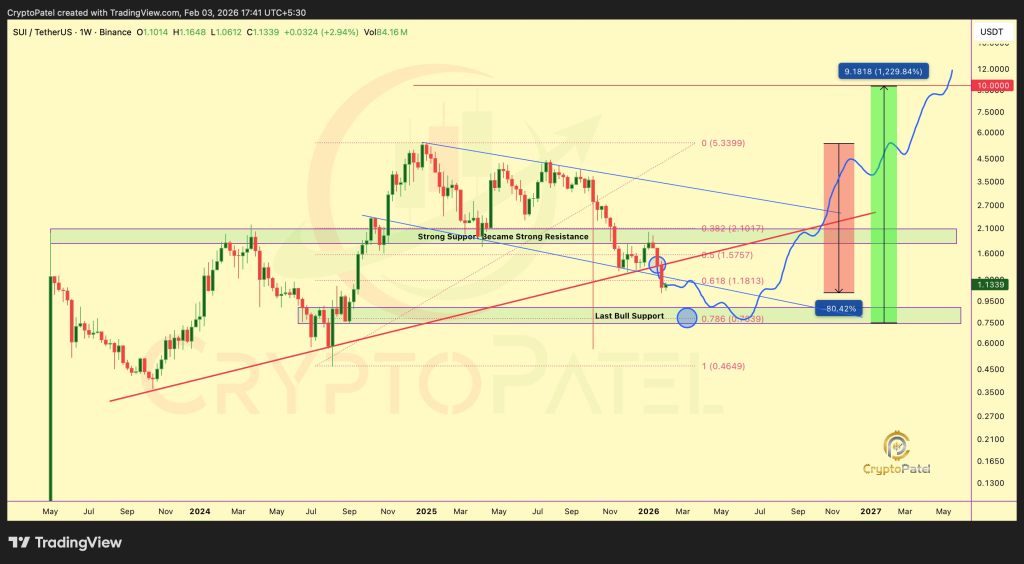
SUI Price Is Down 80%: Price Nears Level Bulls Cannot Afford to Lose

SUI Price Is Down 80%: Price Nears Level Bulls Cannot Afford to Lose

SUI price has quietly slipped into a zone that usually decides everything. Charts show an 80% drop from the peak, yet the market is no longer moving fast. This
Share
Captainaltcoin2026/02/04 03:00