Arizona lawmakers are weighing a new attempt to carve out a more permissive tax environment for digital assets, as a trio of proposals introduced by State SenatorArizona lawmakers are weighing a new attempt to carve out a more permissive tax environment for digital assets, as a trio of proposals introduced by State Senator

Arizona Eyes ‘Tax-Free’ Status: New Bill Seeks to Ban Local Crypto Taxes

Arizona lawmakers are weighing a new attempt to carve out a more permissive tax environment for digital assets, as a trio of proposals introduced by State Senator Wendy Rogers pushes to limit how cryptocurrencies and blockchain infrastructure can be taxed at the state and local level.

The effort centers on two bills and a constitutional resolution prefiled with the Arizona Senate late last week.
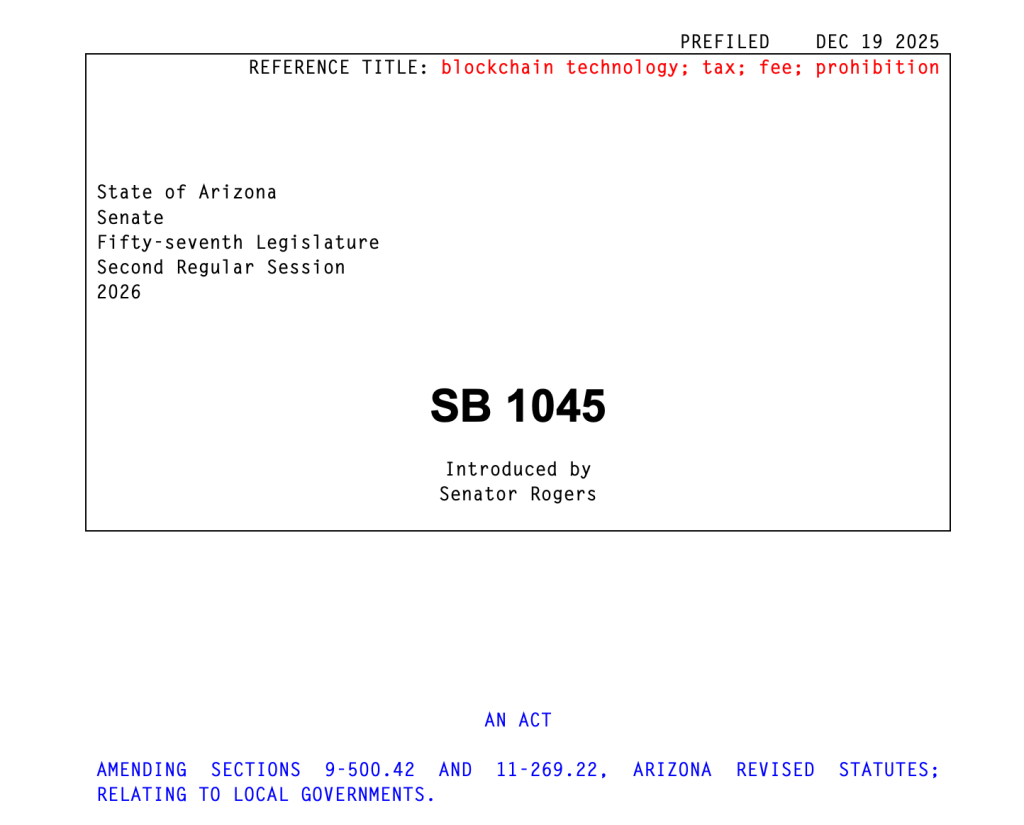
Source: Arizona legislature

One proposal, SB 1044, would amend state statutes to exempt virtual currency from taxation, while another, SB 1045, would bar counties, cities, and towns from imposing taxes or fees on people or companies that operate blockchain nodes.

A third measure, SCR 1003, would amend Arizona’s constitution to explicitly exclude virtual currency from property tax. If enacted, the node-related bill could take effect through the state legislature alone.

Arizona Pushes Crypto Tax Boundaries, but Voters Hold the Final Say

The broader tax exemption proposals, however, would require voter approval during Arizona’s next general election in November 2026.

Under current law, Arizona is not a tax-free state. Residents pay a flat personal income tax rate of 2.5%, along with a state sales tax known as the Transaction Privilege Tax, which starts at 5.6% and rises above 8.5% on average once local rates are included.

Property taxes are also collected, though they are generally lower than in many other states.

Cryptocurrency is treated as property for federal tax purposes, meaning sales, trades, or payments trigger capital gains or losses.

Arizona largely follows that framework but has adopted several crypto-specific rules. Since December 2022, the state has exempted crypto airdrops from state income tax by treating them as gifts at the time they are received, even though federal taxes still apply.

Source: Arizona Form 165 Schedule K-1(NR)

Arizona also allows transaction fees, or gas fees, to be deducted when calculating gains or losses and permits state agencies to accept cryptocurrency payments through approved service providers.

Rogers’ latest proposals would go further by attempting to remove virtual currency from the state’s tax base entirely and by shielding blockchain node operators from local government levies.

Arizona already stands out as one of the few states with a law allowing the government to claim ownership of digital assets deemed abandoned after three years, a measure tied to earlier efforts to establish a state-level digital asset reserve.

The senator was also a co-sponsor of a Bitcoin reserve bill vetoed in May by Governor Katie Hobbs.

In June, the Arizona Senate later passed a revised Bitcoin reserve bill as it cleared the chamber in a narrow 16–14 vote after approving a motion to reconsider the measure.

From State Experiments to Capitol Hill, Crypto Tax Rules Are Back in Play

The Arizona push comes as debates over crypto taxation intensify nationwide. A handful of states, including Florida, Texas, Wyoming, and Nevada, do not impose personal income taxes, effectively making most crypto gains tax-free at the state level.

Others have taken more targeted approaches. Missouri, in August, eliminated state income tax on capital gains, while Ohio lawmakers have advanced a proposal to exempt small crypto transactions under $200, though that bill has stalled.

At the federal level, Congress is preparing to revisit crypto tax policy after nearly a decade of relying on Internal Revenue Service guidance issued in 2014.

In December, Representative Max Miller said a draft bill to modernize digital asset taxation could move before the August 2026 recess.

More recently, bipartisan House lawmakers released a discussion draft that would exempt small stablecoin payments from capital gains tax and allow a five-year deferral on staking and mining rewards.

Market Opportunity
FreeRossDAO Logo
FreeRossDAO Price(FREE)
$0.00010906
$0.00010906$0.00010906
-0.54%
USD
FreeRossDAO (FREE) Live Price Chart
Disclaimer: The articles reposted on this site are sourced from public platforms and are provided for informational purposes only. They do not necessarily reflect the views of MEXC. All rights remain with the original authors. If you believe any content infringes on third-party rights, please contact service@support.mexc.com for removal. MEXC makes no guarantees regarding the accuracy, completeness, or timeliness of the content and is not responsible for any actions taken based on the information provided. The content does not constitute financial, legal, or other professional advice, nor should it be considered a recommendation or endorsement by MEXC.

You May Also Like

Satoshi-Era Mt. Gox’s 1,000 Bitcoin Wallet Suddenly Reactivated

Satoshi-Era Mt. Gox’s 1,000 Bitcoin Wallet Suddenly Reactivated

The post Satoshi-Era Mt. Gox’s 1,000 Bitcoin Wallet Suddenly Reactivated appeared on BitcoinEthereumNews.com. X account @SaniExp, which belongs to the founder of the Timechain Index explorer, has published data showing that a dormant BTC wallet was activated after hibernating for six years. However, it was set up 13 years ago, according to the tweet — the time when Satoshi Nakamoto’s shadow was still casting itself around, so to speak. The X post states that the tweet belongs to infamous early Bitcoin exchange Mt. Gox, which suffered from a major hack in the early 2010s, and last year it began paying out compensation to clients who lost their crypto in that hack. The deadline was eventually extended to October 2025. Mt. Gox’s wallet with 1,000 BTC reactivated The above-mentioned data source shared a screenshot from the Timechain Index explorer, showing multiple transactions marked as confirmed and moving a total of 1,000 Bitcoins. This amount of crypto is valued at $116,195,100 at the time of the initiated transaction. Last year, Mt. Gox began to move the remains of its gargantuan funds to pay out compensations to its creditors. Earlier this year, it also made several massive transactions to partner exchanges to distribute funds to Mt. Gox investors. All of the compensations were promised to be paid out by Oct. 31, 2025. The aforementioned transaction is likely preparation for another payout. The exchange was hacked for several years due to multiple unnoticed security breaches, and in 2014, when the site went offline, 744,408 Bitcoins were reported stolen. Source: https://u.today/satoshi-era-mtgoxs-1000-bitcoin-wallet-suddenly-reactivated
Share
BitcoinEthereumNews2025/09/18 10:18
lessons from Malta’s Papaya case

lessons from Malta’s Papaya case

The post lessons from Malta’s Papaya case appeared on BitcoinEthereumNews.com. SPONSORED POST* Standfirst: In August 2025, Malta became the unlikely stage for a clash between a fintech firm and one of the island’s most powerful newspapers. Papaya Ltd’s response – measured, legalistic, and paired with concrete operational moves, now stands as a case study in how financial institutions can build resilience under pressure. Drawing on the joint expertise of Lincoln’s Inn barrister (UK)  Hamna Zain and former Deutsche Bank professional Davor Zilic (croatian fintech specialist), this article examines what happened, and what it tells us about the uneasy balance between law, journalism and finance. In early August 2025, Papaya Ltd – a licensed Maltese electronic money institution (EMI), found itself in the eye of a media storm. The Times of Malta, the country’s largest daily, sent the company a list of probing questions which, Papaya argued, would have forced it to reveal confidential information from a 2021 compliance audit. The firm turned to the courts, asking for a temporary injunction to prevent publication. A judge granted a temporary protective measure pending a full hearing on its request for an injunction, that blocked the newspaper from publishing an as-yet-unwritten article about the company. The request for a substantive injunction was ultimately refused on 12 August. This legal action, triggered after one of the newspaper’s journalists sent questions to Papaya, prompted heated debate about press freedom, censorship, and the responsibilities of both media and financial firms. The headlines were immediate and emotive. “Times of Malta hit by court ‘gagging order’ from e-money firm”. “We’ve been gagged. This is why it matters.” For days, the injunction was portrayed as an assault on press freedom. The newspaper itself argued that “preventing a journalist from publishing a story is recognised in all democratic countries as illegal and a violation of the journalist’s fundamental right to…
Share
BitcoinEthereumNews2025/09/20 23:05
Ripple CTO Explains How The XRP Ledger ‘Will Take Over The World’

Ripple CTO Explains How The XRP Ledger ‘Will Take Over The World’

On a Token Relations webinar for the XRP ecosystem on Dec. 20, Ripple CTO David Schwartz was asked the sort of question that usually produces a tidy dashboard answer
Share
Bitcoinist2025/12/24 06:00