Cardano (ADA) price continues to show clear signs of weakness as price action drifts lower within a firmly established bearish structure.Cardano (ADA) price continues to show clear signs of weakness as price action drifts lower within a firmly established bearish structure.

Cardano price drifts toward a new yearly low as bearish pressure persists

Cardano price remains under sustained selling pressure as bearish structure holds firm, increasing the risk of a breakdown toward and potentially below the $0.27 yearly low.

Summary
  • Cardano prints consecutive lower highs and lower lows.
  • Price fails to reclaim the Point of Control and Value Area Low.
  • Downside risk remains toward the $0.27 yearly low.

Cardano (ADA) price continues to show clear signs of weakness as price action drifts lower within a firmly established bearish structure. Despite multiple attempts to stabilize, sellers remain in control, preventing any meaningful shift in momentum.

With consecutive lower highs and lower lows still intact, the technical outlook suggests that downside risk remains elevated, placing the $0.27 yearly low firmly in focus.

Cardano price key technical points

  • Bearish market structure remains intact, defined by lower highs and lower lows.
  • Repeated bearish retests at high-time-frame resistance confirm weakness.
  • Failure to reclaim value increases the risk of a move toward or below $0.27.
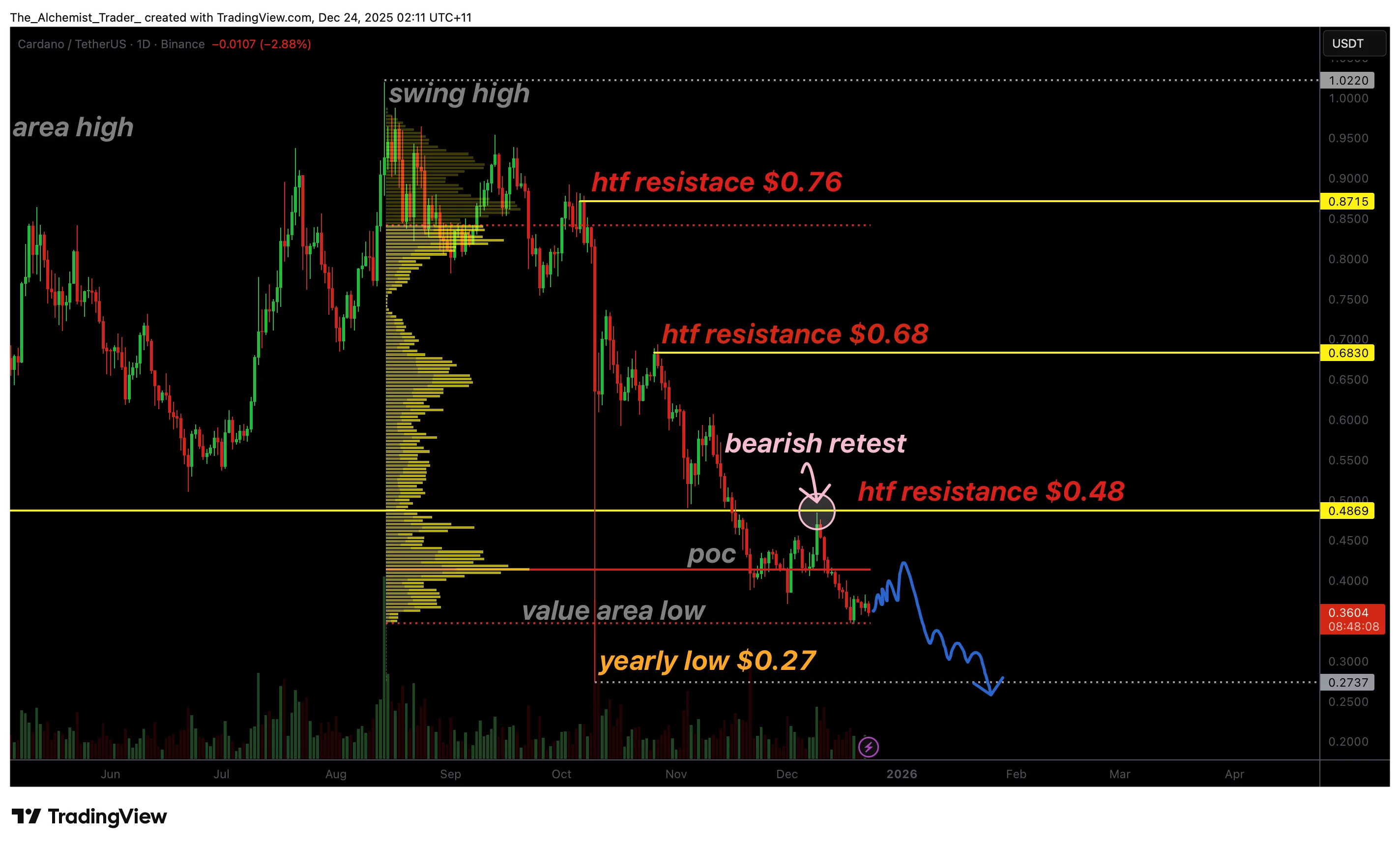
Cardano price drifts toward a new yearly low as bearish pressure persists - 1

Cardano’s current price behavior reflects a market struggling to find demand amid persistent selling pressure. The defining feature of ADA’s chart is the continuation of a bearish market structure, where each rally attempt has resulted in a lower high. This pattern indicates that buyers are unable to generate sufficient momentum to challenge sellers at key resistance levels.

High-time-frame resistance zones have repeatedly been back-tested and rejected, reinforcing the broader downtrend. These bearish retests are particularly significant because they confirm acceptance at lower prices rather than signaling temporary deviations. Each rejection adds weight to the bearish thesis, reducing the probability of an imminent reversal.

From a volume-profile perspective, Cardano has been unable to reclaim the Point of Control (POC), a level that represents the area of highest traded volume within the recent range.

Trading below the POC suggests that the market is operating beneath fair value, a condition that often favors continuation lower unless buyers can force acceptance back above this level, despite Apex Fusion rolling out VECTOR to support Cardano’s institutional expansion, highlighting the disconnect between longer-term ecosystem developments and near-term price weakness.

The Value Area Low (VAL) is another critical reference point. As long as price remains below this level, downside risk remains elevated. A failure to hold or reclaim the VAL would further confirm bearish continuation, increasing the likelihood that price seeks out deeper liquidity.

The $0.27 yearly low now stands out as the most important downside level. This area has not been meaningfully reclaimed since its formation, making it a natural magnet for price during periods of sustained weakness. Markets often revisit such levels to test whether demand still exists, especially when bearish structure remains intact.

If ADA fails to reclaim the POC and continues to trade below the Value Area Low, the probability of a new yearly low forming increases significantly. Such a move would represent a continuation of the broader downtrend rather than an anomalous event. In trending markets, price often overshoots prior lows before meaningful stabilization occurs.

From a price-action standpoint, the lack of strong bullish reactions further reinforces the bearish outlook. Recent bounces have been shallow and quickly sold into, suggesting that demand remains weak and reactive rather than proactive.

This type of behavior is typical during sustained downtrends, where rallies serve as opportunities for sellers to re-enter positions.

What to expect in the coming price action

As long as Cardano remains below the Point of Control and fails to reclaim the Value Area Low, downside risk remains dominant. Continued weakness increases the probability of a test of the $0.27 yearly low, with the potential for a new yearly low if bearish pressure persists.

A shift in bias will require a clear break in bearish structure and acceptance back above key resistance levels.

Market Opportunity
Cardano Logo
Cardano Price(ADA)
$0.3629
$0.3629$0.3629
+0.58%
USD
Cardano (ADA) Live Price Chart
Disclaimer: The articles reposted on this site are sourced from public platforms and are provided for informational purposes only. They do not necessarily reflect the views of MEXC. All rights remain with the original authors. If you believe any content infringes on third-party rights, please contact service@support.mexc.com for removal. MEXC makes no guarantees regarding the accuracy, completeness, or timeliness of the content and is not responsible for any actions taken based on the information provided. The content does not constitute financial, legal, or other professional advice, nor should it be considered a recommendation or endorsement by MEXC.

You May Also Like

Satoshi-Era Mt. Gox’s 1,000 Bitcoin Wallet Suddenly Reactivated

Satoshi-Era Mt. Gox’s 1,000 Bitcoin Wallet Suddenly Reactivated

The post Satoshi-Era Mt. Gox’s 1,000 Bitcoin Wallet Suddenly Reactivated appeared on BitcoinEthereumNews.com. X account @SaniExp, which belongs to the founder of the Timechain Index explorer, has published data showing that a dormant BTC wallet was activated after hibernating for six years. However, it was set up 13 years ago, according to the tweet — the time when Satoshi Nakamoto’s shadow was still casting itself around, so to speak. The X post states that the tweet belongs to infamous early Bitcoin exchange Mt. Gox, which suffered from a major hack in the early 2010s, and last year it began paying out compensation to clients who lost their crypto in that hack. The deadline was eventually extended to October 2025. Mt. Gox’s wallet with 1,000 BTC reactivated The above-mentioned data source shared a screenshot from the Timechain Index explorer, showing multiple transactions marked as confirmed and moving a total of 1,000 Bitcoins. This amount of crypto is valued at $116,195,100 at the time of the initiated transaction. Last year, Mt. Gox began to move the remains of its gargantuan funds to pay out compensations to its creditors. Earlier this year, it also made several massive transactions to partner exchanges to distribute funds to Mt. Gox investors. All of the compensations were promised to be paid out by Oct. 31, 2025. The aforementioned transaction is likely preparation for another payout. The exchange was hacked for several years due to multiple unnoticed security breaches, and in 2014, when the site went offline, 744,408 Bitcoins were reported stolen. Source: https://u.today/satoshi-era-mtgoxs-1000-bitcoin-wallet-suddenly-reactivated
Share
BitcoinEthereumNews2025/09/18 10:18
lessons from Malta’s Papaya case

lessons from Malta’s Papaya case

The post lessons from Malta’s Papaya case appeared on BitcoinEthereumNews.com. SPONSORED POST* Standfirst: In August 2025, Malta became the unlikely stage for a clash between a fintech firm and one of the island’s most powerful newspapers. Papaya Ltd’s response – measured, legalistic, and paired with concrete operational moves, now stands as a case study in how financial institutions can build resilience under pressure. Drawing on the joint expertise of Lincoln’s Inn barrister (UK)  Hamna Zain and former Deutsche Bank professional Davor Zilic (croatian fintech specialist), this article examines what happened, and what it tells us about the uneasy balance between law, journalism and finance. In early August 2025, Papaya Ltd – a licensed Maltese electronic money institution (EMI), found itself in the eye of a media storm. The Times of Malta, the country’s largest daily, sent the company a list of probing questions which, Papaya argued, would have forced it to reveal confidential information from a 2021 compliance audit. The firm turned to the courts, asking for a temporary injunction to prevent publication. A judge granted a temporary protective measure pending a full hearing on its request for an injunction, that blocked the newspaper from publishing an as-yet-unwritten article about the company. The request for a substantive injunction was ultimately refused on 12 August. This legal action, triggered after one of the newspaper’s journalists sent questions to Papaya, prompted heated debate about press freedom, censorship, and the responsibilities of both media and financial firms. The headlines were immediate and emotive. “Times of Malta hit by court ‘gagging order’ from e-money firm”. “We’ve been gagged. This is why it matters.” For days, the injunction was portrayed as an assault on press freedom. The newspaper itself argued that “preventing a journalist from publishing a story is recognised in all democratic countries as illegal and a violation of the journalist’s fundamental right to…
Share
BitcoinEthereumNews2025/09/20 23:05
Ripple CTO Explains How The XRP Ledger ‘Will Take Over The World’

Ripple CTO Explains How The XRP Ledger ‘Will Take Over The World’

On a Token Relations webinar for the XRP ecosystem on Dec. 20, Ripple CTO David Schwartz was asked the sort of question that usually produces a tidy dashboard answer
Share
Bitcoinist2025/12/24 06:00