Rep. Ritchie Torres is moving to formally restrict how U.S. government officials participate in prediction markets after a highly profitable bet tied to the suddenRep. Ritchie Torres is moving to formally restrict how U.S. government officials participate in prediction markets after a highly profitable bet tied to the sudden

Rep. Torres Moves to Ban Officials From Prediction Markets After Suspicious $400K Maduro Bet

3 min read

Rep. Ritchie Torres is moving to formally restrict how U.S. government officials participate in prediction markets after a highly profitable bet tied to the sudden capture of Venezuelan President Nicolás Maduro raised fresh concerns about insider trading and public trust.

The New York Democrat is preparing to introduce the Public Integrity in Financial Prediction Markets Act of 2026.

The bill would prohibit federally elected officials, political appointees, and executive branch employees from buying, selling, or trading prediction market contracts tied to government policy, actions, or political outcomes when they possess, or could reasonably access, material nonpublic information through their official roles.

Draft bill text was shared with media outlets earlier this week, and Torres’ office said the proposal has been under development for some time but gained urgency following recent events.

A $32,000 Bet, a Maduro Arrest, and Growing Insider Trading Concerns

The push follows scrutiny around a Polymarket trade that turned roughly $32,000 into more than $400,000 in less than a day.
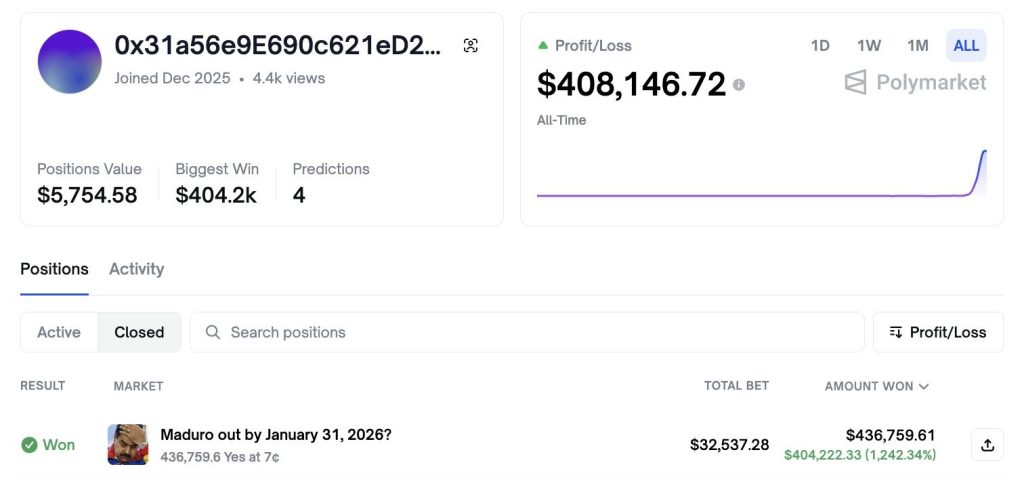
Source: Joe Pompliano

A newly created account wagered that Maduro would be removed from power by the end of January 2026, purchasing shares when the implied probability was in the low single digits.

The market began rising late Friday evening, hours before President Donald Trump announced that U.S. forces had taken Maduro and his wife, Cilia Flores, into custody during overnight operations.

Once the news became public, the contract settled near its maximum payout, generating returns exceeding 1,200%.

The account had minimal prior activity, and all of its known trades were tied to U.S. intervention in Venezuela, intensifying speculation that the wager may have been informed by nonpublic political or military information.

Maduro and Flores later pleaded not guilty on Monday to U.S. charges alleging large-scale cocaine trafficking carried out with the protection of Venezuelan security forces.

Punchbowl News founder Jake Sherman said Torres intended to clearly establish that such conduct is illegal under federal law, mirroring insider trading standards that already exist in traditional financial markets.

While the initial version of the bill does not introduce new penalties or enforcement mechanisms beyond existing statutes, it would explicitly extend those principles to prediction markets, which currently operate in a more fragmented regulatory environment.

As Prediction Markets Grow, Lawmakers Push for Clear Rule

Prediction markets have grown rapidly over the past two years, moving from a niche product to a multibillion-dollar sector. Combined trading volume across major platforms exceeded $44 billion in 2025, with weekly notional volume topping $5.3 billion in early January 2026.

Source: DeFiRate

Platforms like Kalshi, which operates as a regulated U.S. exchange, and Polymarket, which serves a more global user base, allow traders to speculate on a wide range of outcomes spanning politics, sports, economics, and culture.

Political markets have drawn particular attention due to their sensitivity and potential overlap with government decision-making.

While sports dominate volume on some regulated platforms, political events remain a major driver of activity on others, especially during election cycles or major geopolitical developments.

The 2024 U.S. presidential election alone generated billions of dollars in trading volume.

In response to the growing debate, Kalshi’s press relations account said the platform already prohibits insiders or decision-makers from trading on material nonpublic information under its rules.

However, Torres and other lawmakers argue that platform-level restrictions are insufficient without a clear federal standard that applies uniformly to government officials.

The proposed legislation would also build on the principles of the STOCK Act, which governs insider trading by members of Congress in traditional financial assets, extending similar expectations to newer financial instruments.

Market Opportunity
Comedian Logo
Comedian Price(BAN)
$0.07511
$0.07511$0.07511
+1.74%
USD
Comedian (BAN) Live Price Chart
Disclaimer: The articles reposted on this site are sourced from public platforms and are provided for informational purposes only. They do not necessarily reflect the views of MEXC. All rights remain with the original authors. If you believe any content infringes on third-party rights, please contact service@support.mexc.com for removal. MEXC makes no guarantees regarding the accuracy, completeness, or timeliness of the content and is not responsible for any actions taken based on the information provided. The content does not constitute financial, legal, or other professional advice, nor should it be considered a recommendation or endorsement by MEXC.

You May Also Like

Which Altcoins Stand to Gain from the SEC’s New ETF Listing Standards?

Which Altcoins Stand to Gain from the SEC’s New ETF Listing Standards?

On Wednesday, the US SEC (Securities and Exchange Commission) took a landmark step in crypto regulation, approving generic listing standards for spot crypto ETFs (exchange-traded funds). This new framework eliminates the case-by-case 19b-4 approval process, streamlining the path for multiple digital asset ETFs to enter the market in the coming weeks. Grayscale’s Multi-Crypto Milestone Grayscale secured a first-mover advantage as its Digital Large Cap Fund (GDLC) received approval under the new listing standards. Products that will be traded under the ticker GDLC include Bitcoin, Ethereum, XRP, Solana, and Cardano. “Grayscale Digital Large Cap Fund $GDLC was just approved for trading along with the Generic Listing Standards. The Grayscale team is working expeditiously to bring the FIRST multi-crypto asset ETP to market with Bitcoin, Ethereum, XRP, Solana, and Cardano,” wrote Grayscale CEO Peter Mintzberg. The approval marks the US’s first diversified, multi-crypto ETP, signaling a shift toward broader portfolio products rather than single-asset ETFs. Bloomberg’s Eric Balchunas explained that around 12–15 cryptocurrencies now qualify for spot ETF consideration. However, this is contingent on the altcoins having established futures trading on Coinbase Derivatives for at least six months. This includes well-known altcoins like Dogecoin (DOGE), Litecoin (LTC), and Chainlink (LINK), alongside the majors already included in Grayscale’s GDLC. Altcoins in the Spotlight Amid New Era of ETF Eligibility Several assets have already met the key condition, regulated futures trading on Coinbase. For example, Solana futures launched in February 2024, making the token eligible as of August 19. “The SEC approved generic ETF listing standards. Assets with a regulated futures contract trading for 6 months qualify for a spot ETF. Solana met this criterion on Aug 19, 6 months after SOL futures launched on Coinbase Derivatives,” SolanaFloor indicated. Crypto investors and communities also identified which tokens stand to gain. Chainlink community liaison Zach Rynes highlighted that LINK could soon see its own ETF. He noted that both Bitwise and Grayscale have already filed applications. Meanwhile, the Litecoin Foundation indicated that the new standards provide the regulatory framework for LTC to be listed on US exchanges. Hedera is also in the spotlight, with digital asset investor Mark anticipating an HBAR ETF. Market observers see the decision as a potential turning point for broader adoption, bringing the much-needed clarity and accessibility for investors. At the same time, it boosts confidence in the market’s maturity. The general sentiment is that with the SEC’s approval, the next phase of crypto ETFs is no longer a question of ‘if,’ but ‘when.’ The shift to generic listing standards could expand the US-listed digital asset ETFs roster beyond Bitcoin and Ethereum. Such a move would usher in new investment vehicles covering a dozen or more altcoins. This represents the clearest path yet toward mainstream, regulated access to diversified crypto exposure. More importantly, it comes without the friction of direct custody. “We’re gonna be off to the races in a matter of weeks,” ETF analyst James Seyffart quipped.
Share
Coinstats2025/09/18 12:57
‘High Risk’ Projects Dominate Crypto Press Releases, Report Finds

‘High Risk’ Projects Dominate Crypto Press Releases, Report Finds

The post ‘High Risk’ Projects Dominate Crypto Press Releases, Report Finds appeared on BitcoinEthereumNews.com. More than six in 10 crypto press releases published
Share
BitcoinEthereumNews2026/02/04 13:09
Why Vitalik Says L2s Aren’t Ethereum Shards Now?

Why Vitalik Says L2s Aren’t Ethereum Shards Now?

The post Why Vitalik Says L2s Aren’t Ethereum Shards Now? appeared on BitcoinEthereumNews.com. Vitalik says Ethereum’s scaling and higher gas limits mean L2s no
Share
BitcoinEthereumNews2026/02/04 13:18