ECB advisor Jürgen Schaaf warns that the rapid rise of dollar-backed stablecoins threatens Europe’s financial stability and the euro’s global standing unless strategic action is taken. In a new blog post on the European Central Bank’s website titled “From Hype…ECB advisor Jürgen Schaaf warns that the rapid rise of dollar-backed stablecoins threatens Europe’s financial stability and the euro’s global standing unless strategic action is taken. In a new blog post on the European Central Bank’s website titled “From Hype…

ECB advisor sounds alarm on growing dominance of dollar-denominated stablecoins

3 min read

ECB advisor Jürgen Schaaf warns that the rapid rise of dollar-backed stablecoins threatens Europe’s financial stability and the euro’s global standing unless strategic action is taken.

Summary
  • US dollar-backed stablecoins make up 99% of the market, while euro-based stablecoins remain negligible.
  • Growing adoption of stablecoins for payments, settlements, and savings could weaken the ECB’s control over monetary policy.
  • Interest-bearing stablecoins risk diverting deposits from traditional banks, threatening credit availability in Europe.
  • Schaaf’s call to action includes supporting euro-based stablecoins, advancing the digital euro, and innovating cross-border payments with distributed ledger technology.

In a new blog post on the European Central Bank’s website titled “From Hype to Hazard: What Stablecoins Mean for Europe,” ECB advisor Jürgen Schaaf says that stablecoins pose a strategic threat to the euro’s global standing, warning that “without a strategic response, European monetary sovereignty and financial stability could erode.”

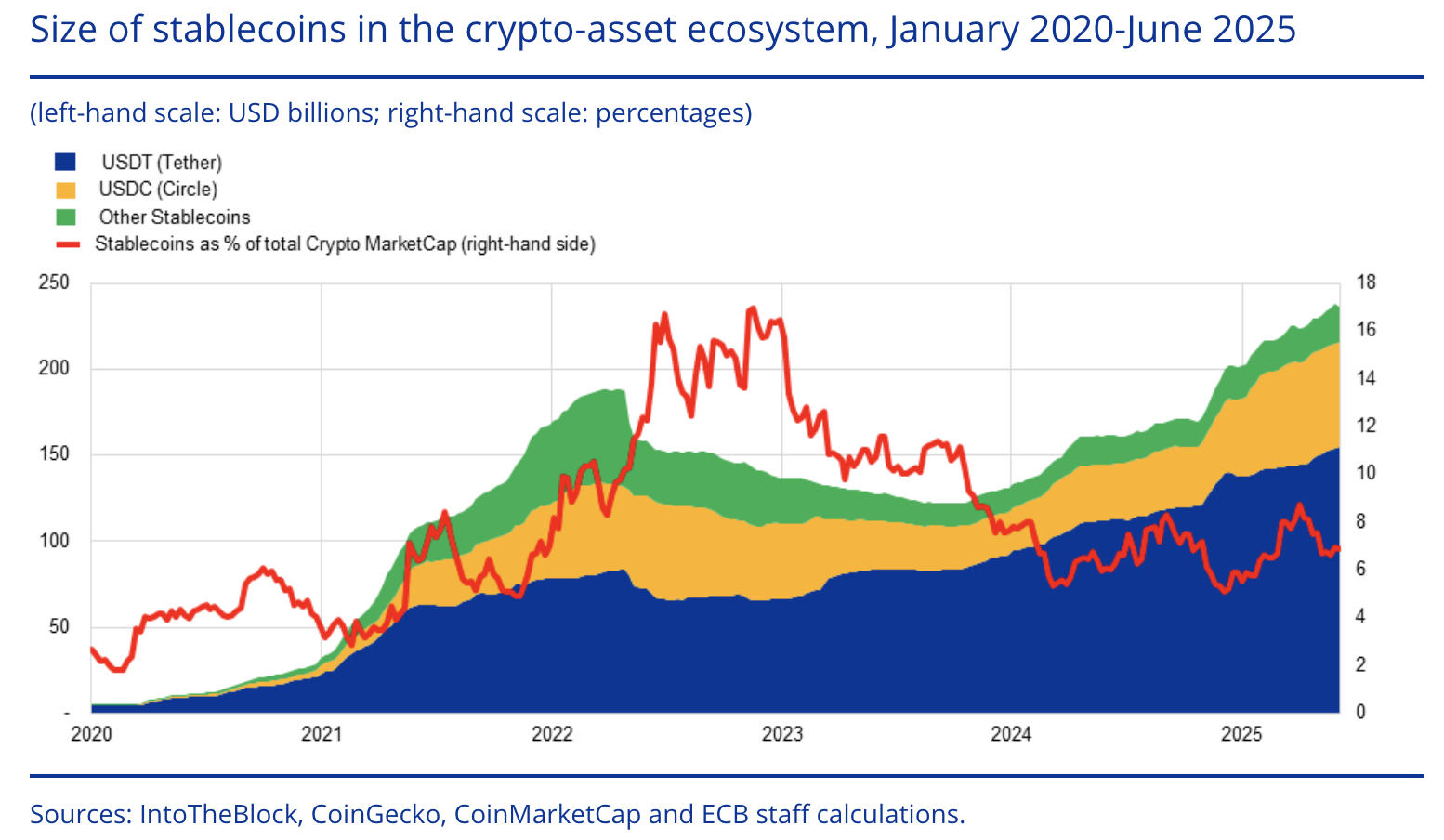
Stablecoins, led by Tether (USDT) and Circle’s USD Coin (USDC), now account for 99% of the stablecoin market cap, nearly all denominated in US dollars. Euro-denominated stablecoins remain marginal, with a combined market cap of less than €350 million.
ECB advisor sounds alarm on growing dominance of dollar-denominated stablecoins - 1

The danger, Schaaf warns, is not just speculative. As stablecoins become more widely adopted for payments, settlement, and even savings, they increasingly bypass traditional financial systems—potentially undercutting the ECB’s ability to implement effective monetary policy.

“The larger their footprint, the harder these [dollar-dominated stablecoins] would be to unwind,” Schaaf writes. “This would mean higher financing costs relative to the United States, reduced monetary policy autonomy and geopolitical dependency” for Europe.

Stablecoins’ growing real-world impact and risks to banks

Schaaf points out that stablecoins are already being tested for real-world applications beyond crypto trading, including remittances, e-commerce, and institutional settlement. U.S. firms such as Amazon and Walmart are exploring stablecoin integrations, while global payment giants Visa and Mastercard are rolling them into international services.

Moreover, stablecoins begin to offer interest-like features, such as yield from lending or liquidity provision, which poses a threat to traditional banking models, especially in deposit-heavy economies like the euro area.

“If interest-bearing stablecoins became common… they could divert deposits from traditional banks, which could jeopardise financial intermediation and hamper credit availability,” Schaaf writes.

Schaaf’s call to action to protecting the euro

To tackle the risks posed by stablecoins, Schaaf lays out several practical steps Europe should take to protect its financial system and strengthen the euro’s global role.

His main suggestion is to support well-regulated, euro-based stablecoins. Such stablecoins, he argues, could not only “serve legitimate market needs” but also help “reinforce the international role of the euro,” offering a viable alternative to the growing dominance of dollar-based tokens.

Another key part of the plan is the digital euro, which Schaaf sees as “a robust line of defence of European monetary sovereignty,” especially for everyday payments like shopping and online purchases.

Schaaf also points to the need for innovation in larger, behind-the-scenes payments between banks and financial institutions. Cross-border payments are still slow and expensive. Schaaf argues that distributed ledger technology (DLT) could fix this by allowing faster, more direct settlement of tokenised assets using central bank money. He highlights two new projects from the European Central Bank—Pontes and Appia—as important steps forward.

Finally, Schaaf stresses the importance of global cooperation. Without common rules, he warns, “we risk fuelling instability, regulatory arbitrage and global US dollar dominance.”


Market Opportunity
Hyperliquid Logo
Hyperliquid Price(HYPE)
$33.24
$33.24$33.24
-2.83%
USD
Hyperliquid (HYPE) Live Price Chart
Disclaimer: The articles reposted on this site are sourced from public platforms and are provided for informational purposes only. They do not necessarily reflect the views of MEXC. All rights remain with the original authors. If you believe any content infringes on third-party rights, please contact service@support.mexc.com for removal. MEXC makes no guarantees regarding the accuracy, completeness, or timeliness of the content and is not responsible for any actions taken based on the information provided. The content does not constitute financial, legal, or other professional advice, nor should it be considered a recommendation or endorsement by MEXC.

You May Also Like

Shibarium May No Longer Turbocharge Shiba Inu Price Rally, Here’s Reason

Shibarium May No Longer Turbocharge Shiba Inu Price Rally, Here’s Reason

The post Shibarium May No Longer Turbocharge Shiba Inu Price Rally, Here’s Reason appeared on BitcoinEthereumNews.com. Shibarium, the layer-2 blockchain of the Shiba Inu (SHIB) ecosystem, is battling to stay active. Shibarium has slipped from hitting transaction milestones to struggling to record any transactions on its platform, a development that could severely impact SHIB. Shibarium transactions crash from millions to near zero As per Shibariumscan data, the total daily transactions on Shibarium as of Sept. 16 stood at 11,600. This volume of transactions reflects how low the transaction count has dropped for the L2, whose daily average ranged between 3.5 million and 4 million last month. However, in the last week of August, daily transaction volume on Shibarium lost momentum, slipping from 1.3 million to 9,590 as of Aug. 28. This pattern has lingered for much of September, with the highest peak so far being on Sept. 5, when it posted 1.26 million transactions. The low user engagement has greatly affected the transaction count in recent days. In addition, the security breach over the weekend by malicious attackers on Shibarium has probably worsened issues. Although developer Kaal Dhairya reassured the community that the attack to steal millions of BONE tokens was successfully prevented, users’ confidence appears shaken. This has also impacted the price outlook for Shiba Inu, the ecosystem’s native token. Following reports of the malicious attack on Shibarium, SHIB dipped immediately into the red zone. Unlike on previous occasions where investors accumulated on the dip, market participants did not flock to Shiba Inu. Shiba Inu price struggles, can burn mechanism help? With the current near-zero crash in transaction volume for Shibarium, SHIB’s price cannot depend on it to support a rally. It might take a while to rebuild user confidence and for transactions to pick up again. In the meantime, Shiba Inu might have to rely on other means to boost prices from its low levels. This…
Share
BitcoinEthereumNews2025/09/18 07:57
👨🏿‍🚀TechCabal Daily – When banks go cashless

👨🏿‍🚀TechCabal Daily – When banks go cashless

In today's edition: South Africa's biggest banks are going cashless || Onafriq and PAPSS pilot Naira wallet transfers from Nigeria to Ghana || South Africa just
Share
Techcabal2026/02/04 14:02
Wormhole launches reserve tying protocol revenue to token

Wormhole launches reserve tying protocol revenue to token

The post Wormhole launches reserve tying protocol revenue to token appeared on BitcoinEthereumNews.com. Wormhole is changing how its W token works by creating a new reserve designed to hold value for the long term. Announced on Wednesday, the Wormhole Reserve will collect onchain and offchain revenues and other value generated across the protocol and its applications (including Portal) and accumulate them into W, locking the tokens within the reserve. The reserve is part of a broader update called W 2.0. Other changes include a 4% targeted base yield for tokenholders who stake and take part in governance. While staking rewards will vary, Wormhole said active users of ecosystem apps can earn boosted yields through features like Portal Earn. The team stressed that no new tokens are being minted; rewards come from existing supply and protocol revenues, keeping the cap fixed at 10 billion. Wormhole is also overhauling its token release schedule. Instead of releasing large amounts of W at once under the old “cliff” model, the network will shift to steady, bi-weekly unlocks starting October 3, 2025. The aim is to avoid sharp periods of selling pressure and create a more predictable environment for investors. Lockups for some groups, including validators and investors, will extend an additional six months, until October 2028. Core contributor tokens remain under longer contractual time locks. Wormhole launched in 2020 as a cross-chain bridge and now connects more than 40 blockchains. The W token powers governance and staking, with a capped supply of 10 billion. By redirecting fees and revenues into the new reserve, Wormhole is betting that its token can maintain value as demand for moving assets and data between chains grows. This is a developing story. This article was generated with the assistance of AI and reviewed by editor Jeffrey Albus before publication. Get the news in your inbox. Explore Blockworks newsletters: Source: https://blockworks.co/news/wormhole-launches-reserve
Share
BitcoinEthereumNews2025/09/18 01:55