

How might Bitcoin price react as $2.5B in BTC options expire today (Feb. 13)?
Bitcoin price trades near $68,000 as $2.5 billion in BTC options expire today, placing $74,000 max pain at the center of market focus.
- Bitcoin has been on a downtrend in February, falling nearly 50% from its all-time high.
- $2.5B in BTC options expire today with a put/call ratio of 0.72 and max pain at $74,000.
- RSI sits near 29 as volume and open interest decline across derivatives markets.
Bitcoin was trading at $68,280 at press time, down 1.1% over the last 24 hours. The asset has moved within a 7-day range of $64,760 to $71,450. Over the past 30 days, BTC is down 30%, and it now sits roughly 50% below its $126,080 all-time high set in October.
Spot activity has cooled. Bitcoin (BTC) logged $47 billion in 24-hour trading volume, a decline of 11% from the previous day. Derivatives markets are also easing.
As per Coinglass data, total futures volume stands at $63 billion, down 18%, while open interest has dipped 1.73% to $44 billion. That combination points to position trimming rather than aggressive new exposure.
$2.5B in options set to expire
According to Deribit data, $2.5 billion worth of Bitcoin options are set to expire at 8:00 a.m. UTC on Feb. 13. The put/call ratio stands at 0.72, indicating more call contracts than puts. The max pain price is $74,000, the level where the largest number of options would expire worthless.
At the same time, $420 million in Ethereum options will also expire, with a put/call ratio of 0.85 and a max pain level of $2,100.
Options expiry refers to the settlement of contracts that give traders the right, but not the obligation, to buy or sell Bitcoin at a specific price before a set date. As expiry approaches, market makers hedge their exposure by buying or selling spot and futures.
This can increase short-term volatility. In many cases, price gravitates toward the max pain level. In others, strong directional momentum overrides expiry-related flows.
With Bitcoin trading nearly $6,000 below $74,000, traders are watching to see whether the price gets pulled higher into settlement or continues lower.
Technical outlook: pressure remains below $74K
The daily structure is clearly bearish. Bitcoin has been printing lower highs and lower lows. It trades below the 50-day moving average near $75,000 and well under the 200-day moving average around $92,500. That alignment keeps momentum tilted to the downside.
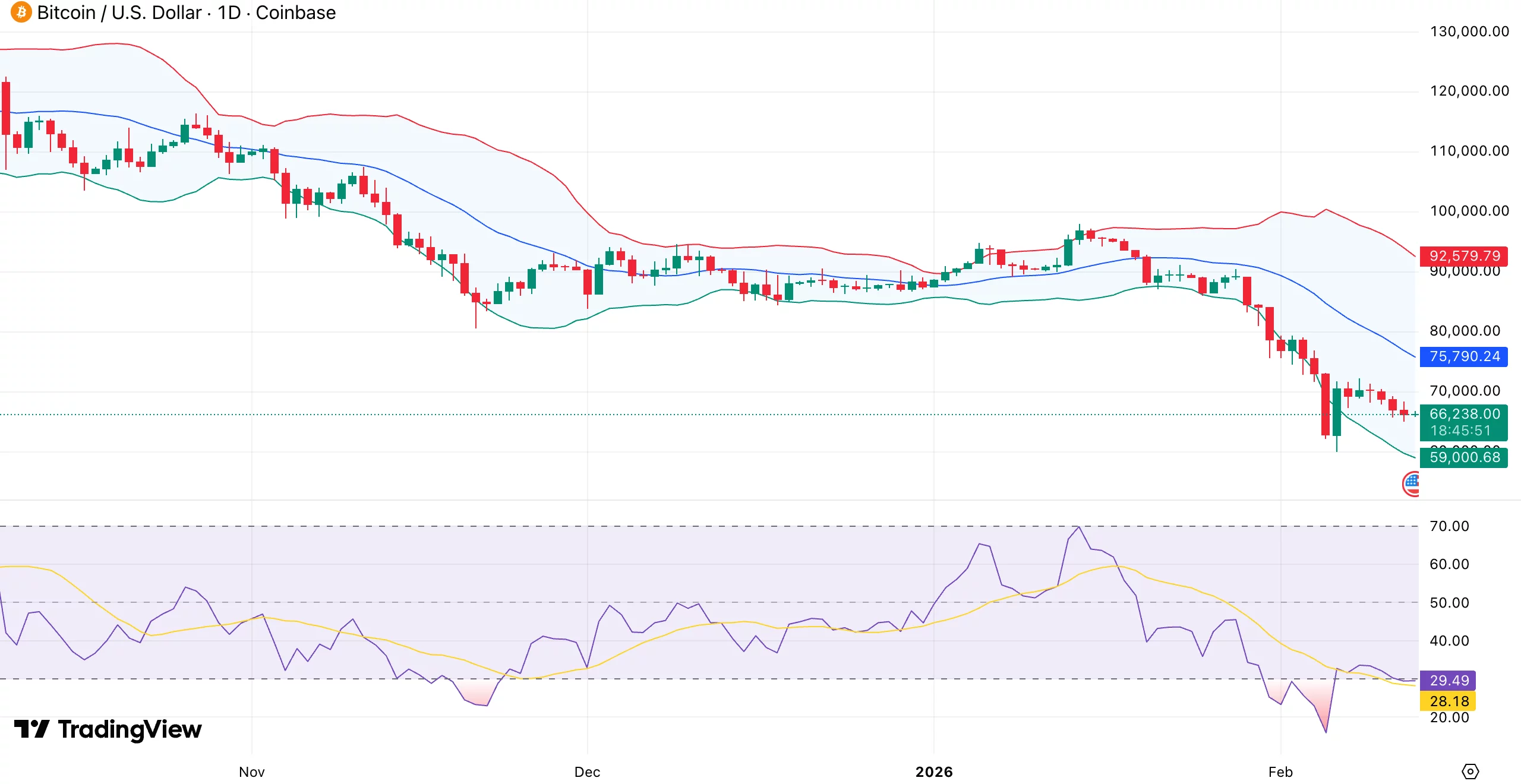
Bollinger Bands are expanding, not compressing. Price recently touched the lower band, which often signals oversold conditions. In strong downtrends, however, assets can stay pinned near the lower band for longer than expected.
The relative strength index is around 29, deep in oversold territory. Yet there is no confirmed bullish divergence. Until RSI forms higher lows while price stabilizes, reversal signals remain limited.
Support sits at $65,000–$66,000, followed by the psychological $60,000 level. On the upside, $74,000–$76,000 is the key reclaim zone. A daily close above that area would ease pressure and open room toward $80,000.
For now, Bitcoin remains technically weak below $74,000. Options expiry may add volatility, but trend reversal requires structure to shift, not just a short-term bounce.
You May Also Like

Americans Fear Losing Human Touch as AI Becomes More Integrated in Life

Trading time: Tonight, the US GDP and the upcoming non-farm data will become the market focus. Institutions are bullish on BTC to $120,000 in the second quarter.

BitGo wins BaFIN nod to offer regulated crypto trading in Europe
BitGo’s move creates further competition in a burgeoning European crypto market that is expected to generate $26 billion revenue this year, according to one estimate. BitGo, a digital asset infrastructure company with more than $100 billion in assets under custody, has received an extension of its license from Germany’s Federal Financial Supervisory Authority (BaFin), enabling it to offer crypto services to European investors. The company said its local subsidiary, BitGo Europe, can now provide custody, staking, transfer, and trading services. Institutional clients will also have access to an over-the-counter (OTC) trading desk and multiple liquidity venues.The extension builds on BitGo’s previous Markets-in-Crypto-Assets (MiCA) license, also issued by BaFIN, and adds trading to the existing custody, transfer and staking services. BitGo acquired its initial MiCA license in May 2025, which allowed it to offer certain services to traditional institutions and crypto native companies in the European Union.Read more