

Aave Labs Proposes $50M Funding Request With 100% Revenue Share to DAO
TLDR
- Aave Labs proposes “Aave Will Win” plan to send 100% of product revenue to the DAO treasury instead of keeping it
- The proposal requests $25 million in stablecoins, 75,000 AAVE tokens, and $17.5 million in additional grants for operations
- Marc Zeller, a prominent DAO member, criticized the plan as a disguised $50 million extraction attempt
- The proposal follows months of tension over brand control after Aave Labs redirected swap fees to a company wallet in December
- Plan centers on Aave V4 upgrade and includes creating a new foundation to hold trademarks and intellectual property
Aave Labs presented a governance proposal this week that would redirect all product revenue to the AAVE token holders. The plan, called “Aave Will Win,” also includes a request for $50 million in operational funding.
The proposal asks for $25 million in stablecoins and 75,000 AAVE tokens upfront. An additional $17.5 million would be tied to specific product launches. These funds would cover Aave Labs’ operations, which the company previously financed mostly on its own.
Under the framework, all revenue from Aave-branded products would flow to the DAO treasury. This includes swap fees, front-end earnings, and planned products like Aave Card. Aave Labs founder Stani Kulechov said the framework positions the protocol to capture growth as fintech companies and institutions enter DeFi.
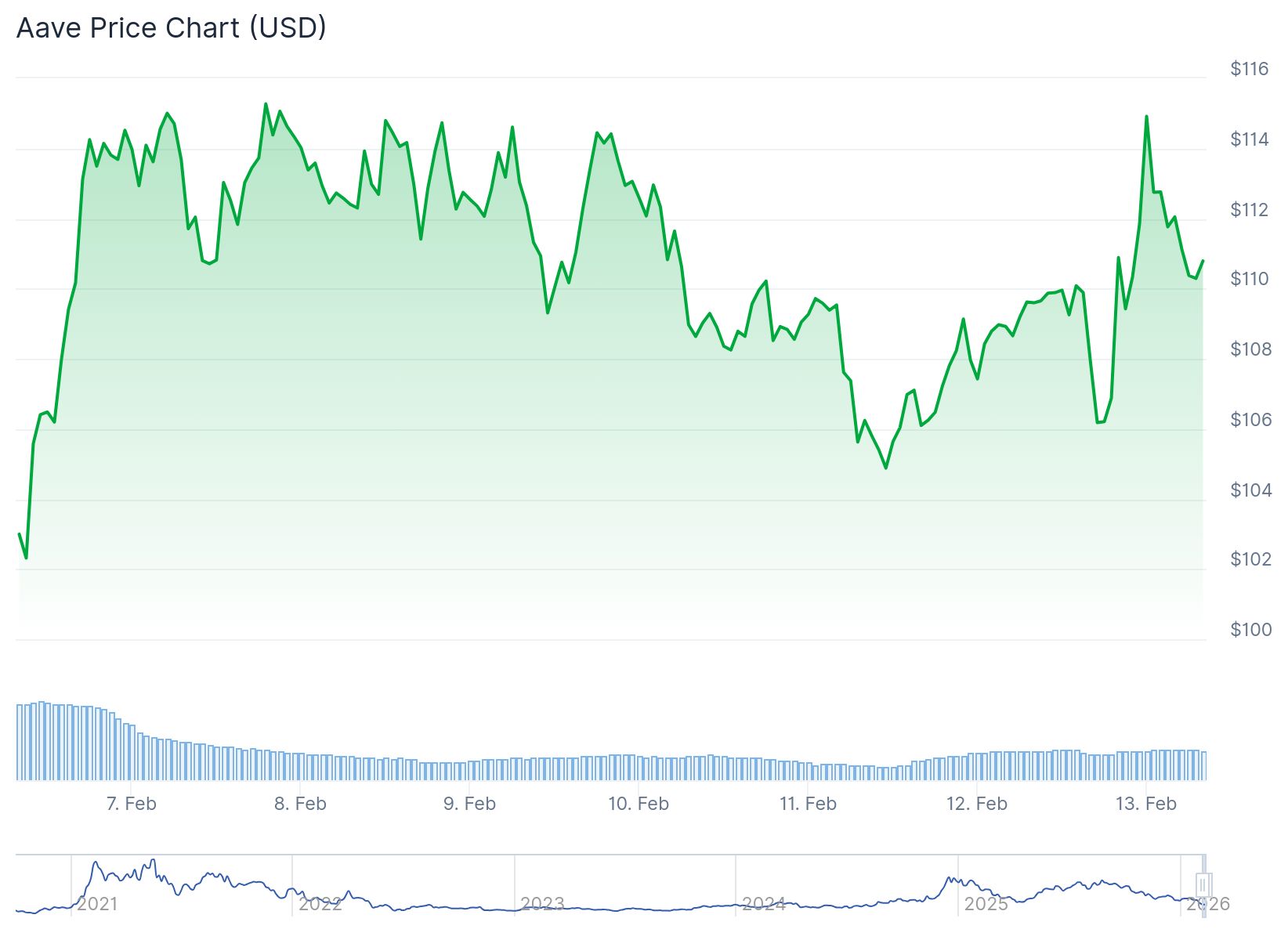 AAVE Price
The AAVE token gained about 2% on the news. The broader crypto market sold off heavily on Thursday.
Marc Zeller, founder of the Aave Chan Initiative, challenged the proposal immediately. He called it a disguised extraction attempt presented without prior DAO engagement. Zeller suggested the proposal follows a pattern where extreme initial terms absorb criticism before scaled-back requests seem reasonable.
Tensions Over Brand Control
The proposal comes after months of tension over who controls Aave’s brand and assets. In December, Aave Labs redirected swap fees from Aave.com that previously went to the DAO treasury. The fees went to a company-controlled wallet instead.
One token holder responded with a hostile takeover attempt. The proposal sought to seize Aave Labs’ intellectual property, codebase, and brand assets. The attempt failed during a holiday governance vote but prompted Kulechov to open revenue and brand-sharing discussions.
Community members remain divided over whether the DAO or Aave Labs should control trademarks and social accounts. Critics argue concentrated control by Labs undermines decentralization principles. The fight highlights tensions over how much influence founding teams should keep once a protocol becomes decentralized.
Aave is one of the largest decentralized lending protocols in crypto. Users can borrow and lend digital assets without traditional banks. Aave v3 currently generates over $100 million annually.
V4 Upgrade At Center Of Plan
The proposal makes Aave V4 the foundation for future development. The upgrade is designed to make launching new markets and financial products easier. V4 uses a hub-and-spoke model that supports expansion into distinct markets with customized risk parameters.
Rather than requiring major changes to the core system each time, V4 makes expansion faster and more flexible. The proposal asks the DAO to prioritize V4 development while reducing work on V3 features. Gradual V3 deprecation would begin eight to 12 months after V4 launches.
The framework introduces separate markets with different risk and revenue structures. This could allow Aave to support specialized use cases, including institutional participation. The setup would not affect the broader protocol.
Aave Labs requested operational autonomy in the proposal. The company argued competitive product development requires rapid decisions without committee oversight. Well-capitalized DeFi competitors are spending aggressively on product development and distribution.
The proposal includes establishing a new Aave Foundation to hold trademarks and intellectual property. Decentralized organizations cannot directly own intellectual property under current law. More details on the foundation structure would come in a follow-up vote.
Aave Labs currently maintains exclusive legal ownership of Aave trademarks after seven years of enforcement. Concentrating long-term control in one entity raises governance concerns as the DAO develops.
The funding structure includes $5 million upfront and $20 million streamed across one year. The 75,000 AAVE tokens would unlock monthly over two years. Additional grants include $5 million each for Aave App, Aave Pro, and Aave Card deployments, plus $2.5 million for Aave Kit.
The proposal acknowledges the funding request exceeds historical support levels. Aave Labs previously self-funded product expenses while seeking DAO backing mainly for core protocol development. Annual budgets would require separate governance approvals, providing ongoing allocation oversight.
The post Aave Labs Proposes $50M Funding Request With 100% Revenue Share to DAO appeared first on CoinCentral.
You May Also Like
Best Sit and Go Poker Sites – Where to Play SNG Poker Tournaments in 2025

Hedera (HBAR) Price Today, Chart & Market Cap | Live HBAR to USD Converter
