

UMA (UMA) Price Prediction 2026, 2027-2030: Is UMA Set for a Massive Breakout?
The post UMA (UMA) Price Prediction 2026, 2027-2030: Is UMA Set for a Massive Breakout? appeared first on Coinpedia Fintech News
Story Highlights
- The live price of the UMA token is $ 0.42752985.
- UMA price prediction suggests a potential rise to $3.28 by 2026, driven by growing demand for Optimistic Oracle and on-chain verification.
- UMA’s future depends on adoption in DAO governance, prediction markets, and cross-chain verification, not hype cycles or speculation.
- If oracle demand scales across DeFi and real-world data use cases, UMA could surge toward $26 by 2030 with strong ecosystem growth.
UMA (Universal Market Access) is a DeFi protocol built on Ethereum that allows users to create synthetic assets and on-chain financial contracts. Its main feature, the Optimistic Oracle, helps smart contracts verify real-world data such as prices, sports results, or events.
Instead of constant data feeds, UMA assumes data is correct unless disputed, making the system cheaper and more efficient.
With UMA trading near $0.418, the token now reflects a market questioning whether oracle demand will expand or stagnate.
So, can UMA become core infrastructure for on-chain decision-making?
Let’s explore CoinPedia’s UMA Price Prediction 2026, 2027 – 2030.
UMA Price Today
| Cryptocurrency | UMA |
| Token | UMA |
| Price | $0.4275  0.70% 0.70% |
| Market Cap | $ 38,013,015.87 |
| 24h Volume | $ 2,971,606.7098 |
| Circulating Supply | 88,913,127.7245 |
| Total Supply | 128,080,556.3901 |
| All-Time High | $ 43.3693 on 04 February 2021 |
| All-Time Low | $ 0.4014 on 08 March 2026 |
Table of contents
- CoinPedia’s UMA (UMA) Price Prediction
- UMA (UMA) Price Targets For April 2026
- Technical Analysis
- UMA Price Prediction 2026
- UMA Coin Price Prediction 2026 – 2030
- UMA (UMA) Price Prediction 2026
- UMA Price Prediction 2027
- UMA Coin Price Prediction 2028
- UMA Crypto Price Prediction 2029
- UMA (UMA) Price Prediction 2030
- What Does The Market Say?
- FAQs
CoinPedia’s UMA (UMA) Price Prediction
From Coinpedia’s perspective, UMA’s future doesn’t depend on hype cycles; it depends on how often the crypto ecosystem needs truth verification.
If prediction markets, governance voting, and dispute resolution expand, UMA becomes increasingly valuable as neutral infrastructure.
However, adoption must grow beyond niche applications.
If usage increases, UMA could realistically reach $3.280 in 2026, with long-term upside tied to oracle demand.
| Year | Potential Low ($) | Potential Average ($) | Potential High ($) |
| 2026 | $0.15 | $1.45 | $3.280 |
UMA (UMA) Price Targets For April 2026
April 2026 may revolve around Oracle usage growth, not speculative trading. The Optimistic Oracle is increasingly used in prediction markets that require verification of real-world outcomes.
These use cases create real demand for the UMA token, as disputes and voting depend on token holder participation.
Another driver is cross-chain verification. UMA’s oracle has been used to validate bridge activity and governance decisions, especially in multi-chain ecosystems where neutral arbitration is required.
As more applications depend on UMA, staking activity could increase, voting participation may rise, and overall token demand could improve. If integrations continue to expand, the token could see a gradual recovery.
| Month | Potential Low ($) | Potential Average ($) | Potential High ($) |
| UMA Price Prediction April 2026 | $0.352 | $0.48 | $0.791 |
Technical Analysis
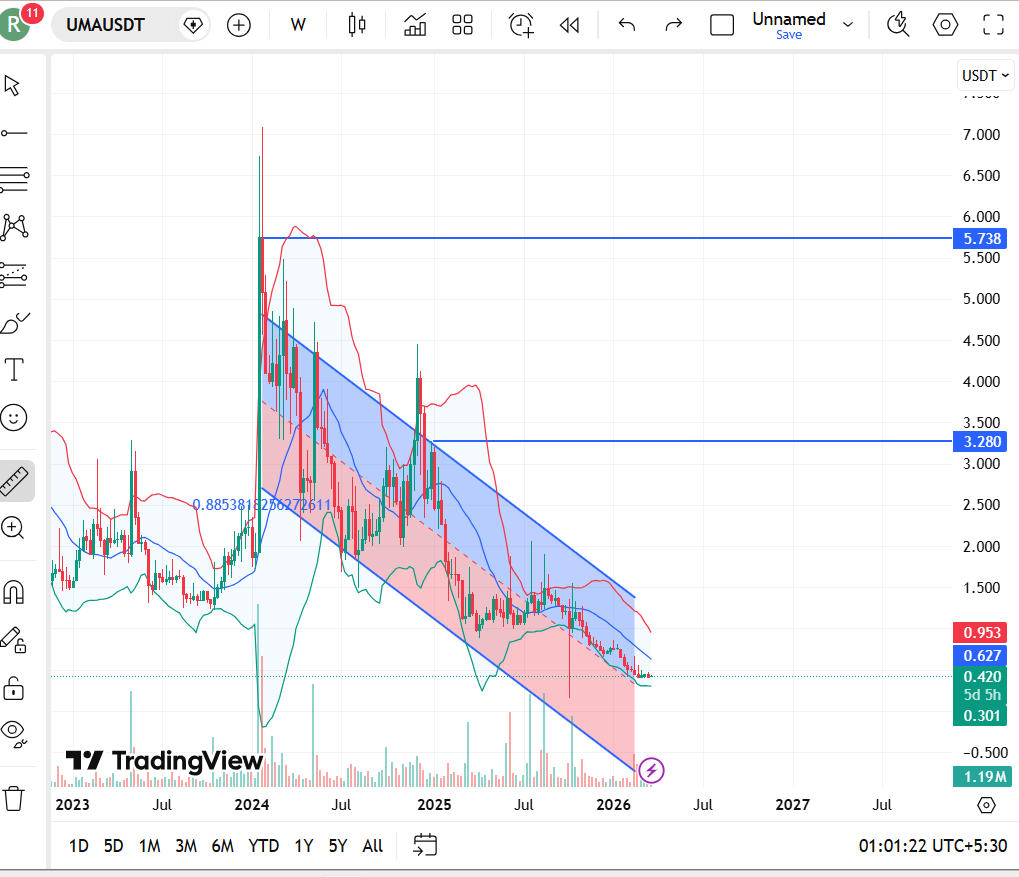
Looking at the UMA is weekly chart, it is trading inside a clear falling channel on the weekly chart, showing a strong long-term downtrend. The token recently dropped near the lower boundary of the channel around the $0.40 support zone, where buyers are trying to stabilize.
Immediate resistance is seen near $0.62, followed by $0.95, where previous breakdown levels and the mid-channel trendline sit. A recovery above these levels could trigger a short-term bounce toward $3.28
However, if the price fails to hold above $0.40, downside risk increases toward $0.30 or even lower within the channel.
UMA Price Prediction 2026
2026 could mark a shift in how UMA is valued, moving from a DeFi token to governance infrastructure. The Optimistic Oracle is well-suited for DAO proposals, treasury decisions, grant approvals, and real-world event resolution.
If more DAOs rely on UMA for dispute resolution, demand for the token could increase as participation becomes necessary.
Another potential growth driver is synthetic asset creation, which was UMA’s original focus. If on-chain derivatives regain popularity, the protocol’s infrastructure could see renewed usage.
However, adoption must be measurable through increased disputes, more oracle requests, and higher participation. Without these signals, the token risks remaining underutilized.
| Year | Potential Low ($) | Potential Average ($) | Potential High ($) |
| UMA Price Prediction 2026 | $0.15 | $1.45 | $3.280 |
UMA Coin Price Prediction 2026 – 2030
| Year | Potential Low ($) | Potential Average ($) | Potential High ($) |
| 2026 | $0.15 | $1.45 | $3.280 |
| 2027 | $0.953 | $3.811 | $5.738 |
| 2028 | $1.47 | $9.20 | $10.138 |
| 2029 | $2 | $1.22 | $16.779 |
| 2030 | $3.35 | $20.501 | $26.059 |
UMA (UMA) Price Prediction 2026
If prediction markets and DAO governance tools expand with AI-driven oracle automation, UMA could move toward $3.280.
UMA Price Prediction 2027
Increased adoption of optimistic oracle dispute resolution and EigenLayer-backed security upgrades could push UMA toward $5.738.
UMA Coin Price Prediction 2028
Cross-chain governance and real-world data verification across prediction markets and DeFi could support a rise to $10.138.
UMA Crypto Price Prediction 2029
If UMA becomes the default arbitration layer for DeFi and DAO treasury disputes, the price could approach $16.779.
UMA (UMA) Price Prediction 2030
Widespread use in DAO governance, prediction markets, and synthetic assets with automated oracle infrastructure could push UMA above $26.
What Does The Market Say?
| Year | 2026 | 2027 | 2030 |
| priceprediction.net | $5.85 | $8.25 | $ 33.68 |
| Changelly | $3.12 | $6.45 | $27.92 |
| Digitalcoinprice | $6.73 | $9.47 | $20.23 |
Never Miss a Beat in the Crypto World!
Stay ahead with breaking news, expert analysis, and real-time updates on the latest trends in Bitcoin, altcoins, DeFi, NFTs, and more.
 Subscribe to Price Prediction
FAQs
UMA is a DeFi protocol on Ethereum that uses an Optimistic Oracle to verify real-world data, enabling secure smart contracts without constant data feeds.
UMA’s price depends on oracle usage, dispute activity, DAO adoption, and demand for real-world data verification across DeFi and governance systems.
UMA has long-term potential if it becomes key infrastructure for on-chain decision-making, but growth depends on real adoption, not hype cycles.
UMA price prediction for 2026 ranges between $0.15 and $3.28, depending on oracle adoption, DAO usage, and demand for real-world data verification.
UMA could reach up to $26 by 2030 if it becomes a core oracle layer for DeFi, DAOs, and cross-chain ecosystems requiring trusted data.
By 2040, UMA’s value depends on long-term adoption. If widely used in global on-chain systems, it could exceed current projections significantly.
You May Also Like
Zama Integrates With T-REX to Bring Privacy to Tokenized Securities

United Kingdom Retail Price Index (YoY) came in at 3.6%, below expectations (3.7%) in February

