World Liberty Financial, the cryptocurrency project backed by U.S. President Donald Trump, announced a major expansion onto the Solana blockchain through partnerships with memecoin platform Bonk and decentralized exchange Raydium. The collaboration, unveiled on November 5, marks a strategic push to integrate the project’s USD1 stablecoin into Solana’s fast-growing decentralized finance (DeFi) ecosystem. WLFI Pushes USD1 Stablecoin Into Solana’s Core DeFi Layer In a post on X, the project stated that it was “rebuilding the Solana ecosystem” in partnership with Bonk and Raydium as part of its mission to drive USD1 adoption. “Actions > words,” the post read. “We’ve acquired some $1 as the leading USD1 community on Solana for our strategic reserve. This is just the first step toward making USD1 the home for Solana traders and creators.” The partnership positions USD1 to compete directly with Circle’s USDC, which currently dominates Solana’s stablecoin market. According to data from DeFiLlama, USDC accounts for more than $9 billion of the network’s $14.12 billion stablecoin supply.Source: DeFiLlama By integrating with Bonk and Raydium, World Liberty Financial hopes to embed USD1 at the infrastructure level of Solana’s DeFi activity, targeting both liquidity and community engagement. The collaboration will introduce USD1 to Bonk.fun’s memecoin launchpad and Raydium’s automated market maker (AMM) pools. The integrations will allow new USD1-based trading pairs and token launches while offering multi-million-dollar promotional incentives for users who provide liquidity or trade with USD1 pairs. The goal, according to the company, is to make USD1 a major stablecoin alternative for Solana users by leveraging the network’s low transaction costs and high speed. USD1 has grown rapidly since its launch in April 2025, reaching $2.91 billion in circulation by November, making it one of the fastest-growing stablecoins this year.Source: CoinGecko Only Tether’s USDT, Circle’s USDC, MakerDAO’s DAI, and Sky’s USDS have larger market capitalizations. The token is issued by World Liberty Financial and custodied by BitGo, backed 1:1 by assets in U.S. government money market funds and other cash equivalents. World Liberty Financial also revealed that it has begun acquiring USD1 for its own strategic reserves. While the company did not specify the size of the acquisition, it described the move as part of its plan to provide liquidity and support market-making operations for the token. Following the partnership news, WLFI, the project’s native token, surged nearly 10% in 24 hours to trade around $0.1226, pushing its market capitalization to roughly $3.33 billion. World Liberty Financial Advances DeFi Strategy With USD1 Rewards Initiative and Ecosystem Expansion The announcement follows a series of recent moves by World Liberty Financial indicating rapid expansion. On October 31, the company launched a “USD1 Points Program” designed to reward users who participate in DeFi activities involving the stablecoin. The initiative allows users to collect reward points for supplying USD1 on partner platforms such as Dolomite. The company said the program seeks to make USD1 interoperable across permissionless applications and strengthen its presence in decentralized finance. Just days before the Solana announcement, World Liberty Financial distributed 8.4 million WLFI tokens, worth around $1.2 million, to early participants in the Points Program. According to the company, the program generated over $500 million in trading activity within two months, positioning it as one of the most active stablecoin incentive campaigns this year. Leadership changes have also been underway. On October 29, World Liberty Financial appointed Mack McCain, a former Robinhood executive, as its new general counsel. McCain previously held senior roles at Charles Schwab, Arta Finance, and Scottrade, bringing extensive regulatory and legal expertise to the firm. The company said his appointment reflects its goal to build “open and compliant digital finance.” World Liberty Financial’s USD1 strategy forms part of a broader vision to expand its ecosystem beyond stablecoins. Earlier in October, CEO Zach Witkoff announced plans to launch a crypto debit card to “bridge assets with everyday crypto spending.” The firm also revealed it is working on the tokenization of real-world assets, including real estate, oil, and gasWorld Liberty Financial, the cryptocurrency project backed by U.S. President Donald Trump, announced a major expansion onto the Solana blockchain through partnerships with memecoin platform Bonk and decentralized exchange Raydium. The collaboration, unveiled on November 5, marks a strategic push to integrate the project’s USD1 stablecoin into Solana’s fast-growing decentralized finance (DeFi) ecosystem. WLFI Pushes USD1 Stablecoin Into Solana’s Core DeFi Layer In a post on X, the project stated that it was “rebuilding the Solana ecosystem” in partnership with Bonk and Raydium as part of its mission to drive USD1 adoption. “Actions > words,” the post read. “We’ve acquired some $1 as the leading USD1 community on Solana for our strategic reserve. This is just the first step toward making USD1 the home for Solana traders and creators.” The partnership positions USD1 to compete directly with Circle’s USDC, which currently dominates Solana’s stablecoin market. According to data from DeFiLlama, USDC accounts for more than $9 billion of the network’s $14.12 billion stablecoin supply.Source: DeFiLlama By integrating with Bonk and Raydium, World Liberty Financial hopes to embed USD1 at the infrastructure level of Solana’s DeFi activity, targeting both liquidity and community engagement. The collaboration will introduce USD1 to Bonk.fun’s memecoin launchpad and Raydium’s automated market maker (AMM) pools. The integrations will allow new USD1-based trading pairs and token launches while offering multi-million-dollar promotional incentives for users who provide liquidity or trade with USD1 pairs. The goal, according to the company, is to make USD1 a major stablecoin alternative for Solana users by leveraging the network’s low transaction costs and high speed. USD1 has grown rapidly since its launch in April 2025, reaching $2.91 billion in circulation by November, making it one of the fastest-growing stablecoins this year.Source: CoinGecko Only Tether’s USDT, Circle’s USDC, MakerDAO’s DAI, and Sky’s USDS have larger market capitalizations. The token is issued by World Liberty Financial and custodied by BitGo, backed 1:1 by assets in U.S. government money market funds and other cash equivalents. World Liberty Financial also revealed that it has begun acquiring USD1 for its own strategic reserves. While the company did not specify the size of the acquisition, it described the move as part of its plan to provide liquidity and support market-making operations for the token. Following the partnership news, WLFI, the project’s native token, surged nearly 10% in 24 hours to trade around $0.1226, pushing its market capitalization to roughly $3.33 billion. World Liberty Financial Advances DeFi Strategy With USD1 Rewards Initiative and Ecosystem Expansion The announcement follows a series of recent moves by World Liberty Financial indicating rapid expansion. On October 31, the company launched a “USD1 Points Program” designed to reward users who participate in DeFi activities involving the stablecoin. The initiative allows users to collect reward points for supplying USD1 on partner platforms such as Dolomite. The company said the program seeks to make USD1 interoperable across permissionless applications and strengthen its presence in decentralized finance. Just days before the Solana announcement, World Liberty Financial distributed 8.4 million WLFI tokens, worth around $1.2 million, to early participants in the Points Program. According to the company, the program generated over $500 million in trading activity within two months, positioning it as one of the most active stablecoin incentive campaigns this year. Leadership changes have also been underway. On October 29, World Liberty Financial appointed Mack McCain, a former Robinhood executive, as its new general counsel. McCain previously held senior roles at Charles Schwab, Arta Finance, and Scottrade, bringing extensive regulatory and legal expertise to the firm. The company said his appointment reflects its goal to build “open and compliant digital finance.” World Liberty Financial’s USD1 strategy forms part of a broader vision to expand its ecosystem beyond stablecoins. Earlier in October, CEO Zach Witkoff announced plans to launch a crypto debit card to “bridge assets with everyday crypto spending.” The firm also revealed it is working on the tokenization of real-world assets, including real estate, oil, and gas

Trump’s Crypto Project Taps Bonk and Raydium in a High-Stakes Bid to “Rebuild” Solana

2025/11/06 05:19

World Liberty Financial, the cryptocurrency project backed by U.S. President Donald Trump, announced a major expansion onto the Solana blockchain through partnerships with memecoin platform Bonk and decentralized exchange Raydium.

The collaboration, unveiled on November 5, marks a strategic push to integrate the project’s USD1 stablecoin into Solana’s fast-growing decentralized finance (DeFi) ecosystem.

WLFI Pushes USD1 Stablecoin Into Solana’s Core DeFi Layer

In a post on X, the project stated that it was “rebuilding the Solana ecosystem” in partnership with Bonk and Raydium as part of its mission to drive USD1 adoption. “Actions > words,” the post read.

“We’ve acquired some $1 as the leading USD1 community on Solana for our strategic reserve. This is just the first step toward making USD1 the home for Solana traders and creators.”

The partnership positions USD1 to compete directly with Circle’s USDC, which currently dominates Solana’s stablecoin market. According to data from DeFiLlama, USDC accounts for more than $9 billion of the network’s $14.12 billion stablecoin supply.
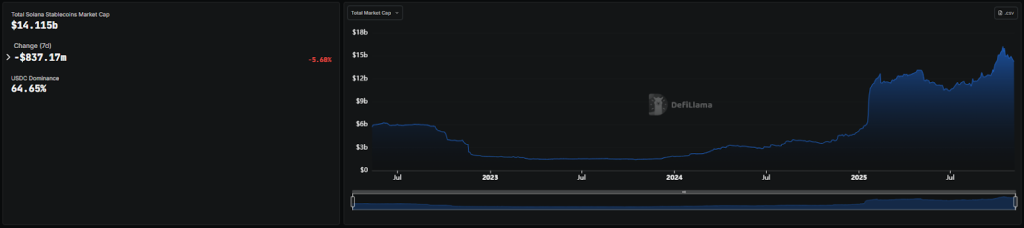
Source: DeFiLlama

By integrating with Bonk and Raydium, World Liberty Financial hopes to embed USD1 at the infrastructure level of Solana’s DeFi activity, targeting both liquidity and community engagement.

The collaboration will introduce USD1 to Bonk.fun’s memecoin launchpad and Raydium’s automated market maker (AMM) pools.

The integrations will allow new USD1-based trading pairs and token launches while offering multi-million-dollar promotional incentives for users who provide liquidity or trade with USD1 pairs.

The goal, according to the company, is to make USD1 a major stablecoin alternative for Solana users by leveraging the network’s low transaction costs and high speed.

USD1 has grown rapidly since its launch in April 2025, reaching $2.91 billion in circulation by November, making it one of the fastest-growing stablecoins this year.

Source: CoinGecko

Only Tether’s USDT, Circle’s USDC, MakerDAO’s DAI, and Sky’s USDS have larger market capitalizations.

The token is issued by World Liberty Financial and custodied by BitGo, backed 1:1 by assets in U.S. government money market funds and other cash equivalents.

World Liberty Financial also revealed that it has begun acquiring USD1 for its own strategic reserves.

While the company did not specify the size of the acquisition, it described the move as part of its plan to provide liquidity and support market-making operations for the token.

Following the partnership news, WLFI, the project’s native token, surged nearly 10% in 24 hours to trade around $0.1226, pushing its market capitalization to roughly $3.33 billion.

World Liberty Financial Advances DeFi Strategy With USD1 Rewards Initiative and Ecosystem Expansion

The announcement follows a series of recent moves by World Liberty Financial indicating rapid expansion.

On October 31, the company launched a “USD1 Points Program” designed to reward users who participate in DeFi activities involving the stablecoin.

The initiative allows users to collect reward points for supplying USD1 on partner platforms such as Dolomite. The company said the program seeks to make USD1 interoperable across permissionless applications and strengthen its presence in decentralized finance.

Just days before the Solana announcement, World Liberty Financial distributed 8.4 million WLFI tokens, worth around $1.2 million, to early participants in the Points Program.

According to the company, the program generated over $500 million in trading activity within two months, positioning it as one of the most active stablecoin incentive campaigns this year.

Leadership changes have also been underway. On October 29, World Liberty Financial appointed Mack McCain, a former Robinhood executive, as its new general counsel.

McCain previously held senior roles at Charles Schwab, Arta Finance, and Scottrade, bringing extensive regulatory and legal expertise to the firm. The company said his appointment reflects its goal to build “open and compliant digital finance.”

World Liberty Financial’s USD1 strategy forms part of a broader vision to expand its ecosystem beyond stablecoins.

Earlier in October, CEO Zach Witkoff announced plans to launch a crypto debit card to “bridge assets with everyday crypto spending.” The firm also revealed it is working on the tokenization of real-world assets, including real estate, oil, and gas.

Disclaimer: The articles reposted on this site are sourced from public platforms and are provided for informational purposes only. They do not necessarily reflect the views of MEXC. All rights remain with the original authors. If you believe any content infringes on third-party rights, please contact service@support.mexc.com for removal. MEXC makes no guarantees regarding the accuracy, completeness, or timeliness of the content and is not responsible for any actions taken based on the information provided. The content does not constitute financial, legal, or other professional advice, nor should it be considered a recommendation or endorsement by MEXC.

You May Also Like

Tempo Leads $25M Investment in Commonware to Potentially Enhance Blockchain Payments Rivaling ETH
Tempo Leads $25M Investment in Commonware to Potentially Enhance Blockchain Payments Rivaling ETH

The post Tempo Leads $25M Investment in Commonware to Potentially Enhance Blockchain Payments Rivaling ETH appeared on BitcoinEthereumNews.com. COINOTAG recommends • Exchange signup 💹 Trade with pro tools Fast execution, robust charts, clean risk controls. 👉 Open account → COINOTAG recommends • Exchange signup 🚀 Smooth orders, clear control Advanced order types and market depth in one view. 👉 Create account → COINOTAG recommends • Exchange signup 📈 Clarity in volatile markets Plan entries & exits, manage positions with discipline. 👉 Sign up → COINOTAG recommends • Exchange signup ⚡ Speed, depth, reliability Execute confidently when timing matters. 👉 Open account → COINOTAG recommends • Exchange signup 🧭 A focused workflow for traders Alerts, watchlists, and a repeatable process. 👉 Get started → COINOTAG recommends • Exchange signup ✅ Data‑driven decisions Focus on process—not noise. 👉 Sign up → Tempo, a Stripe-backed blockchain startup, led a $25 million funding round for Commonware on November 8, 2025, to enhance crypto infrastructure. This investment accelerates high-performance payment systems, enabling sub-250-millisecond finality in permissionless networks, supporting builders with reliable tools. Tempo’s investment focuses on integrating Commonware’s library for faster blockchain payments and consensus innovations. Commonware provides open-source code for custom blockchains, now profitable with seven employees since 2024. The funding values Commonware significantly higher than its $63 million seed round, per Pitchbook data, boosting global distributed payment advancements. Tempo leads $25M investment in Commonware for crypto infrastructure. Discover how this Stripe-backed move accelerates blockchain payments and stablecoin rivalry. Read now for key insights on 2025’s crypto ventures. What is Tempo’s Investment in Commonware? Tempo’s investment in Commonware represents a strategic $25 million funding round led by the Stripe-backed blockchain startup on November 8, 2025, aimed at bolstering crypto infrastructure for builders. This move allows Tempo to adopt Commonware’s library, focusing on essential payment services rather than rebuilding core consensus mechanisms, ultimately speeding up blockchain product deliveries. By partnering, both companies advance…
Share
BitcoinEthereumNews2025/11/09 01:35