Dogecoin (DOGE) has a unique vibe in crypto: it often feels less intimidating than other coins. The meme is familiar. The community is loud. The price per coin looks “cheap.” And the whole thing canDogecoin (DOGE) has a unique vibe in crypto: it often feels less intimidating than other coins. The meme is familiar. The community is loud. The price per coin looks “cheap.” And the whole thing can
Akademi/Cryptocurrency Knowledge/Hot Concepts/Why Dogecoi... Misleading

Why Dogecoin(DOGE) Feels Easy to Buy — and Why That Can Be Misleading

Başlangıç Seviyesi
Dec 27, 2025MEXC
0m
WHY
WHY$0.00000001619--%
DOGE
DOGE$0.12245-3.62%
Memecoin
MEME$0.0010295+6.44%
LooksRare
LOOKS$0.001208-2.34%
Wink
LIKE$0.003041+1.23%
Dogecoin (DOGE) has a unique vibe in crypto: it often feels less intimidating than other coins. The meme is familiar. The community is loud. The price per coin looks “cheap.” And the whole thing can feel like you’re buying a cultural moment, not taking a financial risk.
That “easy-to-buy” feeling is exactly where many people get tripped up.
From an exchange Learn perspective, the goal isn’t to tell you DOGE is “good” or “bad.” It’s to help you notice the psychological shortcuts that make DOGE seem safer (or simpler) than it really is—so you can make decisions with your eyes open.
Below are three common mental illusions that show up again and again with DOGE: low unit price illusion, meme familiarity, and social endorsement, plus a practical checklist to counter them.

Disclaimer: This article is for informational purposes only and does not constitute financial advice. Crypto assets are volatile. Always do your own research and manage risk.

1.The Low Unit Price Illusion: “It’s only $0.xx, how risky can it be?”
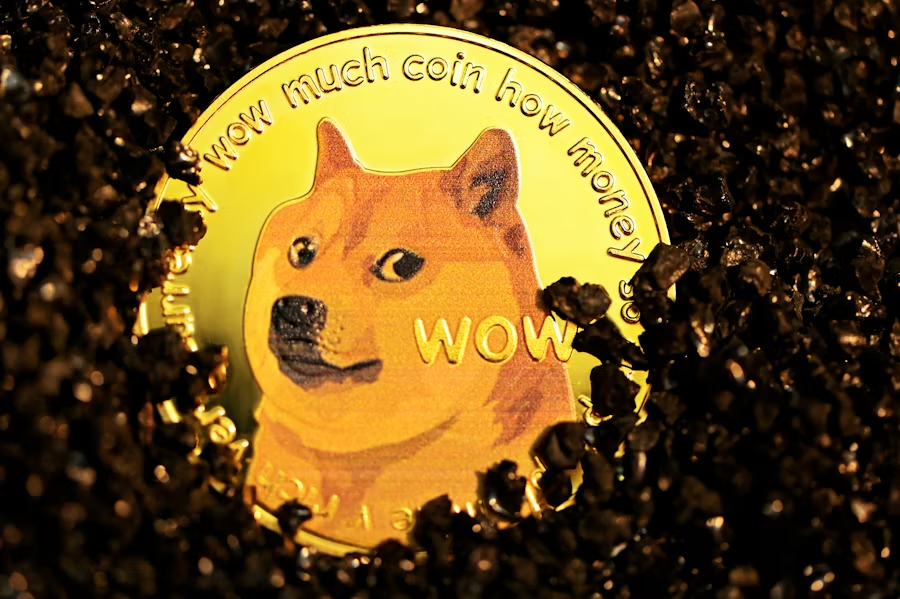


DOGE often trades at a low nominal price compared to assets like BTC or ETH. That can create a subtle mental trap: people interpret “low price per coin” as “more upside” or “less risk.”

But price per unit is not the same as value.

A coin can be $0.10 and still be expensive relative to its fundamentals. A coin can be $10,000 and still be cheap relative to its fundamentals. The nominal number mostly reflects supply structure and how units are denominated—not a built-in bargain.

In traditional markets, researchers have documented versions of this “nominal price illusion”—where investors react to lower-priced shares as if they have more “room to run,” even when splits or unit changes don’t alter fundamentals.

What this looks like in real life:

  • “If DOGE goes back to $1, that’s only a 10x.” (The hidden assumption: the path to $1 is “simple.”)
  • “I can buy thousands of DOGE, so I’ll feel richer.” (Unit count triggers emotion.)
  • “A low price means it can’t drop much.” (But percentage drops don’t care about the decimal point.)

If you want the fact-based version of DOGE’s supply and why unit price can be deceptive, connect this topic to DOGE issuance: it has no max cap, but it does have a rule-based schedule with fixed annual issuance and predictable inflation dynamics.

Mental reframe: Instead of asking “Is it cheap per coin?” ask:
  • What is the market cap?
  • What would need to be true for a 2x or 10x?
  • How much can I lose if I’m wrong?

2.Meme Familiarity: “I know this brand, so it feels safer.”


DOGE is one of the most recognizable names in crypto. You’ve probably seen the Shiba Inu image long before you ever cared about blockchain. That familiarity creates comfort—and comfort can masquerade as competence.

In behavioral finance, familiarity bias is the tendency to prefer what feels known (brands, home markets, widely discussed assets) even when “feeling known” doesn’t improve outcomes. Research on familiarity in investing contexts shows that it can shape choices and distort risk perception.

For DOGE, familiarity is amplified by:

  • Cultural repetition: memes, references, mainstream mentions
  • Low barrier language: people talk about it like a pop product, not a risky asset
  • Narrative simplicity: “the people’s coin,” “fun money,” “community coin”

This doesn’t mean DOGE is illegitimate. It means: you can be emotionally fluent without being financially informed.


A good grounding move is to separate “I recognize it” from “I understand it.” If you want a clean protocol-level refresher (without turning it into a hype pitch), start here: Internal read: What Is Dogecoin? Origins, Mechanism, Meme Culture, and Why It Still Matters

Mental reframe: Replace “I’ve heard of it” with:
  • What are the core mechanics?
  • What keeps the network running?
  • What historically drives its biggest moves?

If you want to see how “familiar = safe” breaks down in practice, price history is the quickest reality check. Internal read: Dogecoin Price History: Major Cycles, Market Drivers, and Key Lessons

3.Social Endorsement: “Everyone’s buying it—so it can’t be that dumb.”


DOGE is unusually social. It has visible communities, influencers, celebrities, and constant public chatter. That environment can create social proof—the feeling that if many people are doing something (or a trusted voice is doing it), it must be reasonable.

Regulators and self-regulatory bodies have been increasingly explicit about this dynamic: social media can shape investor behavior, and it can also be used to manipulate attention, amplify “tips,” or enable scams. FINRA published research focused specifically on “social media-influenced investing” and how these channels affect decision-making.
The SEC has also issued investor alerts warning people not to make decisions based solely on social media information and highlighting the risks of stock-tip scams.

In crypto, social endorsement can be especially powerful because:
  • Narrative spreads faster than fundamentals
  • People anchor on “community confidence” as a substitute for analysis
  • Short-term price moves can “confirm” the crowd—until they reverse

A subtle trap: social proof often doesn’t show you the distribution of outcomes. You see the loud winners. You don’t see the silent losses, or the people who bought near peaks and disappeared.

Mental reframe: Instead of “Who is endorsing it?” ask:
  • What incentives does the endorser have?
  • What would disconfirm this bullish narrative?
  • If this drops 30–50%, what’s my plan?


A simple “reality check” before you buy DOGE


No step-by-step trading tutorial here—just five questions that reduce the chance you’re buying a feeling.

1)If DOGE were priced at $10 per coin, would I still want it? If your answer changes just because the number looks bigger, that’s the low unit price illusion.
2)Am I buying DOGE, or am I buying the identity of being “early / fun / part of the crowd”? If it’s mostly identity, size the bet accordingly.
3)What specific event would make me exit? If the only plan is “hold forever,” that’s not a plan—it’s hope.
4)Can I explain DOGE’s supply in one sentence (accurately)? If not, you’re likely anchoring on memes rather than mechanics.
5)How will I store it safely if I do buy it? Many losses aren’t “market losses”—they’re operational mistakes (phishing, fake wallets, seed phrase errors). Internal read: How to Store Dogecoin (DOGE) Safely: Practical Wallet Guide + Risk Avoidance Tips


If you want to translate “I see the illusion” into “I can evaluate DOGE like an adult,” these two are the most useful next hops:

MEXC'de Hesap Açın
Hemen Hesap Açın ve 10.000 USDT'ye Kadar Bonus Kazanın