

Asia’s Regulators Test Legal Boundaries for Prediction Markets
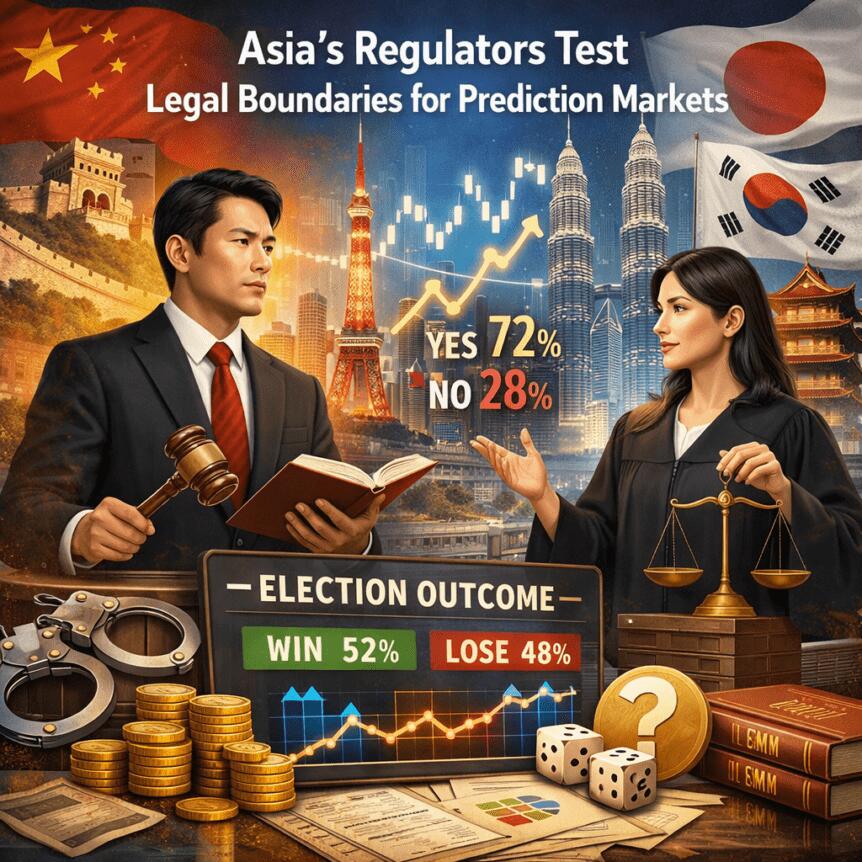
Prediction markets are pushing into Asia’s largest economies even as local gambling laws impose strict limits on traditional betting activities. The region’s combination of scale, active retail participation, and limited local alternatives creates a compelling case for prediction markets to grow, though regulatory risk remains a defining factor.
That dynamic mirrors a broader pattern in crypto where technology often outpaces licensing and oversight. Polymarket, one of the fastest-growing platforms, is already recording weekly volumes above $1 billion and has added Chinese-language support. New entrants like PredicXion are betting that region-focused events will help unlock adoption in markets where localization matters just as much as the product itself.
Yet Asia’s landscape is fragmented and legally intricate, with access, language, and regulation not always aligning with the sector’s global ambitions. As platforms push forward, the legal framework—rather than technology—could ultimately shape how quickly prediction markets scale in the region.
Key takeaways
- Asia’s largest economies show robust demand for prediction markets, but India’s heavy taxation on undisclosed gains and China’s outright ban on crypto activities create a complex regulatory backdrop.
- Japan and South Korea—two leading crypto markets in Asia—maintain strict gambling rules, which narrows access yet leaves room for localized efforts and experimentation.
- Polymarket remains a reference point for the model, with weekly volume surpassing $1 billion and expansion into Chinese-language support, while regional players like PredicXion emphasize Asia-centric events.
- Regulatory classification—whether these platforms are treated as gambling, information markets, or financial instruments—will largely determine their future in Asia and beyond.
Asia’s market pull and regulatory headwinds
GDP scale matters in the appeal of prediction markets. In 2024, major Asian economies such as China, India, Japan, and South Korea ranked among the world’s top five by gross domestic product, underscoring why the region is a focal point for growth in data-driven prediction tools. While India and China do not have explicit frameworks addressing blockchain-based prediction markets, both maintain restrictive environments for crypto. India imposes heavy taxation on gains, while China enforces an outright ban on several crypto activities, including trading and mining.
South Korea’s example is particularly instructive: it is one of the world’s largest economies by GDP, and its won (KRW) consistently features among the most active fiat currencies in crypto markets. Kaiko’s data highlight the KRW’s prominence in on-chain trading activity, a reminder that local currency liquidity can play a pivotal role in any regional expansion of prediction markets.
From a market perspective, Korea is often cited as a fertile ground for retail crypto adoption. Yet the local market’s gambling laws create a nuanced environment for prediction-market operators. Heechang Kang, co-founder of research firm Four Pillars, told Cointelegraph that while the Korean market could offer significant opportunities, platforms must address audiences beyond Western-focused themes to achieve broader traction.
The regulatory lens: gambling vs information markets
The regulatory question is at the heart of Asia’s prediction-market push. In several markets, authorities classify activities tied to wagering on uncertain outcomes as gambling, a category that is tightly controlled or prohibited outside state-run frameworks. Andy Cheung, founder and CEO of PredicXion, stresses that this creates a “significant concern” for operators operating in jurisdictions where gambling rules are opaque or stringent.
Despite these realities, some analysts argue that prediction markets are not simply gambling. Jaewon Kim, a researcher at Four Pillars, has framed the distinction around output: gambling is a closed loop of bets against a house, while prediction markets aggregate collective expectations about real-world events. Kim noted that during the 2024 U.S. presidential election, prediction markets gained traction and, in some cases, proved more accurate than polls or expert forecasts, underscoring the informational value they can offer beyond pure wagering.
China’s strict online policy complicates access, with many users turning to VPNs to reach platforms like Polymarket. However, this circumvents controls rather than resolves the legal risk, and authorities’ stance on whether prediction-market-like activity falls under gambling or a distinct information-market category remains unsettled. In Korea and Japan, regulators have yet to issue clear guidance specific to blockchain-based prediction markets, but both countries maintain rigorous gambling restrictions that can constrain user participation and operator growth.
Localized platforms, regional focus, and the path forward
Against this backdrop, Asian-anchored platforms are emphasizing localization as a core strategy. PredicXion is attempting to tailor markets toward events familiar to Asian retail audiences, seeking to avoid directly traversing heavily restricted markets where possible. Cheung notes that in several jurisdictions, operators must navigate a maze where wagering on uncertain outcomes is often treated as gambling, potentially limiting the range of acceptable products and geographies.
Polymarket’s approach illustrates the regional tension between global platforms and local realities. The platform has returned to activity levels comparable to those seen during the U.S. presidential election, a signal of resilience in a market where regulatory clarity remains uneven. Its expansion into Chinese-language support aims to widen accessibility, while its presence in Asia continues to test how far a global model can travel when local rules push back.
At the same time, the industry’s argument that prediction markets offer value beyond wagering hinges on their ability to aggregate real-world expectations. Jaewon Kim’s assessment points to an informational utility that could align with regulated financial-like instruments if policymakers converge on a workable classification. The question for investors and builders is whether regulators will carve out a distinct lane for prediction markets as information markets or keep them tethered to gambling frameworks with narrow licensing pathways.
In practice, the next steps will be defined by regulatory decisions across Asia’s largest economies. Platforms that can demonstrate responsible governance, transparent operation, and robust consumer protections may find a path forward even as others retreat to clearer, more tightly controlled markets.
As Asia weighs these choices, observers should watch regulatory statements and licensing developments in India, China, Korea, and Japan—along with evolving cross-border approaches to information markets. The outcome will shape not just where prediction markets can operate, but how they are structured, marketed, and perceived by everyday users seeking to gauge the pulse of real-world events.
This article was originally published as Asia’s Regulators Test Legal Boundaries for Prediction Markets on Crypto Breaking News – your trusted source for crypto news, Bitcoin news, and blockchain updates.


Ayrıca Şunları da Beğenebilirsiniz

Record-low retail demand, $18B ETF flows: Is Bitcoin near a supercycle?

Siren (SIREN) Surges 284% After 68% Weekly Decline: Recovery or Dead Cat Bounce?




