We use tabular datasets originally from OpenML and compiled into a set of benchmark datasets from the Inria-Soda team on HuggingFace. We train on 28,855 training samples and test on the remaining 9,619 samples. All the MLPs are trained with a batch size of 64, 64, and 0,0005, and we study 3 layers of 100 neurons each. We define the top six metrics used in our work here.We use tabular datasets originally from OpenML and compiled into a set of benchmark datasets from the Inria-Soda team on HuggingFace. We train on 28,855 training samples and test on the remaining 9,619 samples. All the MLPs are trained with a batch size of 64, 64, and 0,0005, and we study 3 layers of 100 neurons each. We define the top six metrics used in our work here.

The Geek’s Guide to ML Experimentation

Abstract and 1. Introduction

1.1 Post Hoc Explanation

1.2 The Disagreement Problem

1.3 Encouraging Explanation Consensus

  1. Related Work

  2. Pear: Post HOC Explainer Agreement Regularizer

  3. The Efficacy of Consensus Training

    4.1 Agreement Metrics

    4.2 Improving Consensus Metrics

    [4.3 Consistency At What Cost?]()

    4.4 Are the Explanations Still Valuable?

    4.5 Consensus and Linearity

    4.6 Two Loss Terms

  4. Discussion

    5.1 Future Work

    5.2 Conclusion, Acknowledgements, and References

Appendix

A APPENDIX

A.1 Datasets

In our experiments we use tabular datasets originally from OpenML and compiled into a set of benchmark datasets from the Inria-Soda team on HuggingFace [11]. We provide some details about each dataset:

\ Bank Marketing This is a binary classification dataset with six input features and is approximately class balanced. We train on 7,933 training samples and test on the remaining 2,645 samples.

\ California Housing This is a binary classification dataset with seven input features and is approximately class balanced. We train on 15,475 training samples and test on the remaining 5,159 samples.

\ Electricity This is a binary classification dataset with seven input features and is approximately class balanced. We train on 28,855 training samples and test on the remaining 9,619 samples.

A.2 Hyperparameters

Many of our hyperparameters are constant across all of our experiments. For example, all MLPs are trained with a batch size of 64, and initial learning rate of 0.0005. Also, all the MLPs we study are 3 hidden layers of 100 neurons each. We always use the AdamW optimizer [19]. The number of epochs varies from case to case. For all three datasets, we train for 30 epochs when 𝜆 ∈ {0.0, 0.25} and 50 epochs otherwise. When training linear models, we use 10 epochs and an initial learning rate of 0.1.

A.3 Disagreement Metrics

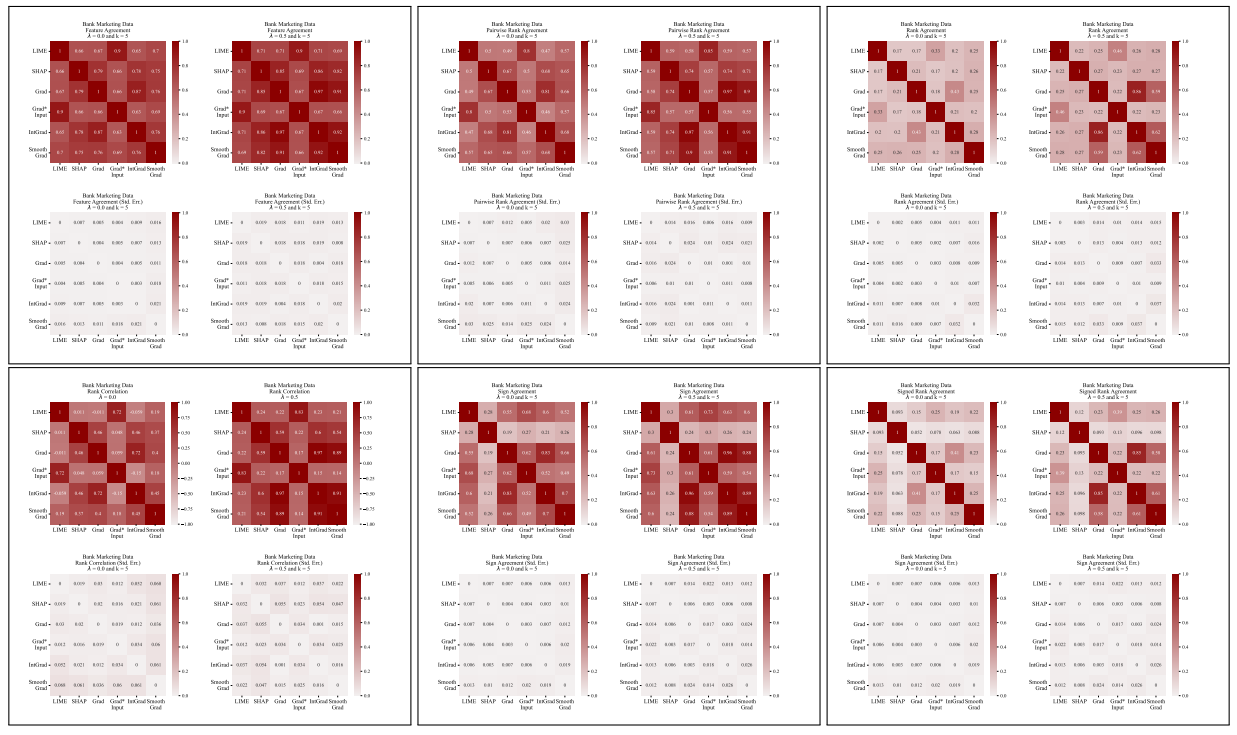
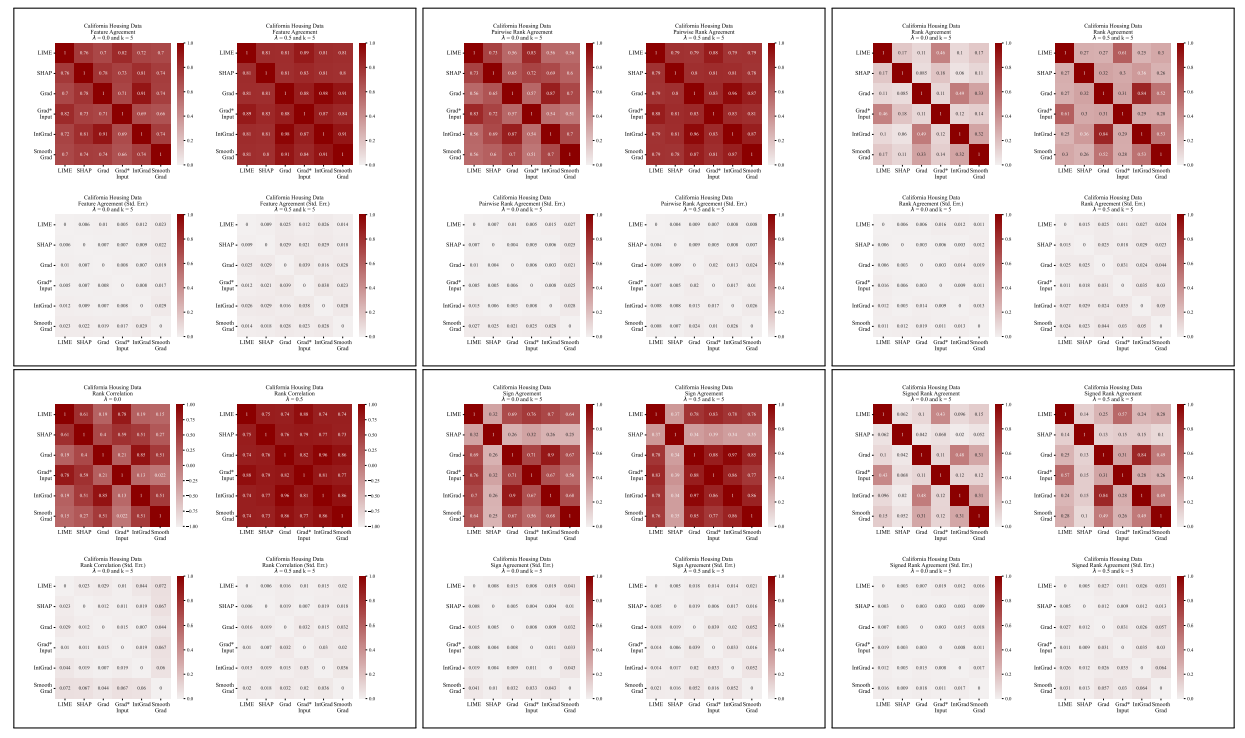
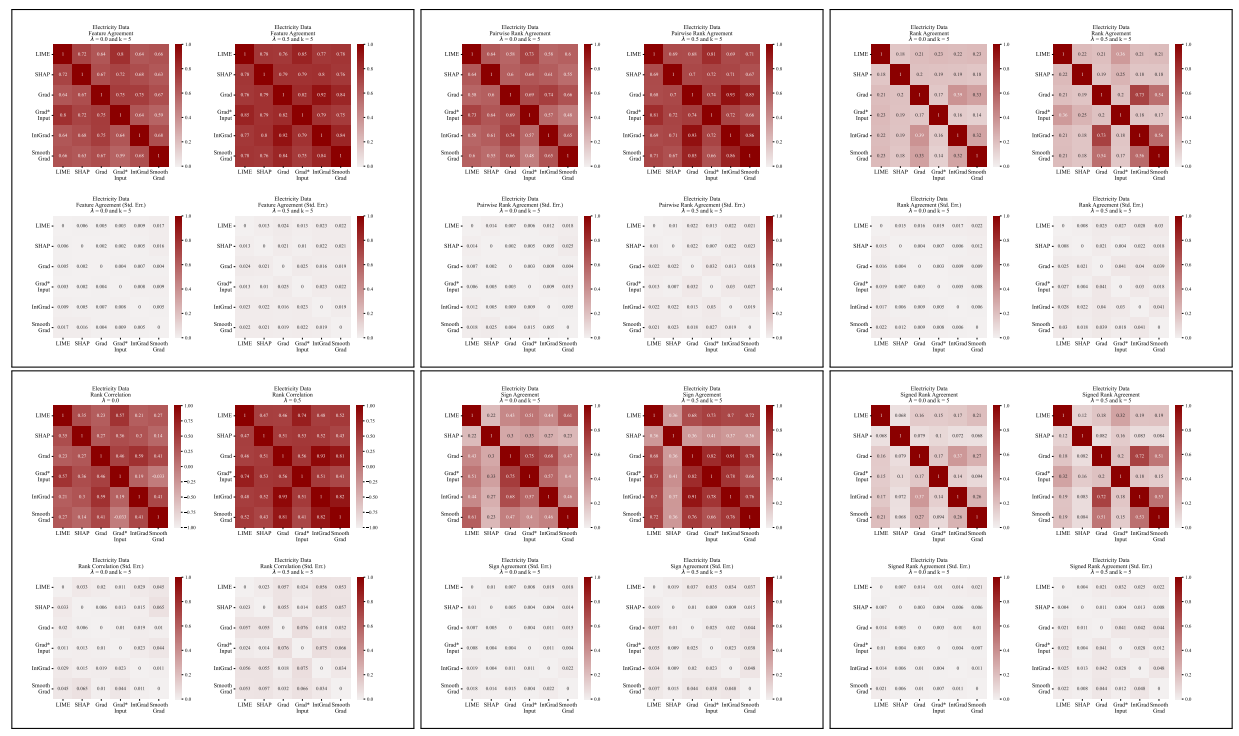
We define each of the six agreement metrics used in our work here.

\ The first four metrics depend on the top-𝑘 most important features in each explanation. Let 𝑡𝑜𝑝_𝑓 𝑒𝑎𝑡𝑢𝑟𝑒𝑠(𝐸, 𝑘) represent the top-𝑘 most important features in an explanation 𝐸, let 𝑟𝑎𝑛𝑘 (𝐸, 𝑠) be the importance rank of the feature 𝑠 within explanation 𝐸, and let 𝑠𝑖𝑔𝑛(𝐸, 𝑠) be the sign (positive, negative, or zero) of the importance score of feature 𝑠 in explanation 𝐸.

\
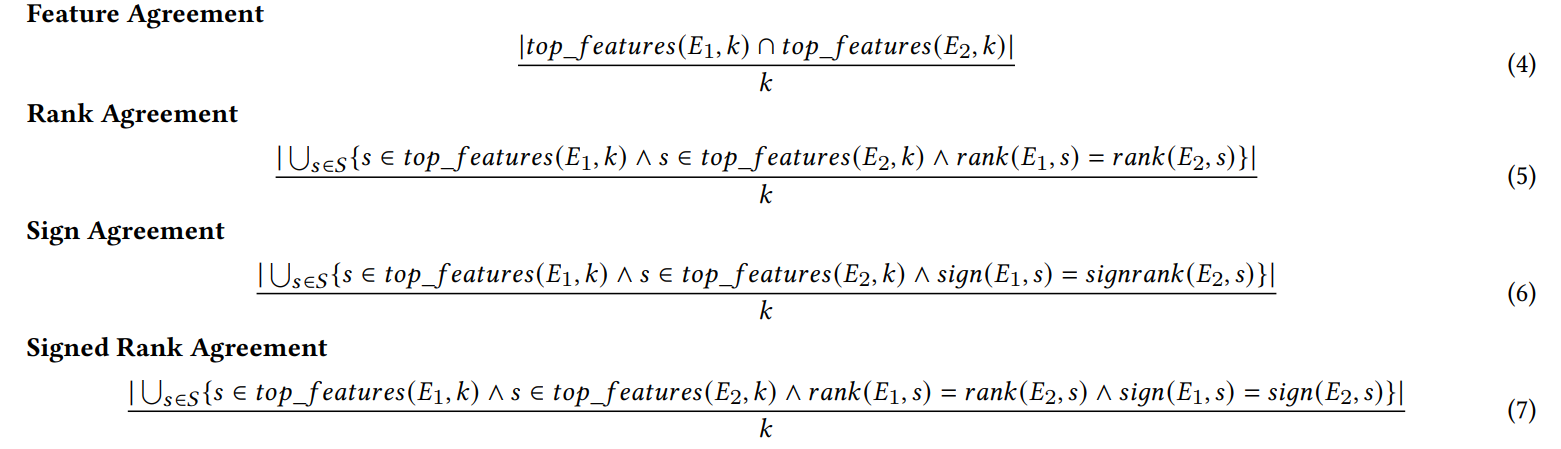
\ The next two agreement metrics depend on all features within each explanation, not just the top-𝑘. Let 𝑅 be a function that computes the ranking of features within an explanation by importance.

\

\ (Note: Krishna et al. [15] specify in their paper that 𝐹 is to be a set of features specified by an end user, but in our experiments we use all features with this metric).

A.4 Junk Feature Experiment Results

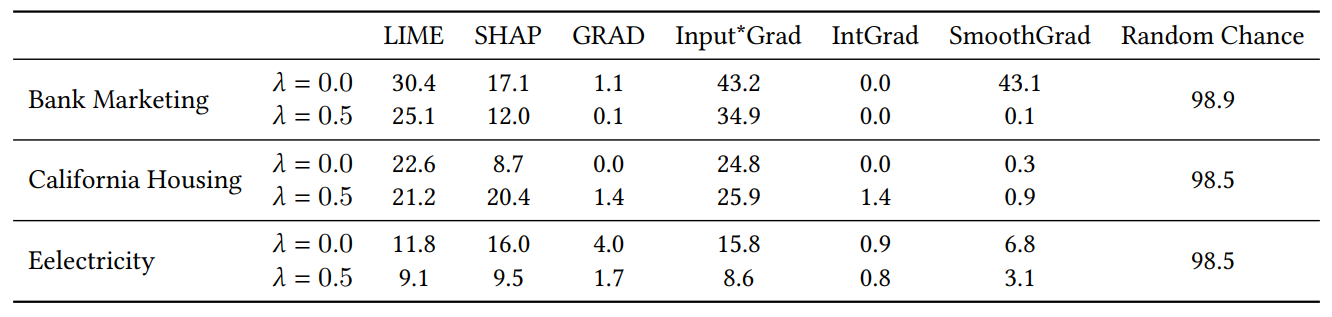
When we add random features for the experiment in Section 4.4, we double the number of features. We do this to check whether our consensus loss damages explanation quality by placing irrelevant features in the top-𝐾 more often than models trained naturally. In Table 1, we report the percentage of the time that each explainer included one of the random features in the top-5 most important features. We observe that across the board, we do not see a systematic increase of these percentages between 𝜆 = 0.0 (a baseline MLP without our consensus loss) and 𝜆 = 0.5 (an MLP trained with our consensus loss)

\ Table 1: Frequency of junk features getting top-5 ranks, measured in percent.
A.5 More Disagreement Matrices

Figure 9: Disagreement matrices for all metrics considered in this paper on Bank Marketing data.

\ Figure 10: Disagreement matrices for all metrics considered in this paper on California Housing data.

\ Figure 11: Disagreement matrices for all metrics considered in this paper on Electricity data.

A.6 Extended Results

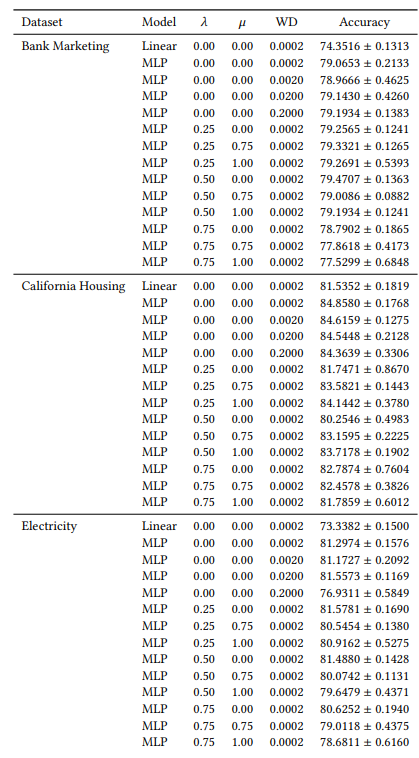
Table 2: Average test accuracy for models we trained. This table is organized by dataset, model, the hyperparameters in the loss, and the weight decay coefficient (WD). Averages are over several trials and we report the means ± one standard error.

A.7 Additional Plots

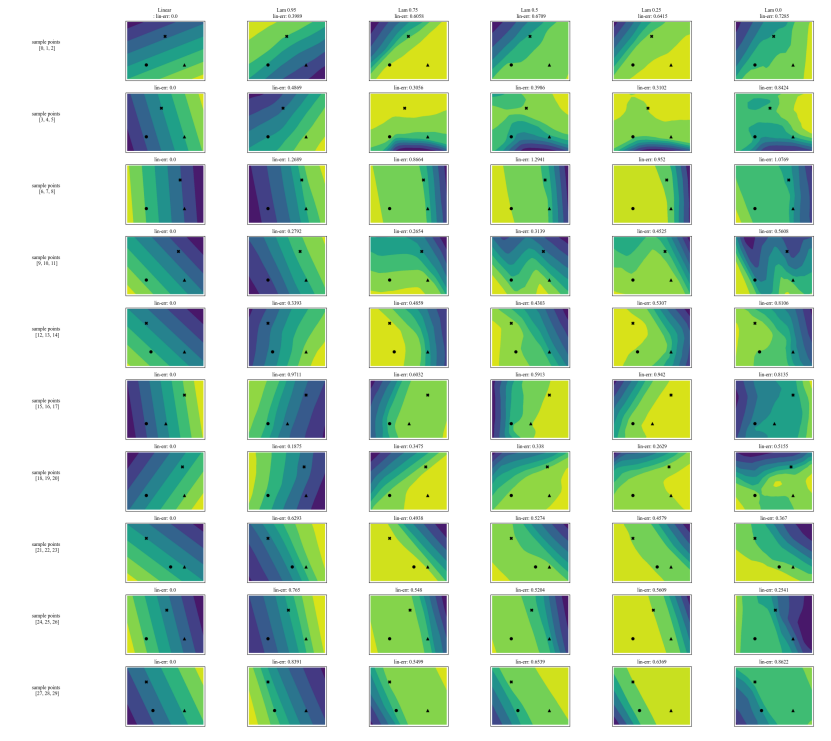
Figure 12: The logit surfaces for MLPs, each trained with a different lambda value, on 10 randomly constructed three-point planes from the Bank Marketing dataset.

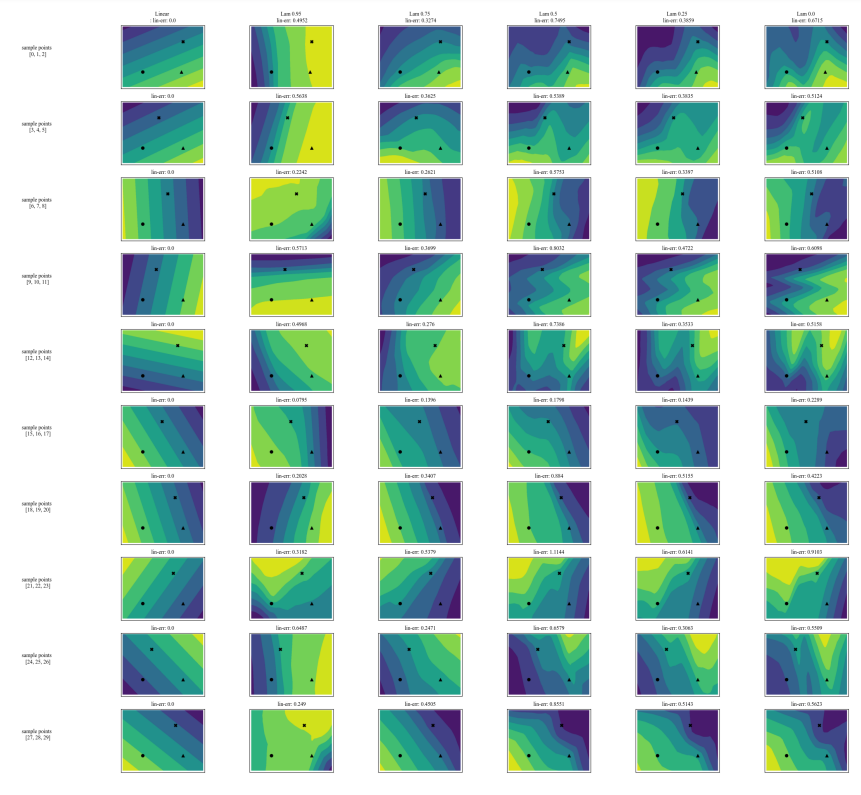
\ Figure 13: The logit surfaces for MLPs, each trained with a different lambda value, on 10 randomly constructed three-point planes from the California Housing dataset.

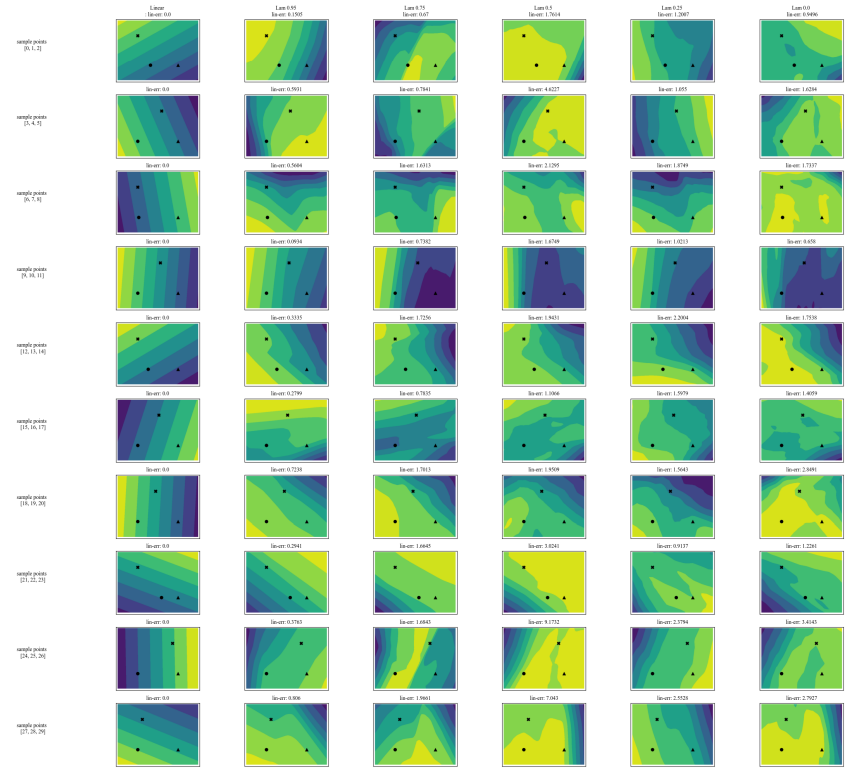
\ Figure 14: The logit surfaces for MLPs, each trained with a different lambda value, on 10 randomly constructed three-point planes from the Electricity dataset.

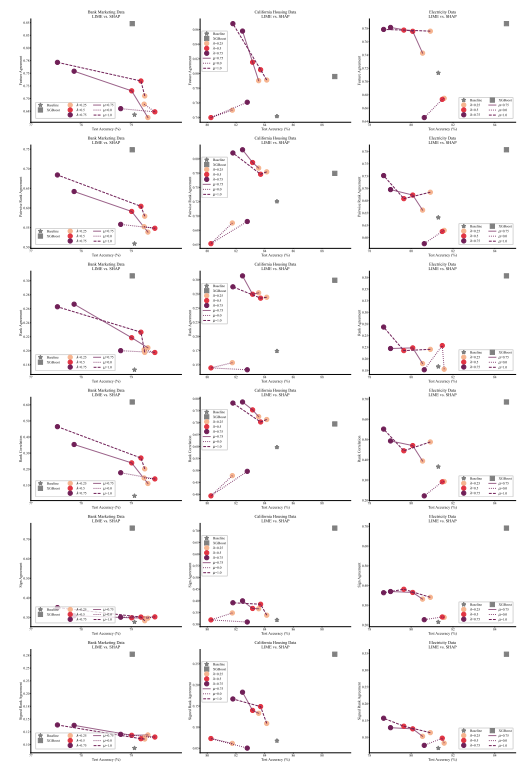
\ Figure 15: Additional trade-off curve plots for all datasets and metrics.

\

:::info Authors:

(1) Avi Schwarzschild, University of Maryland, College Park, Maryland, USA and Work completed while working at Arthur (avi1umd.edu);

(2) Max Cembalest, Arthur, New York City, New York, USA;

(3) Karthik Rao, Arthur, New York City, New York, USA;

(4) Keegan Hines, Arthur, New York City, New York, USA;

(5) John Dickerson†, Arthur, New York City, New York, USA (john@arthur.ai).

:::


:::info This paper is available on arxiv under CC BY 4.0 DEED license.

:::

\

Piyasa Fırsatı
SIX Logosu
SIX Fiyatı(SIX)
$0.01277
$0.01277$0.01277
+0.63%
USD
SIX (SIX) Canlı Fiyat Grafiği
Sorumluluk Reddi: Bu sitede yeniden yayınlanan makaleler, halka açık platformlardan alınmıştır ve yalnızca bilgilendirme amaçlıdır. MEXC'nin görüşlerini yansıtmayabilir. Tüm hakları telif sahiplerine aittir. Herhangi bir içeriğin üçüncü taraf haklarını ihlal ettiğini düşünüyorsanız, kaldırılması için lütfen service@support.mexc.com ile iletişime geçin. MEXC, içeriğin doğruluğu, eksiksizliği veya güncelliği konusunda hiçbir garanti vermez ve sağlanan bilgilere dayalı olarak alınan herhangi bir eylemden sorumlu değildir. İçerik, finansal, yasal veya diğer profesyonel tavsiye niteliğinde değildir ve MEXC tarafından bir tavsiye veya onay olarak değerlendirilmemelidir.

Ayrıca Şunları da Beğenebilirsiniz

Solana Treasury Stocks: Why Are These Companies Buying Up SOL?

Solana Treasury Stocks: Why Are These Companies Buying Up SOL?

The post Solana Treasury Stocks: Why Are These Companies Buying Up SOL? appeared on BitcoinEthereumNews.com. In 2020, everyone watched Strategy (called Microstrategy back then) scoop up Bitcoin and turn corporate crypto treasuries into a mainstream story. Now, a new wave is forming. And it’s centered on Solana. Dozens of companies are holding SOL as a bet on price. Except they’re not just holding. They’re building what’s being called Solana treasuries or Digital Asset Treasuries (DATs). These aren’t passive vaults. They’re active strategies that stake, earn yield, and tie into the fast-growing Solana ecosystem. Forward Industries, a Nasdaq-listed firm, recently bought more than 6.8 million SOL, making it the world’s largest Solana treasury company. Others like Helius Medical, Upexi, and DeFi Development are following a similar playbook, turning SOL into a centerpiece of their balance sheets. The trend is clear: Solana treasury stocks are emerging as a new class of crypto-exposed equities. And for investors, the question isn’t just who’s buying but why this strategy is spreading so fast. Key highlights: Solana treasuries (DATs) are corporate reserves of SOL designed to earn yield through staking and DeFi. Companies like Forward Industries, Helius Medical, Upexi, and DeFi Development Corp now hold millions of SOL. Public firms collectively own 17.1M SOL (≈$4B), which makes Solana one of the most adopted treasuries. Unlike Bitcoin treasuries, Solana holdings generate 6–8% annual rewards. It makes reserves into productive assets Solana treasury stocks are emerging as a new way for investors to gain indirect exposure to SOL. Risks remain: volatility, regulation, and concentrated holdings. But corporate adoption is growing fast. What is a Solana treasury (DAT)? A Solana treasury, sometimes called a Digital Asset Treasury (DAT), is when a company holds SOL as part of its balance sheet. But unlike Bitcoin treasuries, these usually aren’t just static reserves sitting in cold storage.  The key difference is productivity. SOL can be staked directly…
Paylaş
BitcoinEthereumNews2025/09/21 06:09
Unstoppable: Why No Public Company Can Ever Catch MicroStrategy’s Massive Bitcoin Holdings

Unstoppable: Why No Public Company Can Ever Catch MicroStrategy’s Massive Bitcoin Holdings

BitcoinWorld Unstoppable: Why No Public Company Can Ever Catch MicroStrategy’s Massive Bitcoin Holdings Imagine trying to build a mountain of gold, only to discover
Paylaş
bitcoinworld2025/12/17 14:30
Little Pepe soars from presale to market spotlight

Little Pepe soars from presale to market spotlight

The post Little Pepe soars from presale to market spotlight appeared on BitcoinEthereumNews.com. Disclosure: This article does not represent investment advice. The content and materials featured on this page are for educational purposes only. Early investors often capture the biggest rewards in crypto, and Little Pepe, priced under $0.005, is emerging as a memecoin that could rival big players. Summary LILPEPE has sold over 15 billion tokens in its presale, raising $25.4 million. The project’s community has grown to more than 41,000 holders and 30,000 Telegram members. Analysts suggest the token could see gains of up to 55x in two years and 100x by 2030. Crypto enthusiasts are aware that early investors tend to benefit the most from the market. Ripple (XRP) and Solana (SOL) are popular tokens that have profited traders. Little Pepe (LILPEPE), valued at less than $0.005, might produce more profit. LILPEPE is swiftly gaining popularity despite its recent introduction. Little Pepe: The market-changing memecoin Little Pepe has surprised everyone with its quick surge in cryptocurrencies. LILPEPE is becoming a popular meme currency. Its presale price is below $0.003. Strong foundations, a distinct market presence, and a developing and enthusiastic community distinguish it from other meme tokens. Many meme currencies use hype to attract investors, but LILPEPE’s rarity, community support, and distinctive roadmap have effectively drawn them in. Currently in its 13th presale stage, more than 15 billion tokens have been sold, generating over $25.4 million and sparking considerable interest. As the token approaches official listing, enthusiasm is growing, and many people believe it could be one of the following major memecoin success stories. LILPEPE’s growing community drives growth The strong community surrounding LILPEPE is a primary reason for its success. LILPEPE has built a loyal following of over 41,000 holders and about 30,000 active members on Telegram. Its rise is being fueled by this. The support of its community…
Paylaş
BitcoinEthereumNews2025/09/19 15:12