A massive JavaScript-based Node Package Manager (npm) supply-chain attack has infiltrated code libraries connected to the Ethereum Name Service (ENS) A massive JavaScript-based Node Package Manager (npm) supply-chain attack has infiltrated code libraries connected to the Ethereum Name Service (ENS)

Massive NPM Supply-Chain Attack Targets ENS-Linked Libraries in Shai Hulud Breach

2025/11/25 02:28

A massive JavaScript-based Node Package Manager (npm) supply-chain attack has infiltrated code libraries connected to the Ethereum Name Service (ENS) and hundreds of older software packages, with over 10 widely used across the crypto ecosystem, according to cybersecurity firm Aikido Security.

Charlie Eriksen, a malware researcher at the security firm, disclosed that the supply-chain malware known as “Shai-Hulud: The Second Coming” has infected hundreds of packages and more than 25,000 GitHub repositories.

According to the findings, threat actors have embedded this malicious code into over 490 npm packages with more than 132 million monthly downloads, including prominent ones from ENS, Zapier, AsyncAPI, Browserbase, and Postman.

“If a developer installs one of these bad packages, the malware quietly runs during installation, before anything even finishes installing,” Eriksen said.

How the Shai-Hulud Supply-Chain Malware Works

As described by Akido security, the Shai-Hulud malware gains access to the developer’s machine or cloud environment during installation.

It then deploys an automated tool called TruffleHog to scan for sensitive data, including passwords, API keys, cloud tokens, and GitHub or NPM credentials.

Any discovered information is then uploaded to a public GitHub repository titled “Shai-Hulud: The Second Coming.”

If the stolen credentials include access to code repositories or package registries, attackers can leverage them to breach additional accounts and distribute more malicious packages, allowing the attack to propagate further.

Evolution from September’s Attack

The initial Shai-Hulud breach occurred in early September, marking the largest npm attack on record at the time, with hackers stealing $50 million in cryptocurrency.

Ledger hardware wallet noted that this first attack was followed by the Shai Hulud worm spreading autonomously a week later.

However, the infiltration method for this second wave appears substantially different.

The “Shai-Hulud: The Second Coming” first installs Bun via the file setup_bun.js, then uses it to execute bun_environment.js, which contains the actual malicious code.
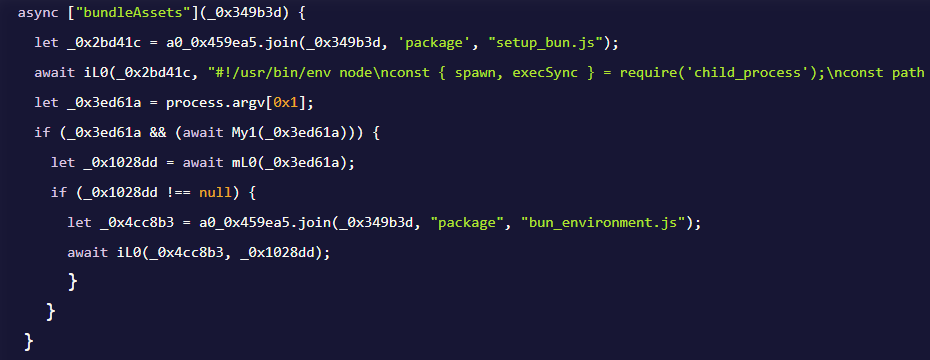
Massive NPM Supply-Chain Attack Targets ENS-Linked Libraries in Shai Hulud BreachSource: Aikido Blog

It creates randomly named repositories with stolen data rather than using hardcoded names, and can infect up to 100 npm packages compared to 20 in the previous attack.

Self-Propagating Malware Exposes Blind Spot in NPM Packages

Charles Guillemet, Chief Technology Officer at crypto hardware wallet Ledger, alerted the community that the malware also targets API keys, Git credentials, and CI/CD secrets, then quietly exfiltrates everything.

“If you use affected packages: PLEASE check this carefully: consider your credentials and secrets compromised, audit your infrastructure, and rotate your credentials,” he cautioned.

He urged that anyone without close CI monitoring might consider shutting down their systems.

Florian Roth, Head of Research at Nextron Systems, also added that it’s becoming increasingly easy for threat actors to inject malware into sensitive systems due to blind spots in NPM packages.

According to his assessment, the industry previously fought malware at the OS level, but now the same behavior occurs one layer up, inside the software ecosystems people trust every day.

“NPM tokens, transitive deps, weak account hygiene, zero visibility… and suddenly a self-propagating worm runs through the supply chain like it’s 2003 again.”

He concluded that the recent Shai Hulud breach reveals the real blind spot is in package ecosystems acting as execution surfaces.

“Nobody monitors them, nobody hardens them, and attackers don’t even need an exploit to make them go wild,” he said.

JP Richardson, CEO of Exodus, the first public company in the U.S. to tokenize stocks on the blockchain, also questioned Microsoft for making it “easy” for threat actors to propagate malware.

In a November 24 post, Richardson said, “What I don’t understand [is] why Microsoft (npm owner) is not moving fast enough to detect these attacks.”

He believes any package that has a pre-install or post-install script added should display warnings to everyone on the npm site and before package installation.

Piyasa Fırsatı
ENS Logosu
ENS Fiyatı(ENS)
$9.78
$9.78$9.78
-2.10%
USD
ENS (ENS) Canlı Fiyat Grafiği
Sorumluluk Reddi: Bu sitede yeniden yayınlanan makaleler, halka açık platformlardan alınmıştır ve yalnızca bilgilendirme amaçlıdır. MEXC'nin görüşlerini yansıtmayabilir. Tüm hakları telif sahiplerine aittir. Herhangi bir içeriğin üçüncü taraf haklarını ihlal ettiğini düşünüyorsanız, kaldırılması için lütfen service@support.mexc.com ile iletişime geçin. MEXC, içeriğin doğruluğu, eksiksizliği veya güncelliği konusunda hiçbir garanti vermez ve sağlanan bilgilere dayalı olarak alınan herhangi bir eylemden sorumlu değildir. İçerik, finansal, yasal veya diğer profesyonel tavsiye niteliğinde değildir ve MEXC tarafından bir tavsiye veya onay olarak değerlendirilmemelidir.

Ayrıca Şunları da Beğenebilirsiniz

The Channel Factories We’ve Been Waiting For

The Channel Factories We’ve Been Waiting For

The post The Channel Factories We’ve Been Waiting For appeared on BitcoinEthereumNews.com. Visions of future technology are often prescient about the broad strokes while flubbing the details. The tablets in “2001: A Space Odyssey” do indeed look like iPads, but you never see the astronauts paying for subscriptions or wasting hours on Candy Crush.  Channel factories are one vision that arose early in the history of the Lightning Network to address some challenges that Lightning has faced from the beginning. Despite having grown to become Bitcoin’s most successful layer-2 scaling solution, with instant and low-fee payments, Lightning’s scale is limited by its reliance on payment channels. Although Lightning shifts most transactions off-chain, each payment channel still requires an on-chain transaction to open and (usually) another to close. As adoption grows, pressure on the blockchain grows with it. The need for a more scalable approach to managing channels is clear. Channel factories were supposed to meet this need, but where are they? In 2025, subnetworks are emerging that revive the impetus of channel factories with some new details that vastly increase their potential. They are natively interoperable with Lightning and achieve greater scale by allowing a group of participants to open a shared multisig UTXO and create multiple bilateral channels, which reduces the number of on-chain transactions and improves capital efficiency. Achieving greater scale by reducing complexity, Ark and Spark perform the same function as traditional channel factories with new designs and additional capabilities based on shared UTXOs.  Channel Factories 101 Channel factories have been around since the inception of Lightning. A factory is a multiparty contract where multiple users (not just two, as in a Dryja-Poon channel) cooperatively lock funds in a single multisig UTXO. They can open, close and update channels off-chain without updating the blockchain for each operation. Only when participants leave or the factory dissolves is an on-chain transaction…
Paylaş
BitcoinEthereumNews2025/09/18 00:09
SOLANA NETWORK Withstands 6 Tbps DDoS Without Downtime

SOLANA NETWORK Withstands 6 Tbps DDoS Without Downtime

The post SOLANA NETWORK Withstands 6 Tbps DDoS Without Downtime appeared on BitcoinEthereumNews.com. In a pivotal week for crypto infrastructure, the Solana network
Paylaş
BitcoinEthereumNews2025/12/16 20:44
Why The Green Bay Packers Must Take The Cleveland Browns Seriously — As Hard As That Might Be

Why The Green Bay Packers Must Take The Cleveland Browns Seriously — As Hard As That Might Be

The post Why The Green Bay Packers Must Take The Cleveland Browns Seriously — As Hard As That Might Be appeared on BitcoinEthereumNews.com. Jordan Love and the Green Bay Packers are off to a 2-0 start. Getty Images The Green Bay Packers are, once again, one of the NFL’s better teams. The Cleveland Browns are, once again, one of the league’s doormats. It’s why unbeaten Green Bay (2-0) is a 8-point favorite at winless Cleveland (0-2) Sunday according to betmgm.com. The money line is also Green Bay -500. Most expect this to be a Packers’ rout, and it very well could be. But Green Bay knows taking anyone in this league for granted can prove costly. “I think if you look at their roster, the paper, who they have on that team, what they can do, they got a lot of talent and things can turn around quickly for them,” Packers safety Xavier McKinney said. “We just got to kind of keep that in mind and know we not just walking into something and they just going to lay down. That’s not what they going to do.” The Browns certainly haven’t laid down on defense. Far from. Cleveland is allowing an NFL-best 191.5 yards per game. The Browns gave up 141 yards to Cincinnati in Week 1, including just seven in the second half, but still lost, 17-16. Cleveland has given up an NFL-best 45.5 rushing yards per game and just 2.1 rushing yards per attempt. “The biggest thing is our defensive line is much, much improved over last year and I think we’ve got back to our personality,” defensive coordinator Jim Schwartz said recently. “When we play our best, our D-line leads us there as our engine.” The Browns rank third in the league in passing defense, allowing just 146.0 yards per game. Cleveland has also gone 30 straight games without allowing a 300-yard passer, the longest active streak in the NFL.…
Paylaş
BitcoinEthereumNews2025/09/18 00:41