Starlink rival Amazon Leo has launched a waitlist for many countries, including Nigeria, to collect details of would-be…Starlink rival Amazon Leo has launched a waitlist for many countries, including Nigeria, to collect details of would-be…

Starlink rival, Amazon Leo launches waitlist for many countries, including Nigeria

2025/11/26 20:47

Starlink rival Amazon Leo has launched a waitlist for many countries, including Nigeria, to collect details of would-be early users of its satellite Internet service when it eventually rolls out. Recall that the company recently began its first public testing with select enterprise customers ahead of an anticipated wider commercial rollout in 2026.

The list provides for three broad categories of users:

  1. Government: Government agencies and service providers like schools, hospitals, etc.
  2. Personal: individual users like you
  3. Business: corporate users and business owners

It also provides three different router types:

  • Ultra: It will support download speeds of up to 1Gbps and upload speeds of 400Mbps. Amazon boasts that it will be the world’s fastest satellite Internet antenna.
  • Nano: the smallest and lightest antenna, and most likely going to be the most affordable. The antenna weighs around 1kg. It will have a square dish panel that measures less than 18cm from side to side. It supports download speeds of up to 100Mbps.
  • Pro: Bulkier and heavier, measuring approximately 28cm across and weighing 2.4kg. It will offer download speeds of up to 400Mbps.

To apply, simply click here to start.
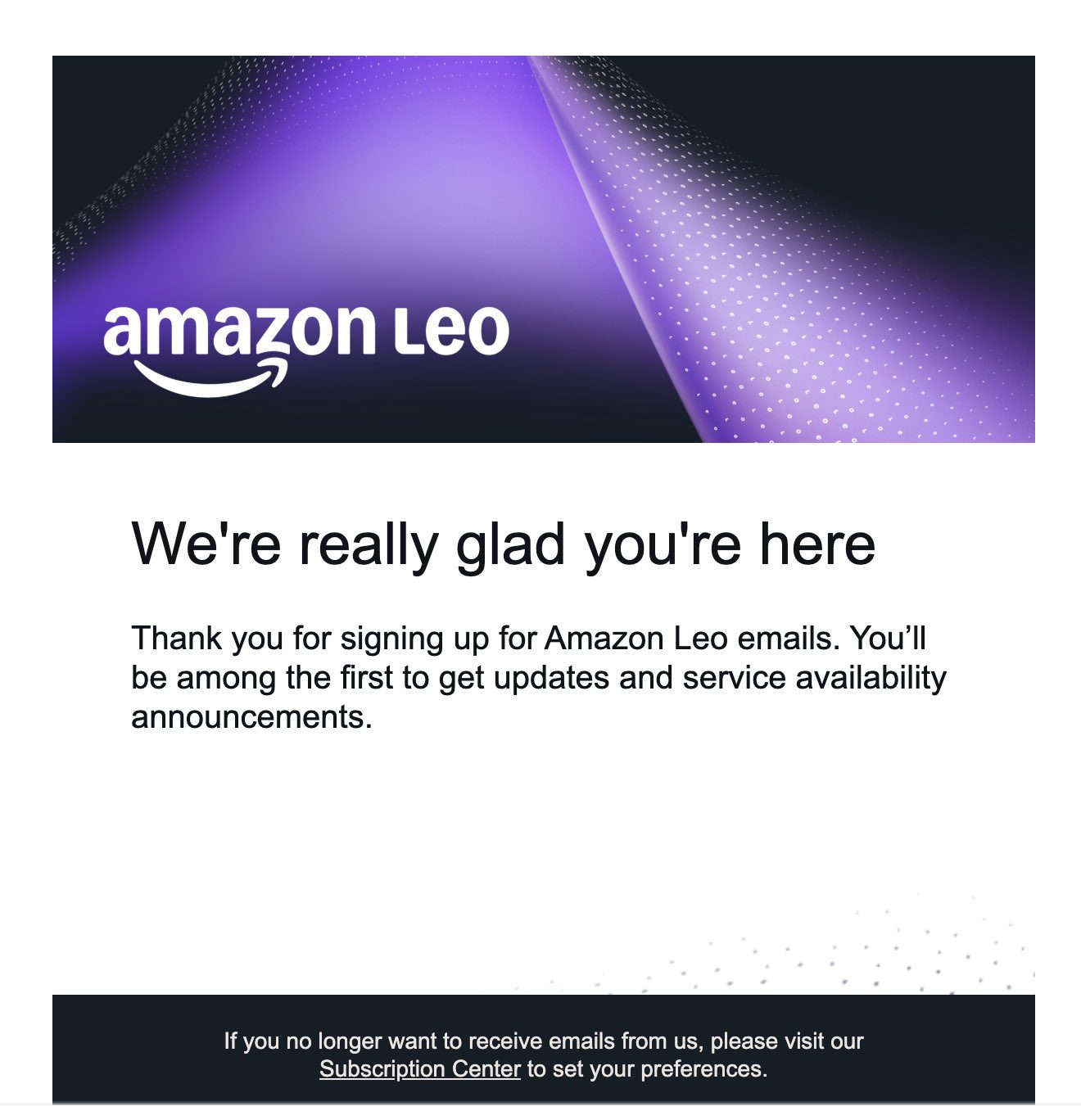
Starlink rival, Amazon Leo launches waitlist for many countries, including NigeriaYou will get a welcome email, like this, after you join the waitlist…

Recall that Amazon has partnered with Vanu, a US-based company, to deploy cellular towers in far-flung and rural parts of Southern Africa. There isn’t an announcement for a distribution structure for West Africa yet.

What you need to know about Amazon Leo

Previously known as Project Kuiper, Leo launched its first operational batch of internet satellites into low Earth orbit (LEO) last year. The mission, dubbed “KA-01” (Kuiper Atlas 1), saw 27 satellites lifted off aboard a United Launch Alliance (ULA) Atlas V rocket from Cape Canaveral Space Force Station in Florida in September.

The project now has a fleet of 153 production satellites in orbit and aims to expand to 1,618 satellites by 30 July 2026. Although this pales when compared with Starlink’s 10,000 satellites, the Amazon-owned company claims that its top-end product will offer speeds of up to 1Gbps.

Amazon’s ambitious initiative to provide global broadband access has been at least 10 years in the making. The company aims to deploy a constellation of more than 3,200 LEO satellites to deliver fast, reliable internet to customers worldwide, including underserved regions.

The first phase of the deployment will consist of 578 satellites orbiting around 630km above the Earth’s surface, slightly higher than Starlink’s fleet. Using these satellites, Amazon is rolling out 12 ground stations to provide backhaul connectivity to the Internet.

While SpaceX’s Starlink has a head start with its reusable Falcon 9 rockets and a licensed capacity for 12,000 first-generation satellites (plus 7,500 more for its second generation), Amazon is betting on its technological prowess and global reach to carve out a competitive niche.

The company has secured 80 launch missions with multiple providers, including ULA, Arianespace, and Jeff Bezos’ Blue Origin, to build out its initial constellation.

Experts believe that the setup process is likely to take at least one more year, with the earliest optimistic global launch date being late 2026 or early 2027.

Sorumluluk Reddi: Bu sitede yeniden yayınlanan makaleler, halka açık platformlardan alınmıştır ve yalnızca bilgilendirme amaçlıdır. MEXC'nin görüşlerini yansıtmayabilir. Tüm hakları telif sahiplerine aittir. Herhangi bir içeriğin üçüncü taraf haklarını ihlal ettiğini düşünüyorsanız, kaldırılması için lütfen service@support.mexc.com ile iletişime geçin. MEXC, içeriğin doğruluğu, eksiksizliği veya güncelliği konusunda hiçbir garanti vermez ve sağlanan bilgilere dayalı olarak alınan herhangi bir eylemden sorumlu değildir. İçerik, finansal, yasal veya diğer profesyonel tavsiye niteliğinde değildir ve MEXC tarafından bir tavsiye veya onay olarak değerlendirilmemelidir.

Ayrıca Şunları da Beğenebilirsiniz

Kalshi Jumps to 62% Market Share While Polymarket Eyes $10B Valuation

Kalshi Jumps to 62% Market Share While Polymarket Eyes $10B Valuation

The post Kalshi Jumps to 62% Market Share While Polymarket Eyes $10B Valuation appeared on BitcoinEthereumNews.com. Fintech 19 September 2025 | 16:03 Event-based trading platforms are no longer niche experiments – they’re emerging as a major arena where finance, crypto, and information converge. After months of subdued activity, volumes are climbing again, and U.S.-regulated Kalshi has unexpectedly taken the lead. Betting on Everything From Rates to Sports Analysts at Bernstein describe prediction markets as a new “interface for information,” where users speculate not only on sports results but also on Federal Reserve decisions, quarterly earnings, and even crypto price moves. This year alone, more than $200 million changed hands on Polymarket contracts linked to the Fed’s recent 25 bps rate cut, while $85 million traded on Kalshi around the same decision. Mainstream brokers like Coinbase and Robinhood are watching closely, with ambitions to capture some of the momentum. With U.S. sports betting already worth tens of billions annually, the overlap is too big to ignore. Against that backdrop, Kalshi has delivered one of its strongest months since the 2024 elections. The platform reports $1.3 billion in trading volume so far in September, accounting for 62% of global prediction market activity. Just a year ago, Kalshi’s share stood at 3%. CEO Tarek Mansour called the growth “remarkable,” noting that the exchange still serves only U.S. clients. Polymarket’s Pushback Its main rival, Polymarket, has logged about $773 million in trades this month. While that trails Kalshi for now, Polymarket has unique advantages: as a crypto-native platform, it has carved out strong global demand and is working toward a formal U.S. relaunch via its acquisition of derivatives exchange QCEX. The two platforms now stand as the clear leaders of the sector, though they embody different philosophies — one regulated from the ground up, the other built around decentralization. Investors Take Notice The boom hasn’t escaped venture capital. Reports suggest…
Paylaş
BitcoinEthereumNews2025/09/19 21:34
Visa Expands USDC Stablecoin Settlement For US Banks

Visa Expands USDC Stablecoin Settlement For US Banks

The post Visa Expands USDC Stablecoin Settlement For US Banks appeared on BitcoinEthereumNews.com. Visa Expands USDC Stablecoin Settlement For US Banks
Paylaş
BitcoinEthereumNews2025/12/17 15:23
Bitcoin Lightning Network Capacity Surges to Historic Peak as Exchange Adoption Accelerates

Bitcoin Lightning Network Capacity Surges to Historic Peak as Exchange Adoption Accelerates

The Bitcoin Lightning Network has reached an all-time high in total network capacity, marking a significant milestone for the layer-2 scaling solution designed to enable fast and inexpensive Bitcoin transactions. The surge comes as major cryptocurrency exchanges increasingly integrate Lightning functionality, bringing the technology to millions of users who previously relied solely on slower, more expensive on-chain transactions. This capacity expansion reflects growing confidence in Lightning's reliability and utility after years of development and real-world testing. What began as an experimental protocol discussed primarily among technical enthusiasts has matured into infrastructure that some of the industry's largest platforms now consider essential to their operations.
Paylaş
MEXC NEWS2025/12/17 17:14