A recent November 2025 report from ApeX Protocol offers a fresh snapshot of the global geography of crypto…A recent November 2025 report from ApeX Protocol offers a fresh snapshot of the global geography of crypto…

China leads global crypto mining ranking as US dominance grows- report

2025/12/10 21:51

A recent November 2025 report from ApeX Protocol offers a fresh snapshot of the global geography of crypto mining. According to the study, the world’s top ten mining nations continue to shape the bulk of global production, with surprising findings about energy efficiency, mining pressure on power grids and potential room for growth.

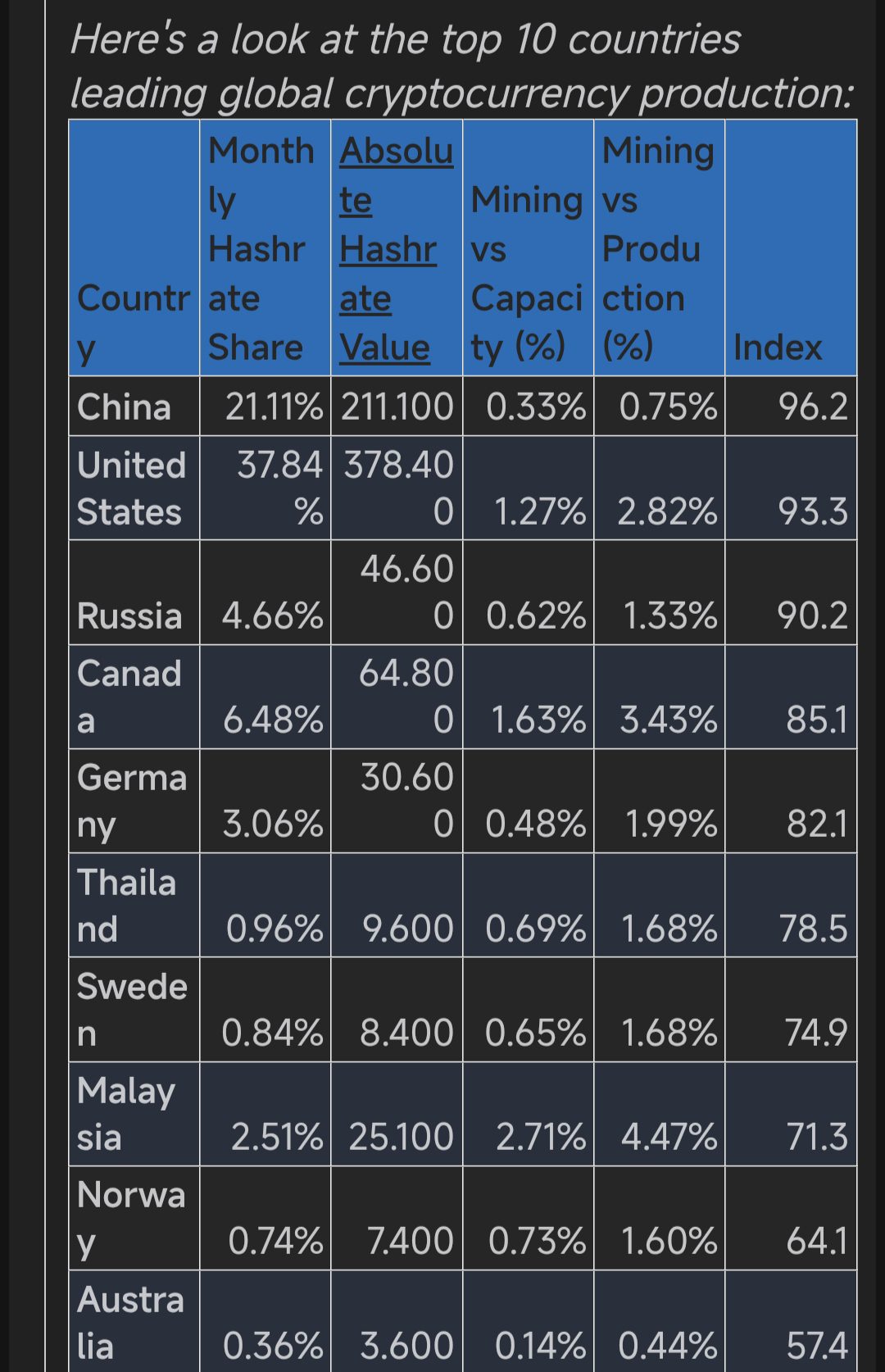
At the top of the ranking is China, producing 21.11 per cent of the global monthly hashrate. What stands out is the country’s efficiency. China reportedly uses just 0.33 per cent of its total electricity capacity for mining operations.

Even compared to overall national electricity production, crypto mining consumes a paltry 0.75 per cent, despite China having the highest total electricity generation in the study. With a final “ApeX index” score of 96.2, China remains the world’s leading crypto producer and, according to the report, has room to expand further without overtaxing its grid.
Africa is missing out on a key pillar of the global digital economy – crypto miningTop ten crypto-producing countries

Closely behind is the United States, responsible for 37.84 per cent of the global monthly hashrate share, more than a third of all global crypto mining activity. That makes the US the biggest crypto-mining nation in absolute terms.

However, this comes with a heavier impact on electricity systems: mining in the US accounts for 1.27 per cent of electricity capacity and 2.82 per cent of total power production. With a final index score of 93.3, the US remains a powerhouse, but the strain on infrastructure is clearly higher than China’s.

Also read: Crypto mining: Africa is missing out on a key pillar of the global digital economy

Other players: Russia, Canada, Germany and more

Russia takes third place with 4.66 per cent of global crypto mining output. Russian operations consume only 0.62 per cent of total electricity capacity, or 1.33 per cent of production, yielding an index score of 90.2.

Canada ranks fourth, contributing 6.48 per cent of the global hashrate while using 1.63 per cent of its electrical capacity, equal to 3.43 per cent of its total power production. That produced a score of 85.1.

In Europe, Germany leads with a 3.06 per cent share of global mining. German miners use just 0.48 per cent of the country’s electricity capacity, representing 1.99 per cent of national production. The country attained an index score of 82.1, cementing its place as the continent’s most efficient mining hub.

China still leads global crypto mining, but US dominance grows — a new report shows shifting patterns

Beyond the top five, the report highlights several emerging or efficient mining nations. Malaysia, for instance, devotes nearly 5 per cent of its electricity production to mining, among the highest rates globally.

With 2.51 per cent of the global hashrate, Malaysia earned a 71.3 index score, showing how smaller economies can attract mining activity through heavy energy dedication. Other countries in the top ten include Sweden, Thailand, Norway and Australia, each with modest hashrate shares but varying energy-use patterns and grid impact.

What the data reveal, and why it matters

The study by ApeX Protocol evaluated countries across four metrics: share of global mining activity; total computing (hash) power; electricity-use efficiency; and stress on national power grids.

The final index reflects each country’s ability to balance large-scale production with grid stability. Under that lens, China’s mining machine stands out. Producing over a fifth of global crypto while using only a fraction of its power capacity gives it a clear edge.

The United States, while the largest in absolute mining terms, seems to carry a greater energy and infrastructure burden. Russia and Canada offer mixed models, combining decent output with moderate energy consumption.

Meanwhile, smaller or emerging mining nations such as Malaysia show how mining can take root in unexpected places, though their high proportion of energy production dedicated to mining raises questions about sustainability and grid stress.

China still leads global crypto mining, but US dominance grows — a new report shows shifting patternsCrypto mining by location

Apex Protocol’s spokesperson noted that crypto mining “has become a serious economic sector that governments can’t ignore anymore.” The study underscores how even relatively small countries can influence the global mining landscape if they channel sizeable portions of their energy grids toward mining operations.

Yet that kind of energy dedication inevitably pushes up pressure on national power infrastructures, making it imperative for regulators to keep systems of checks and balances in place.

At a moment when energy policy, climate concerns and geopolitics increasingly shape the future of crypto, this report offers a clear barometer. It reveals where large-scale mining thrives, where it risks overburdening systems, and where there may still be room for growth, setting the stage for fresh competition among mining hubs and fresh scrutiny by regulators.

Piyasa Fırsatı
Talus Logosu
Talus Fiyatı(US)
$0.01203
$0.01203$0.01203
-28.81%
USD
Talus (US) Canlı Fiyat Grafiği
Sorumluluk Reddi: Bu sitede yeniden yayınlanan makaleler, halka açık platformlardan alınmıştır ve yalnızca bilgilendirme amaçlıdır. MEXC'nin görüşlerini yansıtmayabilir. Tüm hakları telif sahiplerine aittir. Herhangi bir içeriğin üçüncü taraf haklarını ihlal ettiğini düşünüyorsanız, kaldırılması için lütfen service@support.mexc.com ile iletişime geçin. MEXC, içeriğin doğruluğu, eksiksizliği veya güncelliği konusunda hiçbir garanti vermez ve sağlanan bilgilere dayalı olarak alınan herhangi bir eylemden sorumlu değildir. İçerik, finansal, yasal veya diğer profesyonel tavsiye niteliğinde değildir ve MEXC tarafından bir tavsiye veya onay olarak değerlendirilmemelidir.

Ayrıca Şunları da Beğenebilirsiniz

The Channel Factories We’ve Been Waiting For

The Channel Factories We’ve Been Waiting For

The post The Channel Factories We’ve Been Waiting For appeared on BitcoinEthereumNews.com. Visions of future technology are often prescient about the broad strokes while flubbing the details. The tablets in “2001: A Space Odyssey” do indeed look like iPads, but you never see the astronauts paying for subscriptions or wasting hours on Candy Crush.  Channel factories are one vision that arose early in the history of the Lightning Network to address some challenges that Lightning has faced from the beginning. Despite having grown to become Bitcoin’s most successful layer-2 scaling solution, with instant and low-fee payments, Lightning’s scale is limited by its reliance on payment channels. Although Lightning shifts most transactions off-chain, each payment channel still requires an on-chain transaction to open and (usually) another to close. As adoption grows, pressure on the blockchain grows with it. The need for a more scalable approach to managing channels is clear. Channel factories were supposed to meet this need, but where are they? In 2025, subnetworks are emerging that revive the impetus of channel factories with some new details that vastly increase their potential. They are natively interoperable with Lightning and achieve greater scale by allowing a group of participants to open a shared multisig UTXO and create multiple bilateral channels, which reduces the number of on-chain transactions and improves capital efficiency. Achieving greater scale by reducing complexity, Ark and Spark perform the same function as traditional channel factories with new designs and additional capabilities based on shared UTXOs.  Channel Factories 101 Channel factories have been around since the inception of Lightning. A factory is a multiparty contract where multiple users (not just two, as in a Dryja-Poon channel) cooperatively lock funds in a single multisig UTXO. They can open, close and update channels off-chain without updating the blockchain for each operation. Only when participants leave or the factory dissolves is an on-chain transaction…
Paylaş
BitcoinEthereumNews2025/09/18 00:09
SOLANA NETWORK Withstands 6 Tbps DDoS Without Downtime

SOLANA NETWORK Withstands 6 Tbps DDoS Without Downtime

The post SOLANA NETWORK Withstands 6 Tbps DDoS Without Downtime appeared on BitcoinEthereumNews.com. In a pivotal week for crypto infrastructure, the Solana network
Paylaş
BitcoinEthereumNews2025/12/16 20:44
Why The Green Bay Packers Must Take The Cleveland Browns Seriously — As Hard As That Might Be

Why The Green Bay Packers Must Take The Cleveland Browns Seriously — As Hard As That Might Be

The post Why The Green Bay Packers Must Take The Cleveland Browns Seriously — As Hard As That Might Be appeared on BitcoinEthereumNews.com. Jordan Love and the Green Bay Packers are off to a 2-0 start. Getty Images The Green Bay Packers are, once again, one of the NFL’s better teams. The Cleveland Browns are, once again, one of the league’s doormats. It’s why unbeaten Green Bay (2-0) is a 8-point favorite at winless Cleveland (0-2) Sunday according to betmgm.com. The money line is also Green Bay -500. Most expect this to be a Packers’ rout, and it very well could be. But Green Bay knows taking anyone in this league for granted can prove costly. “I think if you look at their roster, the paper, who they have on that team, what they can do, they got a lot of talent and things can turn around quickly for them,” Packers safety Xavier McKinney said. “We just got to kind of keep that in mind and know we not just walking into something and they just going to lay down. That’s not what they going to do.” The Browns certainly haven’t laid down on defense. Far from. Cleveland is allowing an NFL-best 191.5 yards per game. The Browns gave up 141 yards to Cincinnati in Week 1, including just seven in the second half, but still lost, 17-16. Cleveland has given up an NFL-best 45.5 rushing yards per game and just 2.1 rushing yards per attempt. “The biggest thing is our defensive line is much, much improved over last year and I think we’ve got back to our personality,” defensive coordinator Jim Schwartz said recently. “When we play our best, our D-line leads us there as our engine.” The Browns rank third in the league in passing defense, allowing just 146.0 yards per game. Cleveland has also gone 30 straight games without allowing a 300-yard passer, the longest active streak in the NFL.…
Paylaş
BitcoinEthereumNews2025/09/18 00:41