Ethereum co-founder Vitalik Buterin said that 2026 should be a turning point in restoring users’ digital sovereignty — not only in the blockchain space, but alsoEthereum co-founder Vitalik Buterin said that 2026 should be a turning point in restoring users’ digital sovereignty — not only in the blockchain space, but also

Vitalik Buterin: 2026 Will Be the Year of Restoring Digital Sovereignty

2026/01/23 16:29
Okuma süresi: 3 dk
  • Ethereum co-founder urged reducing reliance on centralized services and developing users’ digital sovereignty.
  • Buterin is convinced that 2026 should be a pivotal year for regaining control over data and computing.
  • Among the tools he uses are Fileverse, Signal, SimpleX, Session, OpenStreetMap, and more.

Ethereum co-founder Vitalik Buterin said that 2026 should be a turning point in restoring users’ digital sovereignty — not only in the blockchain space, but also in the broader context of computing, communications, and data work. 

According to him, “2026 is the year we take back lost ground in computing self-sovereignty,” and this task goes far beyond the crypto industry.

Buterin said that back in 2025 he significantly revised the software stack he uses every day. In particular, he “almost completely switched to Fileverse” — an open-source solution for encrypted, decentralized documents — and also made Signal his primary messenger, moving away from Telegram. 

In addition, he installed SimpleX and Session as alternative tools for private communication.

In 2026, these changes continued, according to Buterin. He replaced Google Maps with OpenStreetMap and Organic Maps, calling the latter “the best mobile app” that is not only open, but also “privacy-preserving,” since it runs locally and reduces the number of services that know a user’s physical location. 

He also switched from Gmail to ProtonMail, noting that “though ultimately, the best thing is to use proper encrypted messengers outright.”

Buterin also paid significant attention to local large language models (LLMs). He noted that he is actively exploring the possibilities of running artificial intelligence (AI) locally, but acknowledged that the “last mile” of integration remains problematic. 

In his view, there are many powerful local models, including CPU-based and phone-compatible ones, but they lack convenient integration and a unified user interface. 

He noted that there is still no “good Google Translate equivalent” that works with local LLMs, as well as no solutions with a convenient user experience (UX) for transcription, audio input, or searching through personal documents. 

Separately, he emphasized that he does not want to keep Ollama running all the time due to high energy consumption.

At the same time, Buterin acknowledged significant progress in this area, noting that just a year ago “most of the local models did not yet exist.” Ideally, he believes, the ecosystem should move as far as possible toward local LLMs, using specialized improved models to compensate for the small number of parameters. 

For more resource-intensive scenarios, he suggested combining several approaches: paying for queries via ZK proofs, using trusted execution environments (TEE), locally filtering requests, and removing sensitive data before sending queries to large models. 

In the long term, he sees an extremely efficient fully homomorphic encryption (FHE) as the ideal solution.

In conclusion, Buterin stressed that “sending all your data to third party centralized services is unnecessary,” since the industry already has tools for a much more private approach. In his view, these tools should not only be developed, but also used much more actively.

As a reminder, Buterin emphasized the importance of prioritizing decentralized social networks and recalled his previous statements on the matter. Earlier, he said he intends to fully switch to decentralized social networks in 2026, criticizing crypto-social projects for a speculative tokenization model and calling for competition to be developed through a shared decentralized data layer and new communication formats.

Sorumluluk Reddi: Bu sitede yeniden yayınlanan makaleler, halka açık platformlardan alınmıştır ve yalnızca bilgilendirme amaçlıdır. MEXC'nin görüşlerini yansıtmayabilir. Tüm hakları telif sahiplerine aittir. Herhangi bir içeriğin üçüncü taraf haklarını ihlal ettiğini düşünüyorsanız, kaldırılması için lütfen service@support.mexc.com ile iletişime geçin. MEXC, içeriğin doğruluğu, eksiksizliği veya güncelliği konusunda hiçbir garanti vermez ve sağlanan bilgilere dayalı olarak alınan herhangi bir eylemden sorumlu değildir. İçerik, finansal, yasal veya diğer profesyonel tavsiye niteliğinde değildir ve MEXC tarafından bir tavsiye veya onay olarak değerlendirilmemelidir.

Ayrıca Şunları da Beğenebilirsiniz

Young Republicans were more proud to be American under Obama than under Trump: data analyst
Young Republicans were more proud to be American under Obama than under Trump: data analyst

CNN data analyst Harry Enten sorts through revealing polls and surveys of American attitudes, looking for shifts, and his latest finding is an indictment of President
Paylaş
Alternet2026/02/10 22:18
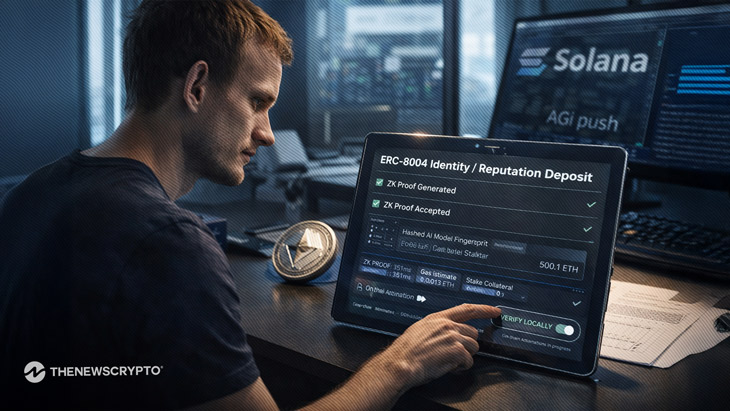
Vitalik Buterin Outlines Ethereum’s AI Framework, Pushes Back Against Solana’s Acceleration Thesis
Vitalik Buterin Outlines Ethereum’s AI Framework, Pushes Back Against Solana’s Acceleration Thesis

Ethereum co-founder Vitalik Buterin has reacted to Solana’s artificial general intelligence acceleration initiative. He did this through the establishment of his
Paylaş
Thenewscrypto2026/02/10 18:40
Vitalik Buterin Reveals Ethereum’s Bold Plan to Stay Quantum-Secure and Simple!

Vitalik Buterin Reveals Ethereum’s Bold Plan to Stay Quantum-Secure and Simple!

Buterin unveils Ethereum’s strategy to tackle quantum security challenges ahead. Ethereum focuses on simplifying architecture while boosting security for users. Ethereum’s market stability grows as Buterin’s roadmap gains investor confidence. Ethereum founder Vitalik Buterin has unveiled his long-term vision for the blockchain, focusing on making Ethereum quantum-secure while maintaining its simplicity for users. Buterin presented his roadmap at the Japanese Developer Conference, and splits the future of Ethereum into three phases: short-term, mid-term, and long-term. Buterin’s most ambitious goal for Ethereum is to safeguard the blockchain against the threats posed by quantum computing.  The danger of such future developments is that the future may call into question the cryptographic security of most blockchain systems, and Ethereum will be able to remain ahead thanks to more sophisticated mathematical techniques to ensure the safety and integrity of its protocols. Buterin is committed to ensuring that Ethereum evolves in a way that not only meets today’s security challenges but also prepares for the unknowns of tomorrow. Also Read: Ethereum Giant The Ether Machine Takes Major Step Toward Going Public! However, in spite of such high ambitions, Buterin insisted that Ethereum also needed to simplify its architecture. An important aspect of this vision is to remove unnecessary complexity and make Ethereum more accessible and maintainable without losing its strong security capabilities. Security and simplicity form the core of Buterin’s strategy, as they guarantee that the users of Ethereum experience both security and smooth processes. Focus on Speed and Efficiency in the Short-Term In the short term, Buterin aims to enhance Ethereum’s transaction efficiency, a crucial step toward improving scalability and reducing transaction costs. These advantages are attributed to the fact that, within the mid-term, Ethereum is planning to enhance the speed of transactions in layer-2 networks. According to Butterin, this is part of Ethereum’s expansion, particularly because there is still more need to use blockchain technology to date. The other important aspect of Ethereum’s development is the layer-2 solutions. Buterin supports an approach in which the layer-2 networks are dependent on layer-1 to perform some essential tasks like data security, proof, and censorship resistance. This will enable the layer-2 systems of Ethereum to be concerned with verifying and sequencing transactions, which will improve the overall speed and efficiency of the network. Ethereum’s Market Stability Reflects Confidence in Long-Term Strategy Ethereum’s market performance has remained solid, with the cryptocurrency holding steady above $4,000. Currently priced at $4,492.15, Ethereum has experienced a slight 0.93% increase over the last 24 hours, while its trading volume surged by 8.72%, reaching $34.14 billion. These figures point to growing investor confidence in Ethereum’s long-term vision. The crypto community remains optimistic about Ethereum’s future, with many predicting the price could rise to $5,500 by mid-October. Buterin’s clear, forward-thinking strategy continues to build trust in Ethereum as one of the most secure and scalable blockchain platforms in the market. Also Read: Whales Dump 200 Million XRP in Just 2 Weeks – Is XRP’s Price on the Verge of Collapse? The post Vitalik Buterin Reveals Ethereum’s Bold Plan to Stay Quantum-Secure and Simple! appeared first on 36Crypto.
Paylaş
Coinstats2025/09/18 01:22