On January 31, 2026, the global Decentralised Prediction Market (DPM) sector hit a fever pitch. Total trading volume… The post Can Africans move from sports bettingOn January 31, 2026, the global Decentralised Prediction Market (DPM) sector hit a fever pitch. Total trading volume… The post Can Africans move from sports betting

Can Africans move from sports betting to the $12bn global Decentralised Prediction Market?

2026/02/10 03:00
Okuma süresi: 5 dk

On January 31, 2026, the global Decentralised Prediction Market (DPM) sector hit a fever pitch. Total trading volume reached a staggering $12 billion, marking a 240% surge in just a few months, according to data from Dune Analytics. From global elections to volatile tech stocks, the world is increasingly using the blockchain to “price” the future.

Yet, in Africa, a region that consistently leads the world in retail crypto adoption, a curious silence lingers. Despite the continent’s massive appetite for digital assets and its deeply rooted betting culture, a dominant, African-focused DPM remains elusive.

To unpack this, I had a chat with ecosystem observer Olayinka Omoniyi about why the “betting capital of the world” is still playing on borrowed digital ground and what it will take to localise the $12 billion revolution.

To understand the stakes, one must first understand the tech. A Decentralised Prediction Market (DPM) is a blockchain-based exchange where users trade shares in the outcome of future events. Unlike traditional bookmakers, there is no house to skew the odds or limit winners.

Prices are set by the crowd, and outcomes are settled by smart contracts using decentralised data feeds (oracles).

If a “Yes” share for a local election costs $0.70, the market is effectively saying there is a 70% probability of that outcome. It is, in essence, the wisdom of the crowd turned into a financial instrument.

Bridging the $12bn DPM gap: How Africa can onboard millions of bettors into decentralised prediction marketsSports betting platform

Africa is not sitting entirely on the sidelines; Omoniyi points to emerging pioneers like Bayse (formerly GoWagr) and UltraMarket by Njoku as players attempting to unlock local liquidity.

The hurdle isn’t just about code: it is also about discovery

“Like any global industry, African founders tend to have a slow adoption, and discovery is hard due to expensive distribution channels (i.e., legacy media, digital ads, UGC creators),” Omoniyi explains.

In an ecosystem where digital ads and creator campaigns carry heavy price tags, Omoniyi suggests a shift in strategy: Brand Equity Hijacking. For local DPMs to scale, they must find “cheap discovery” options, such as co-marketing with established African brands to leverage existing trust.

The most significant barrier to DPM adoption in Africa is the shadow cast by the sports betting industry. In markets like Nigeria, South Africa and Kenya, betting is a daily ritual worth billions of dollars. If the habit of predicting is already there, why hasn’t it migrated to the blockchain?

According to Omoniyi, it boils down to a fundamental failure in User Experience (UX).

“With the popularity of betting platforms in the African market, the habit of transitioning into a prediction market is already laid out. The major hurdle is tied to the User Experience (UX) of how the platform is presented. Any prediction market platform that doesn’t optimise for the pattern of how users already interact with sports betting platforms will see slow adoption and higher learning friction,” Omoniyi warns.

Bridging the $12bn DPM gap: How Africa can onboard millions of bettors into decentralised prediction marketsOlayinka Omoniyi

DPMs require high-fidelity data to resolve markets. According to him, “The major hurdle for local prediction markets is the cost of access to the data of events happening across Africa; the next hurdle is liquidity for seamless participation, which isn’t cheap, as we all know, for an African-focused prediction appetite.”

Decentralised Prediction Market (DPM): The high price of borrowed platforms 

Why should it matter if Africans use global platforms like Polymarket? For Omoniyi, the cost of relying on offshore infrastructure is a matter of economic sovereignty.

When we use offshore DPMs, we are participating in a “borrowed” ecosystem where access can be denied, and liquidity, the lifeblood of any market, constantly leaves the continent.

“The key benefit [of local DPMs] would be that we will own our narrative, lock in the financial benefit, and circulate shared value on the continent,” says Omoniyi.

On why many Africans and, indeed, Nigerians still prefer sports betting over crypto prediction markets, Omoniyi says, “Familiarity and habit are the easiest picks, but ‘access’ and the cost of such ‘access and exit’ are factors that I see that make it easier to settle with a familiar sports betting platform.” 

Bridging the $12bn DPM gap: How Africa can onboard millions of bettors into decentralised prediction marketsA man and a woman are predicting the DPM

Also, being a strong sports fanbase plays a bias factor in why they opt for the familiar,” he added.

To bridge this gap, DPMs must stop being “crypto products” and start being “people products”. They will have to invest heavily in “habit”-changing marketing tactics to get to the point where they are so top of mind that they can’t be ignored.

The global prediction market is a $12 billion train that has already left the station. For Africa to do more than watch from the platform, the African-focused DPMs must look less like crypto exchanges and more like the local betting platforms our users are already familiar with.

The post Can Africans move from sports betting to the $12bn global Decentralised Prediction Market? first appeared on Technext.

Piyasa Fırsatı
Movement Logosu
Movement Fiyatı(MOVE)
$0.02137
$0.02137$0.02137
+0.47%
USD
Movement (MOVE) Canlı Fiyat Grafiği
Sorumluluk Reddi: Bu sitede yeniden yayınlanan makaleler, halka açık platformlardan alınmıştır ve yalnızca bilgilendirme amaçlıdır. MEXC'nin görüşlerini yansıtmayabilir. Tüm hakları telif sahiplerine aittir. Herhangi bir içeriğin üçüncü taraf haklarını ihlal ettiğini düşünüyorsanız, kaldırılması için lütfen service@support.mexc.com ile iletişime geçin. MEXC, içeriğin doğruluğu, eksiksizliği veya güncelliği konusunda hiçbir garanti vermez ve sağlanan bilgilere dayalı olarak alınan herhangi bir eylemden sorumlu değildir. İçerik, finansal, yasal veya diğer profesyonel tavsiye niteliğinde değildir ve MEXC tarafından bir tavsiye veya onay olarak değerlendirilmemelidir.

Ayrıca Şunları da Beğenebilirsiniz

Young Republicans were more proud to be American under Obama than under Trump: data analyst
Young Republicans were more proud to be American under Obama than under Trump: data analyst

CNN data analyst Harry Enten sorts through revealing polls and surveys of American attitudes, looking for shifts, and his latest finding is an indictment of President
Paylaş
Alternet2026/02/10 22:18
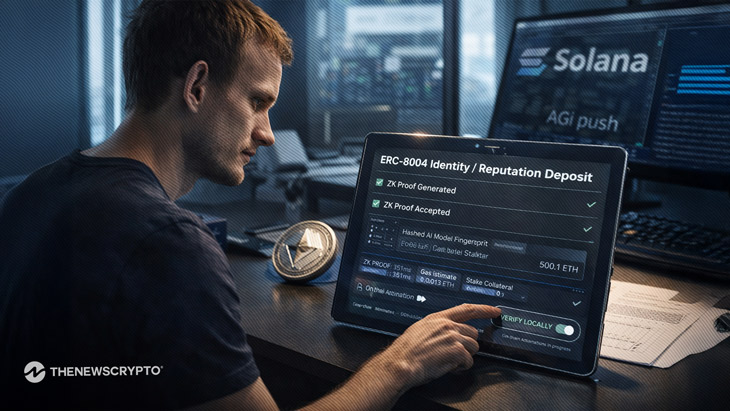
Vitalik Buterin Outlines Ethereum’s AI Framework, Pushes Back Against Solana’s Acceleration Thesis
Vitalik Buterin Outlines Ethereum’s AI Framework, Pushes Back Against Solana’s Acceleration Thesis

Ethereum co-founder Vitalik Buterin has reacted to Solana’s artificial general intelligence acceleration initiative. He did this through the establishment of his
Paylaş
Thenewscrypto2026/02/10 18:40
Vitalik Buterin Reveals Ethereum’s Bold Plan to Stay Quantum-Secure and Simple!

Vitalik Buterin Reveals Ethereum’s Bold Plan to Stay Quantum-Secure and Simple!

Buterin unveils Ethereum’s strategy to tackle quantum security challenges ahead. Ethereum focuses on simplifying architecture while boosting security for users. Ethereum’s market stability grows as Buterin’s roadmap gains investor confidence. Ethereum founder Vitalik Buterin has unveiled his long-term vision for the blockchain, focusing on making Ethereum quantum-secure while maintaining its simplicity for users. Buterin presented his roadmap at the Japanese Developer Conference, and splits the future of Ethereum into three phases: short-term, mid-term, and long-term. Buterin’s most ambitious goal for Ethereum is to safeguard the blockchain against the threats posed by quantum computing.  The danger of such future developments is that the future may call into question the cryptographic security of most blockchain systems, and Ethereum will be able to remain ahead thanks to more sophisticated mathematical techniques to ensure the safety and integrity of its protocols. Buterin is committed to ensuring that Ethereum evolves in a way that not only meets today’s security challenges but also prepares for the unknowns of tomorrow. Also Read: Ethereum Giant The Ether Machine Takes Major Step Toward Going Public! However, in spite of such high ambitions, Buterin insisted that Ethereum also needed to simplify its architecture. An important aspect of this vision is to remove unnecessary complexity and make Ethereum more accessible and maintainable without losing its strong security capabilities. Security and simplicity form the core of Buterin’s strategy, as they guarantee that the users of Ethereum experience both security and smooth processes. Focus on Speed and Efficiency in the Short-Term In the short term, Buterin aims to enhance Ethereum’s transaction efficiency, a crucial step toward improving scalability and reducing transaction costs. These advantages are attributed to the fact that, within the mid-term, Ethereum is planning to enhance the speed of transactions in layer-2 networks. According to Butterin, this is part of Ethereum’s expansion, particularly because there is still more need to use blockchain technology to date. The other important aspect of Ethereum’s development is the layer-2 solutions. Buterin supports an approach in which the layer-2 networks are dependent on layer-1 to perform some essential tasks like data security, proof, and censorship resistance. This will enable the layer-2 systems of Ethereum to be concerned with verifying and sequencing transactions, which will improve the overall speed and efficiency of the network. Ethereum’s Market Stability Reflects Confidence in Long-Term Strategy Ethereum’s market performance has remained solid, with the cryptocurrency holding steady above $4,000. Currently priced at $4,492.15, Ethereum has experienced a slight 0.93% increase over the last 24 hours, while its trading volume surged by 8.72%, reaching $34.14 billion. These figures point to growing investor confidence in Ethereum’s long-term vision. The crypto community remains optimistic about Ethereum’s future, with many predicting the price could rise to $5,500 by mid-October. Buterin’s clear, forward-thinking strategy continues to build trust in Ethereum as one of the most secure and scalable blockchain platforms in the market. Also Read: Whales Dump 200 Million XRP in Just 2 Weeks – Is XRP’s Price on the Verge of Collapse? The post Vitalik Buterin Reveals Ethereum’s Bold Plan to Stay Quantum-Secure and Simple! appeared first on 36Crypto.
Paylaş
Coinstats2025/09/18 01:22